Medieval Bread Peel May Have Doubled as Game Board
Archaeologists in Russia have discovered an 11th-century wooden kitchen gadget that appears to be both a medieval bread peel and a game board.
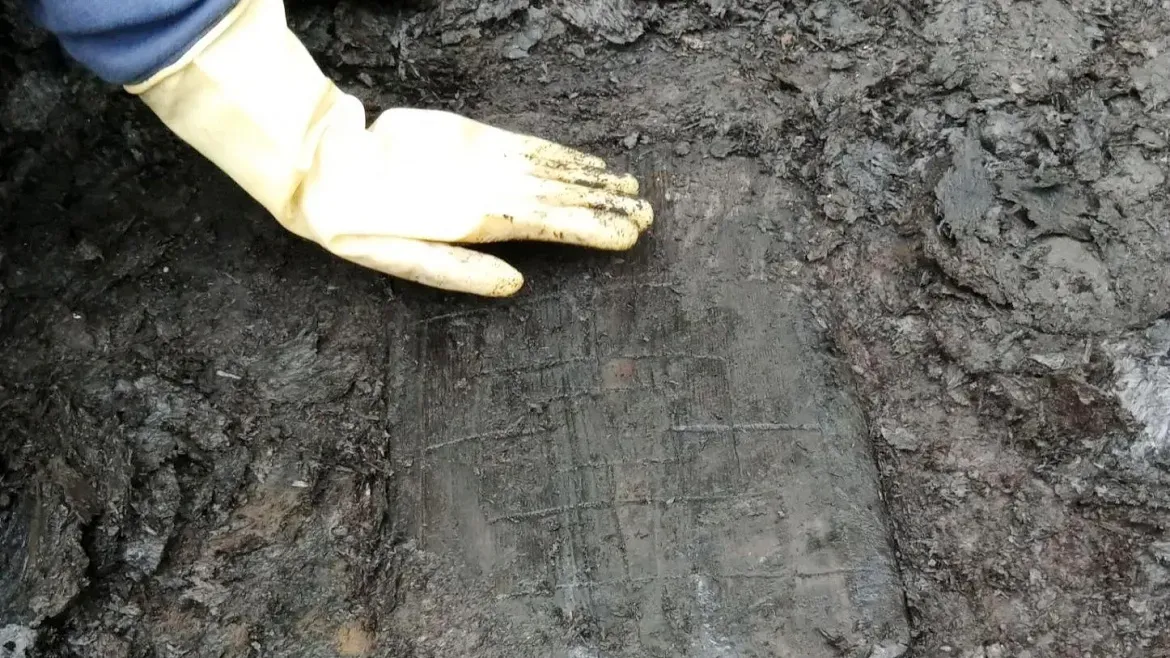
Archaeologists in Russia have made an intriguing discovery at an 11th-century archaeological site: a wooden kitchen gadget that appears to be both a medieval bread peel and a game board from an ancient board game.
The object, described as a "bread shovel, was found at the Pyatnitsky site in Staraya Russa, a medieval town situated between Moscow and St. Petersburg. This region has been yielding numerous archaeological treasures in recent months, including a recently discovered snake amulet.
According to Sergey Toropov, director of Novgorod State University's Center for Archaeological Research, the wooden paddle is likely to have been used by medieval bakers to transfer bread into an oven. However, its design suggests it may have served another purpose as well: passing the time while waiting for food to cook.
Measuring approximately 12 by 16 inches in size, the preserved portion of the bread shovel was crafted from oak wood. Its flat surface on one side is consistent with a baking tool, but the opposite side features a carved board for playing an ancient game known as merels or nine-men's morris.
The presence of three concentric squares on the back of the wooden paddle implies that it may have been used to play this particular game while waiting for bread to bake in the oven.
The game of merels has been around for centuries, but its exact origins are still a mystery. Historical records suggest that it was played by the ancient Romans two thousand years ago, and possibly even earlier than that. Its popularity peaked in the Middle Ages across Europe and Asia, where it could be set up quickly with minimal equipment.
A typical merels board consists of three concentric squares connected by horizontal and vertical lines, with each player having nine pieces of the same color. The objective is to arrange the pieces into columns of three along the lines, requiring a combination of strategy and luck. Players can remove any one of their opponent's pieces when they form a line, making merels a unique blend of tic-tac-toe and checkers.
The presence of a similar game board on various household objects from antiquity suggests that special boards may have been created for playing merels. However, it was not uncommon to find makeshift game boards scratched or carved into flat surfaces of everyday items, such as tables or stones.
While the wooden bread peel's primary function was likely to be used in baking, it is possible that it served a secondary purpose as a game board. The archaeologists are unsure whether it was designed with two functions in mind or if it was repurposed after breaking and losing its original use.
The versatility of merels allowed players to set up a game board anywhere, using any available flat surface and objects such as small stones. This flexibility may have contributed to the game's widespread popularity across ancient civilizations.
The discovery of a well-preserved 11th-century pizza peel" in Russia has shed new light on the versatility of ancient kitchen tools. This artifact, which doubled as a game board, has been found to be remarkably similar to merel boards and playing pieces discovered at ninth-century archaeological sites.
It's worth noting that the ancestors of the people who used these kitchen tools were Vikings who arrived in what is now Russia in the eighth century. The fact that such a well-preserved artifact was uncovered is significant, as it provides valuable insights into the daily lives of ancient civilizations.
The discovery has sparked interest among archaeologists and historians, who are eager to learn more about the uses and functions of these multifunctional tools. It's clear that ancient kitchen tools were not just for cooking, but also served other purposes such as entertainment and leisure.
The finding serves as a testament to the resourcefulness and creativity of our ancestors, who found ways to adapt everyday objects into various items that could be used in different contexts.
Facts based on reporting originally published by Live Science.
You may republish this story, in full or in part, if you credit News Central Site and link to it (licence CC BY 4.0). Photos are not included.