Massive security operation in New Delhi detains thousands of protesters affiliated with the "Cockroach movement".
The crackdown on the Cockroach movement began before protesters could reach their designated protest site at Jantar Mantar, and police claimed they had rejected the protest application due to its late submission.
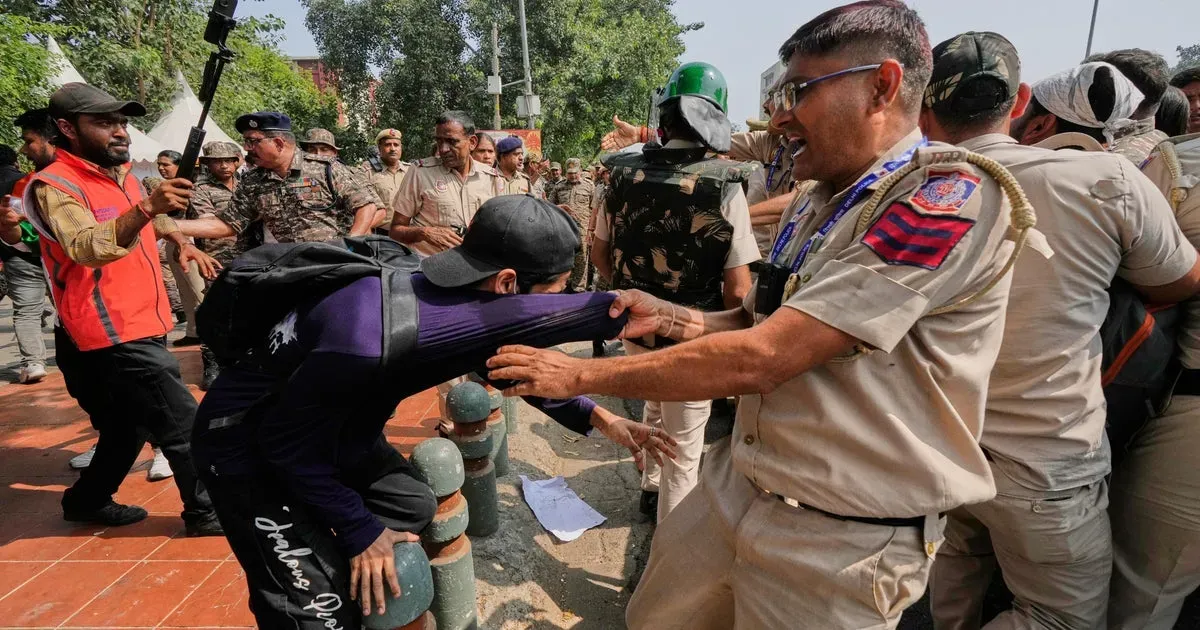
Indian authorities launched a massive security operation in New Delhi on Saturday, detaining thousands of protesters affiliated with the "Cockroach movement. The crackdown began before demonstrators could even reach their designated protest site at Jantar Mantar, the heart of India's capital.
Police intercepted protesters en route to the venue, chasing some off and taking others into custody. Many were dragged away and bundled into police vehicles, which then transported them to temporary detention centers.
Police claimed that they had rejected the protest application due to its late submission, but the crackdown's sheer scale speaks volumes about the government's resolve to curb the growing momentum of the Cockroach movement.
The authorities' efforts to quash the protests were further bolstered by sweeping security measures in New Delhi, including a ban on gatherings of five or more people in certain areas. Meanwhile, leaders of the protest campaign, Abhijeet Dipke, Saurav Das and Ashutosh Ranka, were detained upon their arrival at Delhi airport from Mumbai on Saturday.
As the protest campaign against the Election Commission's Special Intensive Revision continues to gain momentum, Indian authorities have responded with an unprecedented show of force. The capital city is under a total siege, with citizens being driven out and opposition lawmakers speaking out against the government's actions.
Opposition lawmaker John Brittas has questioned whether India can still be considered a democracy given the government's heavy-handed approach to containing public dissent. Meanwhile, peaceful protesters are being met with force, sparking concerns about the erosion of democratic rights in the country.
The Cockroach" movement has been a thorn in the side of Indian Prime Minister Narendra Modi's government since its emergence online in May. Protests, demonstrations, and sit-ins over alleged exam paper leaks have drawn widespread attention to the cause.
As the protests gain momentum, they pose a challenge for Modi midway through his third term. The timing is particularly significant as state elections are scheduled next year in Uttar Pradesh, India's most populous state ruled by the BJP, and Gujarat, Modi's home state.
Facts based on reporting originally published by CBS News World.
You may republish this story, in full or in part, if you credit News Central Site and link to it (licence CC BY 4.0). Photos are not included.