Latvian Burial Site Yields Grim Discovery of Mass Slaying
Six individuals, including four men and two children, were buried together with evidence suggesting they may have been killed by attackers wielding sharp blades.
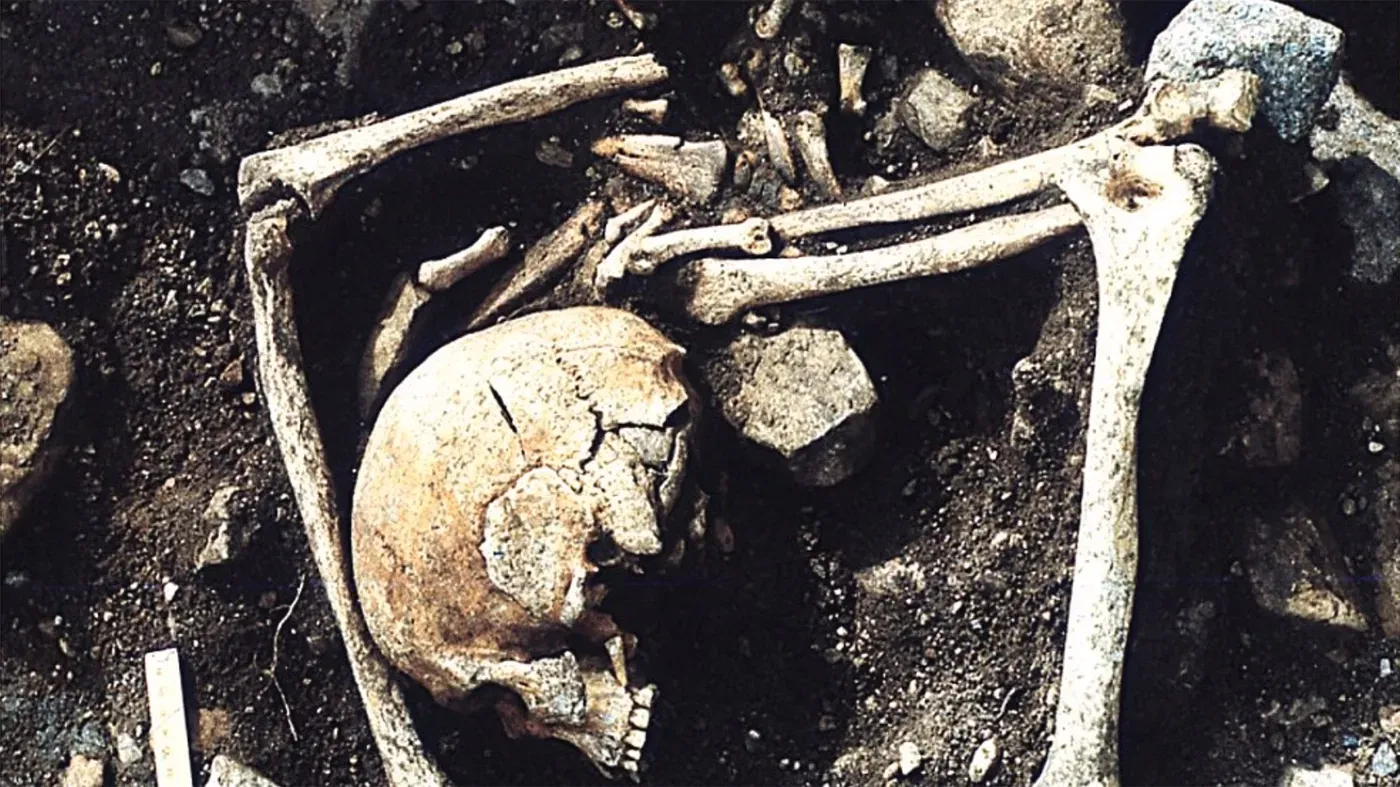
A 1,200-year-old burial site in Latvia has yielded a grim discovery: six individuals, including four men and two children, were buried together in a single grave, with evidence suggesting they may have met their demise at the hands of attackers wielding sharp blades.
Genetic analysis of the remains revealed that some of the deceased were related to each other, with one boy identified as the son of one of the men. Another man was found to be a third-degree relative, possibly a first cousin or great uncle. This family connection suggests that these individuals may have been part of a close-knit community.
Further examination of the remains revealed that three of the men had suffered "sharp force injuries, which could have been inflicted by an axe or sword. However, it is unclear how the other three individuals died, and researchers are left to speculate about the circumstances surrounding their deaths.
The presence of sharp force injuries on three of the men has sparked theories about a possible battle or raid that may have led to their demise. One scenario suggests that the group was killed in a conflict with neighboring communities, while another possibility is that they were targeted by Viking invaders.
According to study co-author Elīna Pētersone-Gordina, an archaeologist at the University of Latvia, it is impossible to say for certain whether the individuals were victims of a raid. However, the date of the burial and the evidence of fatal trauma suffered by three of the men do raise suspicions about Viking involvement in their deaths.
The radiocarbon dating of the grave suggests that the interment took place in the second half of the ninth century, which is considered to be within the early Viking Age period.
Located near the Gulf of Riga, a sheltered bay of the Baltic Sea, the Čunkāni-Dreņģeri cemetery has been home to hundreds of graves dating back to Latvia's Iron Age. The site was first discovered in 1924 and contains burials that span the seventh to eleventh centuries.
In stark contrast to most other graves found at this cemetery, which typically contain a single set of remains, six people were buried together in this particular grave. Initial research suggests that at least three of these individuals suffered fatal injuries as a result of violent trauma.
Despite the apparent violence surrounding their deaths, the group was laid to rest with care and respect, accompanied by traditional grave goods. The only female among them was buried with her head pointing northwest, while all the males were placed beside her in a row, their heads oriented southeast, a distinction seen in other local burials from this time.
This interment is being viewed as a multiple burial" rather than a hasty mass grave, where each body was properly arranged and accompanied by customary offerings.
The careful arrangement of bodies within the ancient burial suggests that the deceased individuals were members of a respected group in their community.
Their burial in a single grave implies that they died at the same time, possibly during a traumatic event such as an attack or a natural disaster.
Genetic analysis has revealed that all six individuals buried together shared Indigenous Baltic ancestry, which is consistent with the cultural heritage of the region during the Iron Age period.
The Čunkāni-Dreņģeri cemetery, where this burial was discovered, contains other graves with similar characteristics, indicating a possible connection between these burials and the local culture.
The Semigallian people, an Iron Age group that inhabited Latvia's fertile plains, are believed to be among the individuals buried in this grave.
The grave discovered in Latvia contains the remains of four individuals who met a violent end, likely due to sharp force injuries.
Analysis of the skeletal remains suggests that two of the men buried alongside each other were related, while the other two men were not family members but part of the same community or extended household.
This distinction is significant as it implies that the unrelated men were killed in the same event, possibly a violent confrontation rather than an isolated act. The researchers' findings support this interpretation and provide insight into the lives of people living in Eastern Europe during the Viking Age.
Marks on the bones reveal gruesome details about the manner of death, including defensive cuts on one man's forearm and hand, a shattered jaw for another, and near decapitation for a third individual.
The archaeological study of a 1,200-year-old burial site in Latvia has shed new light on the social structure of the Semigallian people during that time period.
The excavation revealed evidence of an emerging aristocratic class, with the burial receiving special care and attention to detail. This suggests that certain individuals within the community held positions of power or influence, which was reflected in their treatment after death. The findings also provide insight into the daily lives and social hierarchies of ancient societies.
Researchers have pieced together a grim picture of the circumstances surrounding the deaths, with injuries indicating a violent and brutal end for those buried at the site. Despite the passage of centuries, the details of these events remain starkly clear, offering a glimpse into the darker side of history.
Facts based on reporting originally published by Live Science.
You may republish this story, in full or in part, if you credit News Central Site and link to it (licence CC BY 4.0). Photos are not included.