Japan Launches Mission to Explore Martian Moons Deimos and Phobos
The mission aims to study the composition, geology, and potential resources of Mars' moons, with a focus on collecting samples from Phobos for further analysis.
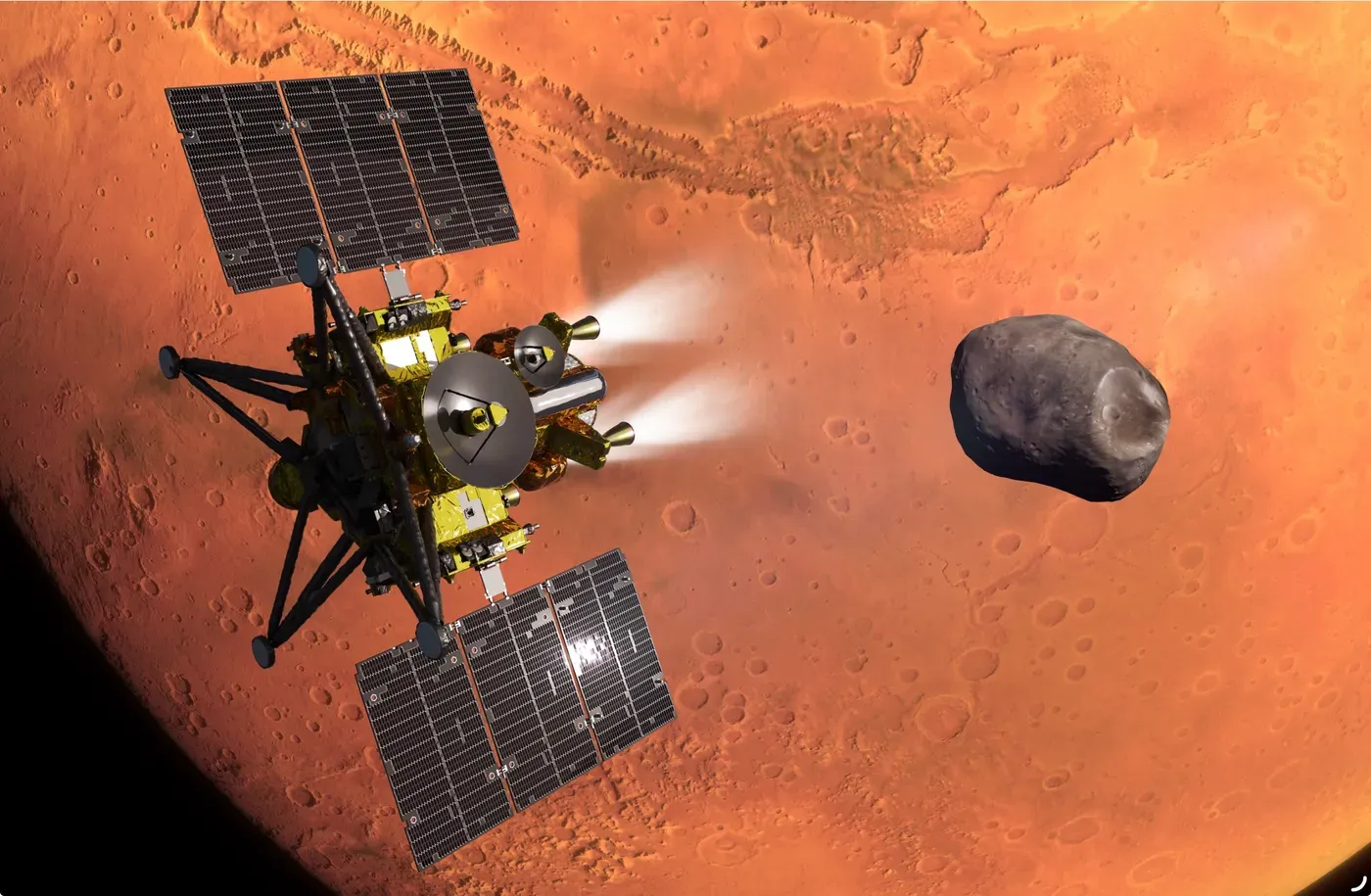
Japan has successfully launched a mission to explore Mars' moons, Deimos and Phobos, from the Tanegashima Space Center on Monday afternoon. The Martian Moons eXploration (MMX) mission is a collaborative effort between Japan's space agency, JAXA, and NASA.
As part of this ambitious project, scientists aim to send a spacecraft to study both moons in detail, gathering valuable information about their composition, geology, and potential resources. Crucially, the mission also plans to collect samples from Phobos' surface for further analysis on Earth. This will be a groundbreaking achievement if it succeeds.
The MMX mission has significant implications for our understanding of the solar system's history. By studying the Martian moons, scientists hope to gain insights into how Earth's moon was formed and why it shares similarities with its Martian counterparts. This knowledge can help us better comprehend the complex processes that shaped our planet and others in the solar system.
JAXA has been working closely with NASA on this project, leveraging each other's expertise to ensure the mission's success. The collaboration is expected to yield valuable data that will have far-reaching implications for future space exploration, particularly as NASA prepares to send humans to Mars.
The formation of Mars' asteroid-size moons, Deimos and Phobos, remains a topic of debate among scientists. While it is theorized that they may have originated from a collision between Mars and another celestial body, some experts believe that the Martian moons could be captured asteroids.
To shed more light on this mystery, scientists plan to study the moons up close and bring back samples for further analysis. This will enable them to determine whether Deimos and Phobos share similar origins with Earth's own moon.
According to NASA program executive Tom Statler, understanding the origins of Mars' moons could reveal valuable insights into the early era of our solar system, particularly regarding the acquisition of water and organic compounds by Earth and other inner planets. This knowledge will be crucial in illuminating the formation processes that shaped our cosmic neighborhood when it was still young.
NASA is contributing several key components to the mission, including a spectrograph instrument to study Phobos' surface composition and a pneumatic sampler technology demonstration to collect samples from the moon. The agency will also provide communications and navigation support using its Deep Space Network.
The mission will serve as a crucial testbed for technologies that could support future human missions to Mars. By sending a spacecraft to Phobos, the Martian moon, and back to Earth, JAXA aims to gain valuable insights into the challenges of a round trip to the Red Planet.
JAXA has set a tight schedule for the mission, with the MMX spacecraft expected to arrive at Mars in August 2027. After conducting its scientific experiments on Phobos, the craft will depart Mars in November 2030 and return to Earth by July 2031, marking the end of a five-year journey.
The mission's success is not guaranteed, however, as China's Tianwen-3 spacecraft is also planned for launch in 2028 with the goal of returning samples from Mars to Earth. If all goes according to plan, the MMX and Tianwen-3 missions would both return to Earth in 2031.
The Japanese space agency's mission will not be the first to attempt a round trip to Mars, as NASA's Osiris-Rex spacecraft successfully retrieved samples from an asteroid in 2020 and brought them back to Earth in 2023.
Facts based on reporting originally published by CNET.
You may republish this story, in full or in part, if you credit News Central Site and link to it (licence CC BY 4.0). Photos are not included.