Incident at Albania's Education Ministry Amid Student Protests
Violence erupts during second day of student protests against corruption and education policies.
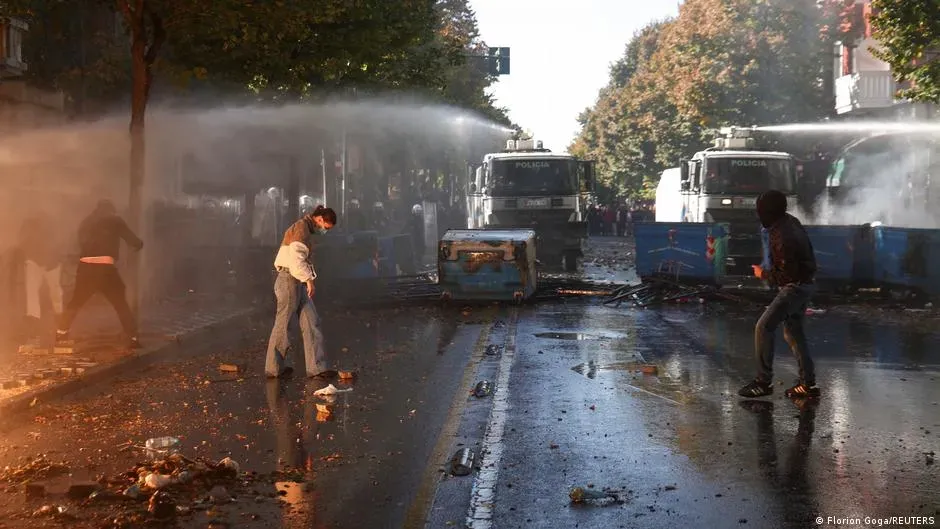
A fire has broken out at Albania's Education Ministry as students continue to protest against corruption and education policies. The incident occurred on Wednesday, marking the second day of demonstrations that have taken a violent turn.
Protesters gathered in large numbers outside the ministry in Tirana, with many covering their faces. Some individuals threw bricks at the building, damaged barriers, and overturned trash cans.
A nearby bank caught fire, according to eyewitness reports cited by Reuters news agency. Riot police were deployed to disperse the crowds, using tear gas and water cannons to try and restore order.
The situation in Albania continued to escalate on Wednesday, with reports of 40 detentions and 13 people injured, including six police officers. The unrest persisted even after these figures were released, indicating that the protests showed little sign of abating.
Deputy Prime Minister Albana Kociu took to Facebook to express her disappointment at the turn of events, describing it as "disheartening to see peaceful demonstrations degenerate into orchestrated violence. She criticized the attacks on institutions and police, as well as the senseless destruction of public property, which she believed was not an effective way for young people to express themselves.
The Deputy Prime Minister's comments were aimed at those who used violent tactics to mask their own political shortcomings. Kociu urged students who genuinely believed in the right to protest to distance themselves from violence and vandalism, implying that there was a distinction to be made between legitimate dissent and destructive behavior.
Student organizers have maintained that the protests are centered around pressing issues such as university conditions, rising higher education costs, financial support for students, and employment prospects after graduation. The demonstrations are part of a broader movement in Albania, which has seen several major protests this year, often referred to as the Flamingo Revolution.
The demonstrations in Albania are not just about environmental concerns, but also reflect broader discontent with the country's established political elite. For over three decades, the Socialists and Democrats have taken turns leading the government since Albania transitioned to democracy after the fall of communism.
The protests' timing is noteworthy, coinciding as they do with international attention focused on student unrest in France. This heightened profile may be contributing to the sense of momentum behind the Albanian demonstrations, which are part of a larger movement known as the Flamingo Revolution".
The widespread dissatisfaction among Albanians with their current leadership has been building for some time, making it difficult for the government to address the protesters' demands and restore stability.
Facts based on reporting originally published by DW English.
You may republish this story, in full or in part, if you credit News Central Site and link to it (licence CC BY 4.0). Photos are not included.