Hybrid Nanocrystal Surface Manipulates Infrared Light
Researchers have developed a novel technique for manipulating infrared light using a hybrid nanocrystal surface.
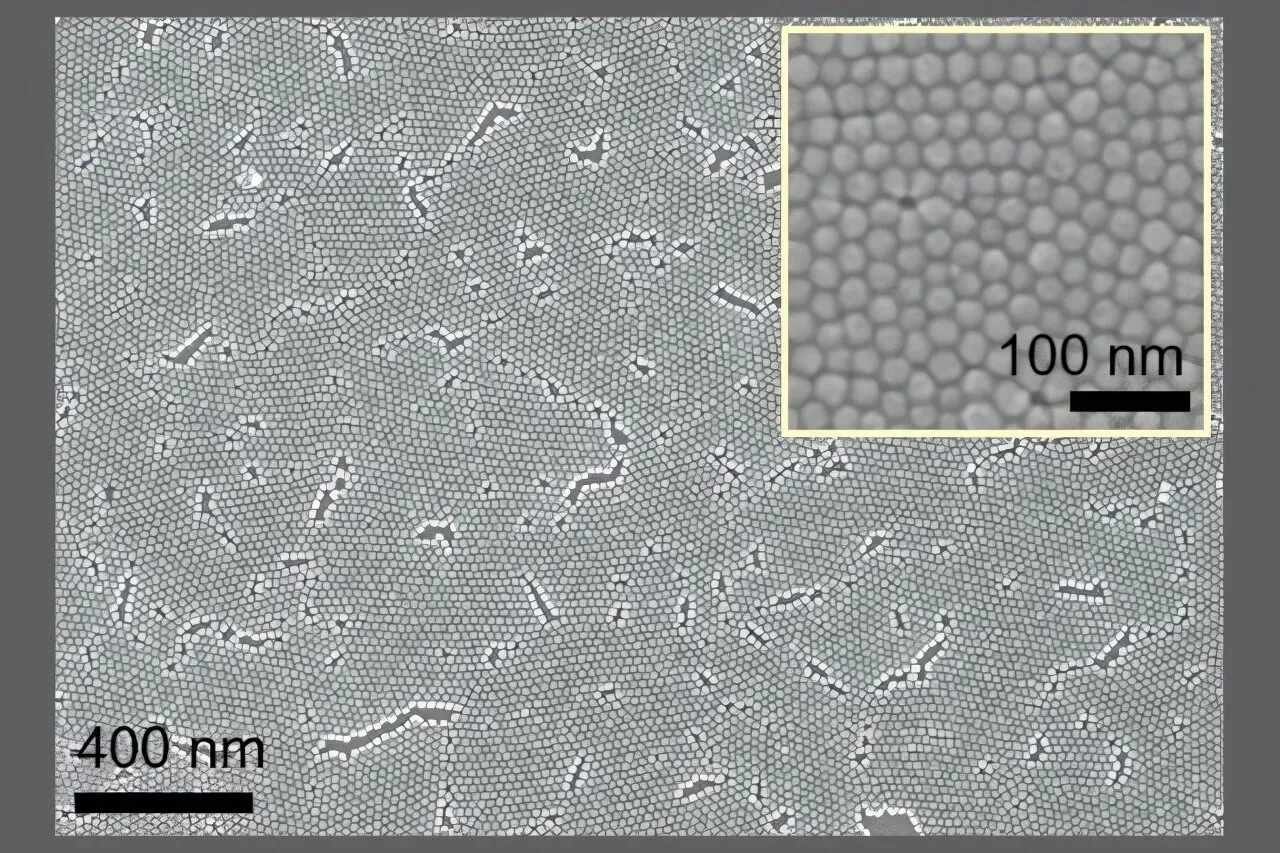
A novel technique for manipulating infrared light has been discovered by researchers using a hybrid nanocrystal surface.
The breakthrough involves creating a thin sheet made from two types of mixed nanocrystals, indium oxide doped with either 1% or 3% tin, which can amplify or suppress infrared light beyond what would be expected if the components were used separately.
This metasurface, just one crystal thick, exhibits a superlinear optical effect due to the interactions between the nanocrystals and infrared light. The researchers employed various experimental methods to develop a model that other scientists can use as a design tool for achieving specific light-matter interactions.
The interaction between the nanocrystals and infrared light triggers waves of electrons called plasmons, which trap the light on the surface.
Depending on the frequency of the incoming infrared light, the mismatched electron waves from neighboring nanocrystals with different doping levels either boost or suppress the trapped energy.
Researchers from various institutions joined forces for this project, combining their expertise to explore new ways of interacting with infrared light on a hybrid nanocrystal surface.
To study these interactions, the team employed far-field infrared spectroscopy as their initial approach. This technique involves shining an infrared light source on the material as a whole, which effectively averages out the individual interactions among all the tiny crystals.
As they dug deeper, the researchers switched to near-field techniques, bringing the light source closer to the metasurface using synchrotron infrared nanospectroscopy (SINS) at Lawrence Berkeley National Laboratory. SINS revealed that absorption varied significantly across the surface, with different patterns emerging depending on each particle's immediate neighbors.
Using a powerful electron microscope at Oak Ridge National Laboratory, the team zoomed in on individual nanocrystals with subnanometer precision. This allowed them to map plasmon energy patterns around each crystal, confirming that 1% and 3% ITO nanocrystals were indeed randomly mixed and interacted with their neighbors in distinct ways.
The differing interactions between neighboring particles resulted in varying levels of absorption across the surface, depending on the frequency of incoming infrared light. The higher-energy plasmon waves produced by 3% ITO nanocrystals reinforced or dampened each other's ripples at different frequencies, creating a complex pattern of interaction with the incoming light.
The unique properties of nanocrystals can be revealed through electron beam microscopy, allowing researchers to distinguish between different types of nanocrystals that are otherwise invisible to visible light.
This ability to differentiate between nanocrystals has significant implications for the development of plasmonic metasurfaces, which are used to manipulate light at the nanoscale. The experimental data from this study validate predictions made using electromagnetic simulations, providing a crucial link between theory and practice.
By manufacturing metasurfaces in solution, researchers can sidestep the limitations of expensive top-down methods that require etching microscopic patterns onto a surface. This approach could potentially enable the large-scale production of plasmonic metasurfaces with tailored properties.
The versatility of nanocrystals offers exciting possibilities for manipulating light in new and innovative ways. Researchers are now exploring the potential of near-field interactions to design metamaterials that can convert light between frequencies or polarize it in unusual directions.
Researchers have discovered that ultrathin nanocrystal coatings can interact with infrared light in a way that could lead to innovative applications such as antiglare coatings or thermal camouflage.
These coatings, which are still in the early stages of development, have the potential to be used for self-cooling surfaces by harnessing light to dissipate heat.
Facts based on reporting originally published by Phys.org.
You may republish this story, in full or in part, if you credit News Central Site and link to it (licence CC BY 4.0). Photos are not included.