Heat from Crematoria Used to Warm Homes and Public Facilities
A groundbreaking experiment is underway in the UK, where excess heat from crematoria is being harnessed to warm homes and public facilities.
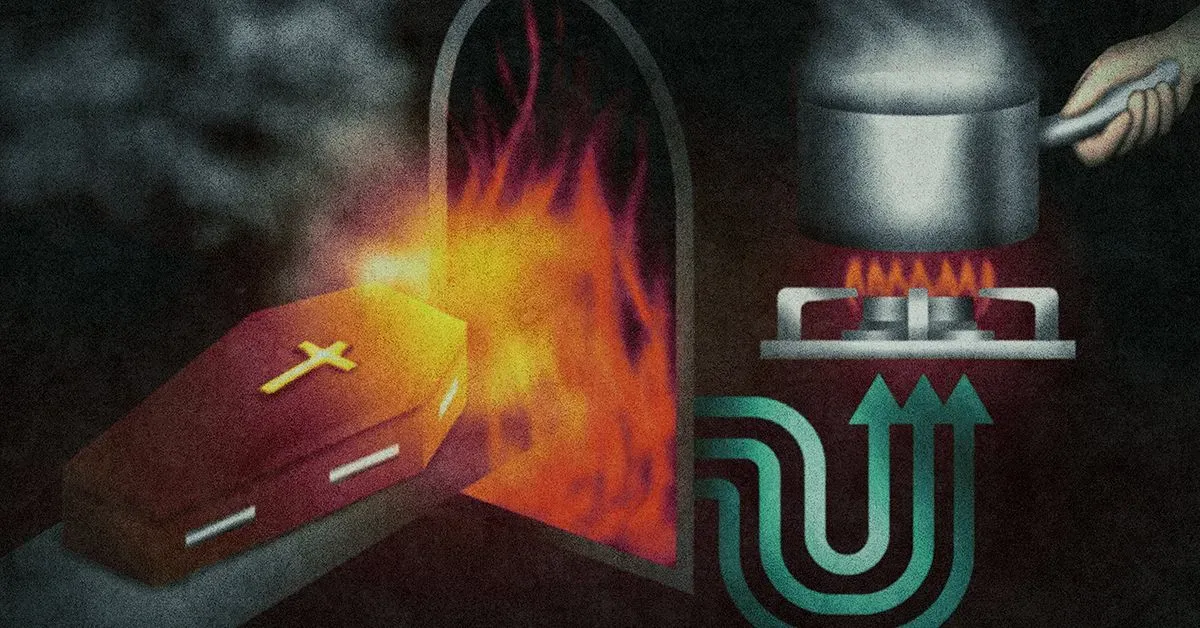
A groundbreaking experiment is underway in the UK, where excess heat from crematoria is being harnessed to warm homes and public facilities. This innovative approach has sparked controversy among some local officials, who question its practicality.
Critics argue that capturing heat from cremations amounts to little more than warming radiators with a tube, as Redditch and Bromsgrove Councils' Guy Revans put it. Despite initial backlash, the project has won recognition for its eco-friendly credentials and is now being replicated in other parts of Europe.
Redditch's crematorium has been utilizing waste heat since 2013 to warm the local swimming pool. The facility conducts around 1,200 cremations annually, generating a modest but usable amount of excess heat. This heat is typically captured as part of a process that removes vaporized mercury from dental fillings in the flue gases emitted by the gas-fired ovens.
The process involves using a heat exchanger to capture the excess heat before venting the remaining gas into the atmosphere. In essence, this method captures heat by default, leaving the question of whether it makes sense to waste or utilize this resource. The captured heat is then channeled through an underground water loop to supply the swimming pool with warmth.
The Redditch experiment has sparked debate about the potential for utilizing crematoria waste heat on a larger scale. While some view it as a viable means of reducing carbon intensity in funeral rites, others remain skeptical about its practicality and feasibility.
The use of crematoria as a source of heat is being explored in various parts of the world, with some projects already underway. One such example is the recreation center in the UK that has partnered with a local crematorium to utilize excess heat from the cremation process. This heat is then used to warm the pool and surrounding areas.
The system in place at the recreation center has proven to be effective, saving the council tens of thousands of pounds per year in fuel costs. The combination of waste heat from the crematorium with gas-fired boilers allows for a more efficient use of energy. This approach has also been implemented at other locations, including a school currently under construction in Aberdeen, Scotland.
The Aberdeen school will receive approximately half of its total heat requirement from the city's crematorium, with a heat pump covering the remaining needs. The system is expected to be fully operational by February 2027. This project highlights the potential for crematoria to provide a significant source of renewable energy.
In Finland, a new crematorium set to open in 2028 will be connected to the town's district heat network, supplying over 6,500 homes with hot water for heating.
The new crematorium in Kangasala, Finland will be fully electric and partly powered by solar panels on its roof, highlighting the innovative approach to energy efficiency in heating homes.
Timo Heikkilä, an expert working on the project, emphasizes that using this facility for heat generation is a significant development. Winter temperatures in Kangasala can remain below 0 degrees Celsius for weeks on end, making efficient heating systems crucial for residents.
Finland's reliance on natural gas for heating has been decreasing due to concerns over climate change and Russia's invasion of Ukraine, which had previously provided affordable gas supplies. As a result, the country is seeking alternative sources of heat, including waste heat from various facilities.
In the UK, crematoria have also started adopting eco-friendly practices, such as scheduling the firing of gas ovens to match funeral services and holding coffins for up to 72 hours to optimize energy usage.
Implementing heat recovery technology at crematoria in the US is a more complex process than in other countries due to the rarity of district heat networks and the private ownership of most crematoria facilities.
This means that the investment required for heat exchangers and pipework necessary to connect buildings is significantly higher, making it less feasible for businesses to adopt this technology.
Matthews Environmental Solutions, a company specializing in environmental solutions, is closely monitoring the situation and exploring potential opportunities for implementing heat recovery systems at US crematoria when the economic conditions are favorable.
The company's director of strategy, Paul Seyler, emphasizes that utilizing waste heat from cremation flue gases would be a significant resource-saving measure, but notes that there are currently no fully operational systems in place in the US.
The energy performance of the building is now displayed on an LED screen in the reception area, providing visitors with a visual representation of the impact of the heat exchanger's operation.
While gas is still used for some heating needs and cremations, the new system has saved an estimated 29 metric tons of greenhouse gas emissions annually, a significant reduction in environmental impact.
Hannah Rumble, associate at the University of Bath's Centre for Death and Society, notes that recovering heat from cremations is one way to mitigate the devastating effects humans have had on the environment, highlighting the importance of finding innovative solutions.
Using waste heat from crematoria has been hailed as a sensible approach by some, including independent humanist funeral and wedding celebrant Gaynor Doherty in the UK, who suggests that natural burials might be preferred by many eco-conscious individuals.
The carbon intensity of cremation varies across facilities but can reach around 250 kilograms of carbon per gas-fired cremation, with recovering heat from the process offsetting some emissions while still leaving a significant amount unaccounted for.
Decarbonizing heat production is a complex challenge, but every effort counts in this endeavor.
The innovative use of crematoriums as heat sources for homes and swimming pools may also hold emotional significance for those involved. Some individuals may appreciate the idea that their loved ones' warmth is being shared with others after they pass away.
In Finland, an all-electric crematorium in Kangasala operates continuously, producing less heat than a gas-fired equivalent but running 24/7 due to its efficiency in topping up retained heat within ceramic ovens using electricity. The facility connects to the local district heat network, making it possible for mourners to feel the warmth generated by their loved one's cremation upon returning home.
The project has led Heikkilä to contemplate his own end-of-life choices, with him expressing a desire to be cremated and have his waste heat recycled.
Facts based on reporting originally published by Wired.
You may republish this story, in full or in part, if you credit News Central Site and link to it (licence CC BY 4.0). Photos are not included.