Guilty Verdict Handed Down to Former Kosovo President Hashim Thaci
A court in The Hague has handed down another guilty verdict to former Kosovo President Hashim Thaci for obstructing justice and attempting to influence witnesses during his recent war crimes trial.
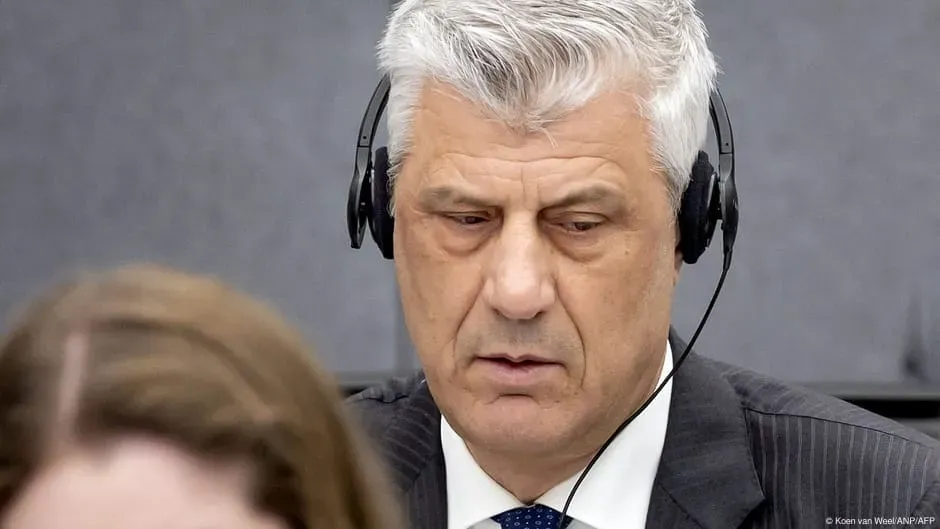
A court in The Hague has handed down another guilty verdict to former Kosovo President Hashim Thaci, this time for obstructing justice and attempting to influence witnesses during his recent war crimes trial. The sentence of 17 months will be added to his existing 25-year term for war crimes.
The charges stem from an indictment by the Specialist Prosecutor's Office, which alleges that Thaci shared confidential information about witnesses in his war crimes trial with visitors at a detention facility in The Hague. These individuals were reportedly instructed on how to influence the testimony of these witnesses. This is just the latest development in a complex and contentious case.
Thaci has a complicated legacy in Kosovo, where he is viewed by many as a hero due to his role as the former leader of the Kosovo Liberation Army (KLA) during the 1998-1999 conflict. His war crimes conviction in September sparked widespread anger and dismay among his supporters back home. The conviction of three other men, former head of the Kosovo Intelligence Agency Bashkim Smakaj, former Minister of Justice Hajredin Kuci, and Fadil Fazliu, also raises questions about accountability.
The Specialist Prosecutor's Office has been investigating allegations of war crimes committed during the 1998-1999 conflict in Kosovo. Thaci's actions, as described in the indictment, suggest a deliberate attempt to undermine the integrity of the trial process. His lawyers may argue that his intentions were not malicious, but rather an effort to protect himself from potential perjury charges.
The conviction has sparked intense debate in Kosovo about the country's justice system and its ability to deliver fair verdicts.
Kosovo society is grappling with complex emotions as it reflects on the war that ended 27 years ago, the role of former leaders, and the ongoing discussion about individual or collective responsibility for the KLA's actions during the conflict.
The government responded swiftly to the ruling, issuing a statement that highlighted its commitment to upholding the rule of law.
In a clear expression of its stance, the government emphasized that trust in justice is not solely built on the decisions made, but also on how those decisions are reached, stressing the importance of fair, transparent, and credible judicial processes.
The appeal proceedings before the Kosovo Specialist Chambers have been a focal point for Kosovo's state authorities since Hashim Thaci's first conviction in September.
To navigate this complex process, Kosovo has established a working group, led by Foreign Minister Glauk Konjufca, which includes members of the country's parliament. This initiative aims to develop a strategy for appealing the Specialist Chambers' decision at the appellate level.
The government, under Prime Minister Albin Kurti, continues to express its dissatisfaction with the first-instance judgment, labeling it "unjust, both legally and morally". As a result, the authorities are working to secure a correction in the appeals process.
Meanwhile, Kosovo's parliament is deliberating on amendments to the law governing the Specialist Chambers. These proposed changes aim to limit the court's jurisdiction in various areas, including the time frame of its authority and the maximum prison sentence allowed.
The move by Kosovo's parliament to amend the law on the Specialist Chambers has sparked intense debate among analysts and experts about the country's commitment to justice.
Political analyst Artan Muhaxheri believes that from an international perspective, the initiative could be seen as an attempt to interfere with the judicial process. He warns that if this is indeed the case, it would undermine Kosovo's efforts to demonstrate its ability to uphold the rule of law and adhere to its obligations towards the European Union.
Muhaxheri emphasizes that for the amendment to be successful, it must be demonstrated that it does not conflict with Kosovo's international commitments. He stresses that this can only be achieved by ensuring that the proposed changes are argued professionally and rigorously, guaranteeing judicial independence and solidifying support within Kosovo's legal system.
The Specialist Chambers were established by Kosovo itself, but their functioning has raised concerns about bias and prejudice in the justice process. Ehat Miftaraj, executive director of the Kosovo Law Institute (IKD), points out that judges, prosecutors, and international actors have sometimes treated accused individuals and the country as a whole with distrust, condescension, and an overly critical approach.
Muhaxheri's advice to Kosovo's politicians is to carefully consider how their actions will be perceived internationally. He cautions that any move to undermine the Specialist Chambers could damage Kosovo's reputation and credibility on the world stage.
The Specialist Chambers' decisions have sparked intense debate in Kosovo about justice and the role of the chambers themselves. Critics argue that reactions to these decisions are often rooted in a historical and emotional context that cannot be ignored.
In this complex landscape, it's essential to distinguish between legitimate criticism of judicial decisions based on legal arguments and attempts to undermine the credibility of the courts or exert influence over their proceedings.
Facts based on reporting originally published by DW English.
You may republish this story, in full or in part, if you credit News Central Site and link to it (licence CC BY 4.0). Photos are not included.