Groundbreaking Discovery Made at CERN's Large Hadron Collider
Physicists have detected evidence of a rare particle decay occurring approximately once every 10 billion "beauty particles, bringing scientists closer to exploring the Zeptoverse.
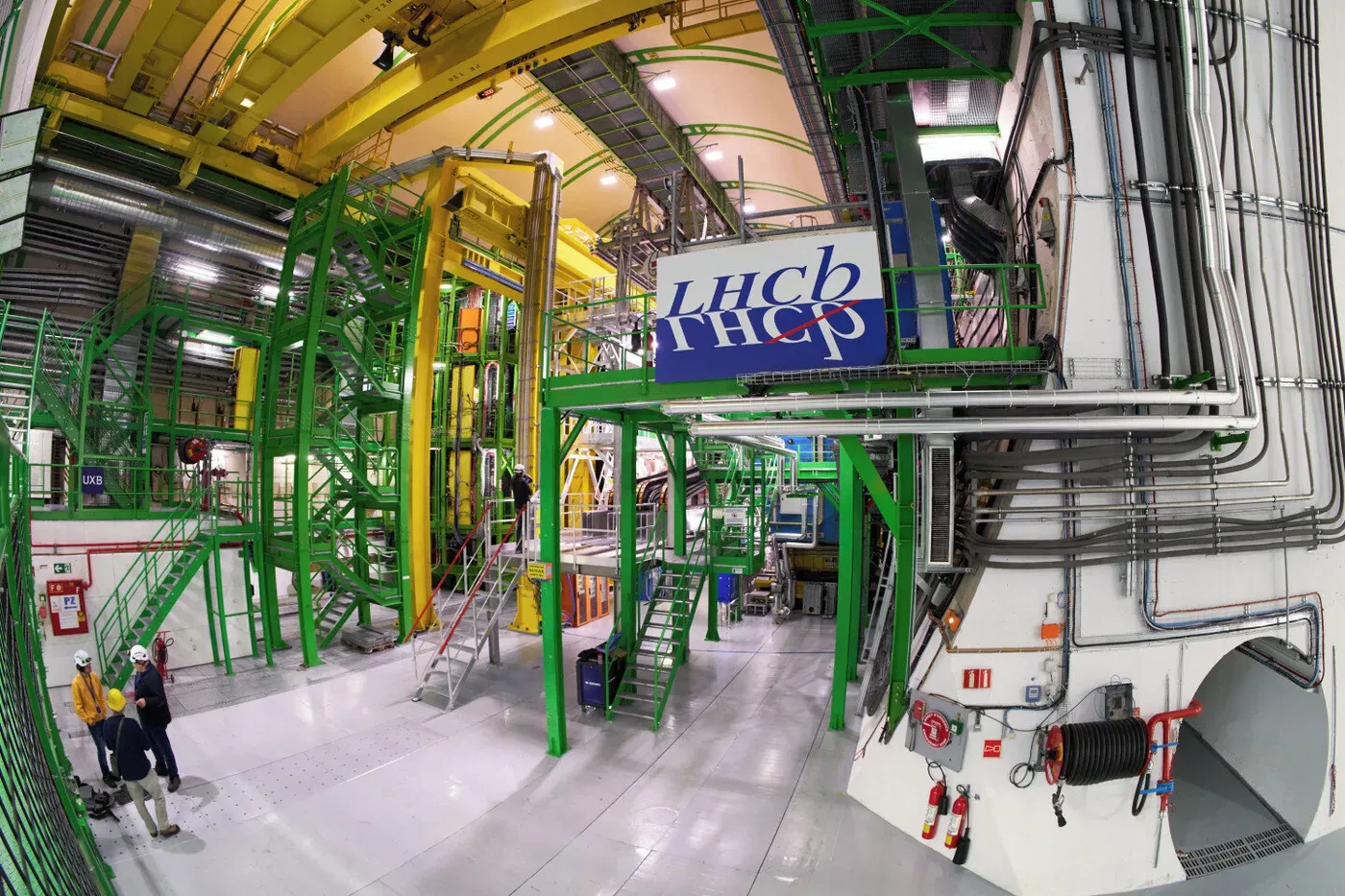
Physicists have made a groundbreaking discovery at CERN's Large Hadron Collider (LHC), detecting evidence of a rare particle decay that occurs approximately once every 10 billion "beauty particles. This finding brings scientists closer to exploring the mysterious realm known as the Zeptoverse, where new particles and forces may exist.
The Zeptoverse is thought to reside at distances measured in zeptometers, an unfathomably small scale of one billionth of a trillionth of a meter. For over 40 years, researchers have been searching for hints of this unexplored world, and the recent discovery marks a significant milestone in their quest.
A team from The University of Manchester has played a crucial role in the LHCb experiment, which has undergone a major upgrade to collect data at significantly higher rates than before. This improved technology has enabled researchers to make precise measurements that would have been impossible with earlier equipment.
The detection of this rare particle decay will enable physicists to test the Standard Model, our current understanding of fundamental particles and their interactions, with greater accuracy. By doing so, scientists hope to uncover signs of new particles or forces that may exist beyond the boundaries of the Standard Model.
Researchers are now poised to explore the Zeptoverse in unprecedented detail, thanks to this breakthrough discovery. The upgraded LHCb experiment will continue to provide valuable insights into the mysteries of particle physics, and its findings have the potential to revolutionize our understanding of the universe.
The decay of beauty quarks into two muons is an extremely rare process, occurring in less than one in 10 billion cases.
Physicists have been searching for evidence of this phenomenon for over four decades, and their efforts have finally yielded a significant breakthrough.
To detect the influence of new particles on this rare decay, scientists rely on precise measurements of its occurrence. The rarer the decay, the more sensitive it is to external factors that could alter its probability.
The Bd to mu mu process involves a particle containing a beauty quark decaying into two muons, heavier relatives of electrons.
The construction of the upgraded LHCb experiment was a massive undertaking, involving a 15-year design and construction project from an international collaboration of over 1,900 members.
The UK played a significant role in this endeavor, making the largest national contribution to the project and pioneering new technologies that have enabled scientists to probe nature at an unprecedented scale.
A key component of the upgraded LHCb experiment is a silicon pixel detector known as the Vertex Locator. This detector sits just five millimeters from the Large Hadron Collider's beams and enables scientists to pinpoint with extreme precision where particles are produced and decay.
The construction of this detector involved collaboration with nearly 90 UK companies, who worked alongside researchers to train the next generation of scientists and engineers in novel technologies.
This detector is crucial for locating the production site of the beauty meson and pinpointing its decay into two muons. Its precise tracking capabilities have made it possible for scientists to study particle decays at an unprecedented level of detail.
The Vertex Locator's precision is essential for unraveling the mysteries of particle physics, particularly in relation to the Bd to mu mu process, where a beauty quark decays into two muons.
Physicists are one step closer to unraveling the mysteries of particle physics after a 42-year search for evidence of a rare decay process. This breakthrough is crucial in understanding the behavior of subatomic particles and could potentially reveal new physics beyond our current knowledge.
The latest measurement confirms that the Standard Model's predictions hold true, but increasingly precise measurements of these decays will allow physicists to probe deeper into the unknown. With each new discovery, researchers are getting closer to understanding where the model may eventually break down.
Professor Conor Fitzpatrick of The University of Manchester emphasizes the significance of this discovery. He notes that a more than 40-year-long search by physicists worldwide has led to the observation of this elusive decay process. This milestone is considered a golden opportunity to uncover new physics from beyond our current understanding.
The upgraded experiment will continue to collect data into the early 2030s, allowing researchers to study the decay with increasing precision. As a result, scientists expect to gain valuable insights into the behavior of subatomic particles and potentially discover undiscovered particles at even shorter distances.
A further planned upgrade could increase the rate of data collection by another factor of 10, enabling physicists to make even more precise measurements of these decays. This will give researchers greater sensitivity to new physics and bring them closer to understanding the fundamental nature of our universe.
The discovery is a significant milestone in particle physics research, marking a major breakthrough after 42 years of searching for evidence of the Zeptoverse". This phenomenon, which has long been a subject of theoretical interest, may hold the key to understanding the fundamental nature of our universe.
The experiment's success is a testament to the advancements made in instrumentation and data analysis techniques. By upgrading their tools and refining their methods, researchers have gained greater sensitivity to new physics, allowing them to make a significant discovery that could potentially revolutionize our understanding of the universe.
Facts based on reporting originally published by Phys.org.
You may republish this story, in full or in part, if you credit News Central Site and link to it (licence CC BY 4.0). Photos are not included.