Groundbreaking Discovery in Magnetism: Creation of Anti-Spin Ice
Researchers have successfully created an anti-spin ice, a system that defies conventional rules governing spin ices by using attractive particles instead of repulsive ones.
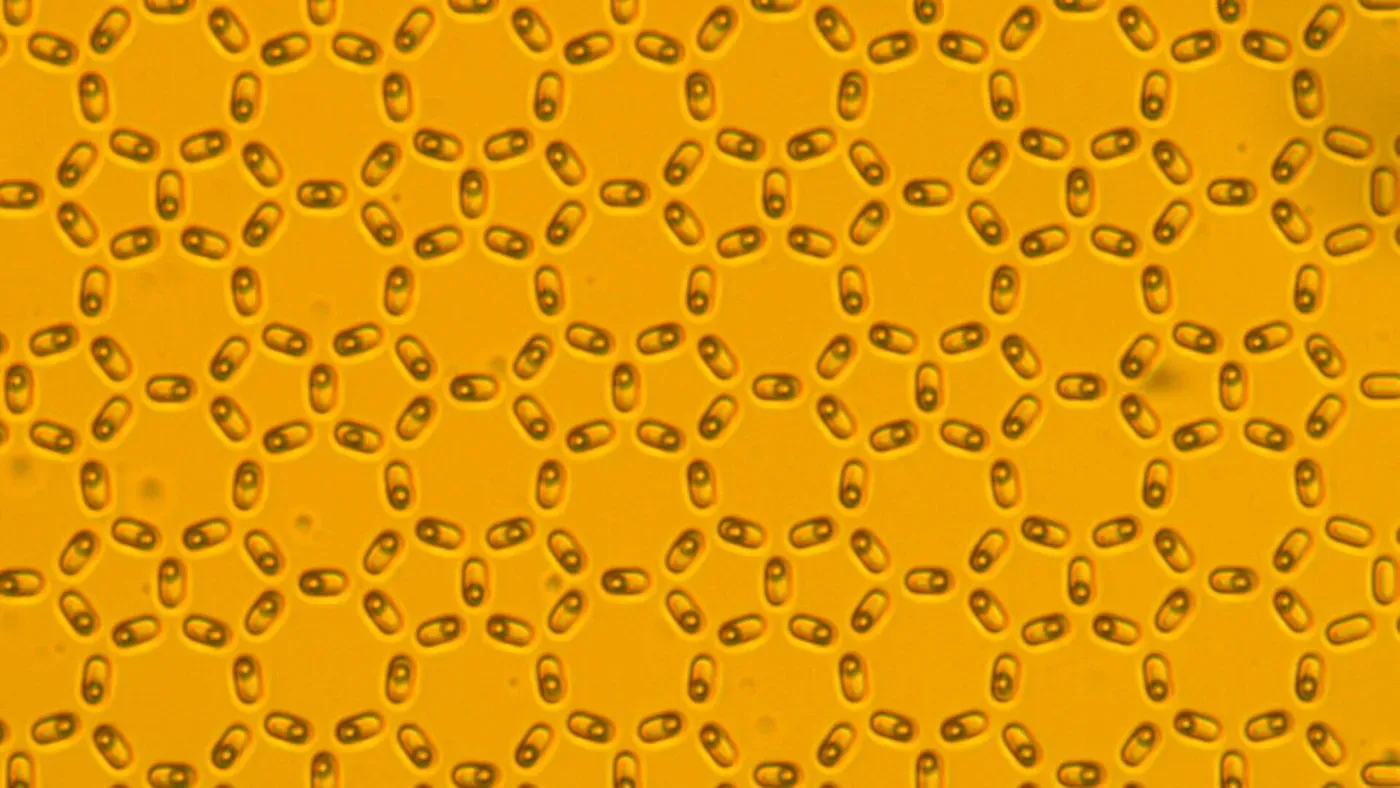
Researchers have made a groundbreaking discovery in the field of magnetism by creating an anti-spin ice, a system that defies the conventional rules governing spin ices.
Spin ices are magnetic systems that mimic the behavior of water ice, where each oxygen atom is surrounded by two hydrogen atoms close and two farther away. This "ice rule is a fundamental principle in physics, but it has limitations: many arrangements satisfy this rule equally well, leading to disorder and no repeating pattern among the hydrogen atoms.
This phenomenon is known as geometric frustration, which occurs when competing interactions within a system cannot be satisfied simultaneously. As a result, particles or atoms end up making compromises that leave the system with multiple possible configurations.
Scientists have successfully replicated the behavior of spin ices in artificially engineered systems called artificial spin ices. These systems are composed of arrays of tiny magnets or microscopic particles called colloids, arranged in lattices to mimic the structure of water ice.
Colloidal ices feature particles situated in tiny grooves or wells, each particle repelling its neighbors and spreading out evenly to minimize the imbalance at each junction. This balance is essential to understanding the topological charge of the system.
The researchers behind this new study have taken a different approach by using attractive particles instead of repulsive ones, creating what they call an anti-spin ice. This fundamental shift in particle interaction could potentially change the way geometric frustration emerges in physical systems.
According to co-author Pietro Tierno from the University of Barcelona, the motivation behind this work was to explore how altering the basic pair interaction between particles, from repulsive to attractive, might significantly alter the manifestation of geometric frustration in a system.
The arrangement of particles in colloidal ice is governed by a specific rule, where each groove holds a single particle that links two vertices of the lattice. These particles can act as tiny arrows, pointing toward one vertex and away from the other, or they can spin, which gives each vertex a topological charge.
The researchers count how many particles sit near a vertex and how many sit far away to determine its charge. This difference in particle distribution is what gives each vertex its unique topological properties. The balance of these charges is crucial to understanding the behavior of colloidal ice.
In a square lattice, each vertex is surrounded by four grooves, with two particles near and two far from it resulting in zero charge. This balanced arrangement is the lowest-energy state when particles repel each other. As a result, the system strives to maintain this equilibrium, adhering to the ice rule.
This rule has been the cornerstone of artificial spin-ice research for decades, governing the low-energy states of many frustrated systems. It dictates how particles interact and arrange themselves in these complex systems, making it a fundamental principle in understanding their behavior.
When attractive forces come into play, particles start to crowd toward some vertices and away from others. This change in interaction dynamics leads to the emergence of anti-spin ice, where the system seeks to maximize local topological charges rather than minimize them.
In an anti-spin ice lattice, high positive charges are found at vertices with all four particles nearby, while high negative charges occur at vertices with all four particles far away. These extreme configurations are now allowed by the new rules governing particle distribution in this altered state.
The researchers selected colloidal particles 2.8 micrometers wide, made of polystyrene embedded with iron oxide grains, to study this phenomenon. These particles become magnetic when exposed to an external magnetic field.
In previous experiments with magnetic colloidal ice, the application of a straight-up magnetic field resulted in every particle becoming an upward-pointing magnet. When placed side by side, these particles repelled each other due to their opposing magnetic moments.
However, creating a scenario where the particles attract each other is more challenging. This requires a different approach to manipulating the magnetic field and its effects on the colloidal particles.
To achieve this, the researchers applied a rotating magnetic field that moved along the surface of the particles. As it rotated, each pair of particles alternated between attracting and repelling each other.
The head-to-tail attraction was found to be significantly stronger than the side-by-side repulsion, resulting in a net attraction that remained consistent in all directions. This unique property allowed the researchers to create an attractive force between the particles.
To further explore this phenomenon, the team placed the colloidal particles within a pentaheptite lattice pattern made of tiny elliptical grooves. Each groove contained one particle.
The researchers noted that unlike repulsive colloidal ice, where small hills or bumps helped maintain order in the system, attractive colloidal ice required no such structural features to prevent particles from settling at the center of their respective grooves.
The researchers used computer simulations to study various lattices and understand how they behaved under attractive forces. They examined square, honeycomb, and pentaheptite lattices, among others, with a field rotating 50 times per second.
In the case of the square lattice, as the attraction between particles was strengthened, the vertices that balanced by the ice rule began to disappear. Instead, they found vertices where all four particles were either near or far away from each other, alternating in a checkerboard pattern across the lattice.
A similar phenomenon occurred on the honeycomb lattice, which has three grooves meeting at each vertex. Here too, vertices with all three particles near alternated with those that had all three particles far away.
According to Tierno, this behavior is characteristic of charge crystallization," where high charges arrange themselves in a staggered way, alternating between positive and negative values. This state allows the system to settle into a single ordered arrangement.
The researchers observed similar ordering effects on the triangular and direct-kagome lattices, both of which exhibited a single preferred arrangement. However, this contrasts with the repulsive case, where many arrangements satisfy the ice rule equally well.
In contrast to other lattices, the pentaheptite lattice did not behave in a uniform manner as the attraction increased. Most vertices became highly charged, but a significant number of low-charge vertices remained even at the strongest attraction.
Tierno explained that this behavior is due to frustration, which arises when the geometry makes it impossible for charges to alternate perfectly around odd-sided loops. As a result, the system has many nearly equivalent arrangements rather than one clear ordered pattern.
The researchers have discovered that frustration in colloidal ices can arise not just from trying to minimize local charges, but also from attempting to maximize them due to the lattice's topology.
This finding challenges the conventional understanding of frustration and highlights the importance of considering both local rules and overall layout when studying these systems. The pentaheptite lattice, with its mix of odd-sided five- and seven-sided loops, creates a conflict that prevents highly charged vertices from alternating everywhere.
The researchers describe this conflict as a question of compatibility between local rules and the overall layout of the lattice, which is influenced by the interaction between particles. In systems with repulsion, vertices favor the smallest possible charge, while those with attraction favor the largest.
When the interaction between particles is set by the magnetic field, it becomes possible to switch from one type of behavior to another simply by changing the orientation of the applied magnetic field. This could be achieved by adding a vertical component to the rotating field, creating a cone that sweeps out different angles depending on its orientation.
The researchers have identified a critical angle at which the particles begin to attract or repel on average, known as the magic angle. At around 54.7 degrees, the changeover from attraction to repulsion occurs, offering a potential point of control for programming the system's behavior.
By tuning the pair interactions using the magnetic field, it may be possible to program the system to behave as either a conventional colloidal ice or a colloidal anti-spin ice. This could provide new insights into how frustration emerges and disappears in these systems.
Further research is needed to explore the full potential of this discovery, including its applications to other artificial-ice platforms such as nanomagnetic, superconducting, or metamaterial systems.
The researchers' innovative approach to creating an anti-spin ice has paved the way for further exploration of its properties and potential applications.
By using attracting particles, the scientists were able to form a crystal structure that exhibits emergent charge crystallization and frustration, characteristics not typically found in artificial-ice systems. This breakthrough discovery opens up new avenues for research into the behavior of these materials under different conditions.
Further research is needed to explore the full potential of this discovery, including its applications to other artificial-ice platforms such as nanomagnetic, superconducting, or metamaterial systems.
Facts based on reporting originally published by Phys.org.
You may republish this story, in full or in part, if you credit News Central Site and link to it (licence CC BY 4.0). Photos are not included.