Google Launches AI-Powered Playground Tool for Game Creation
Users can create simple games without prior programming knowledge using Google's AI-powered Playground tool.
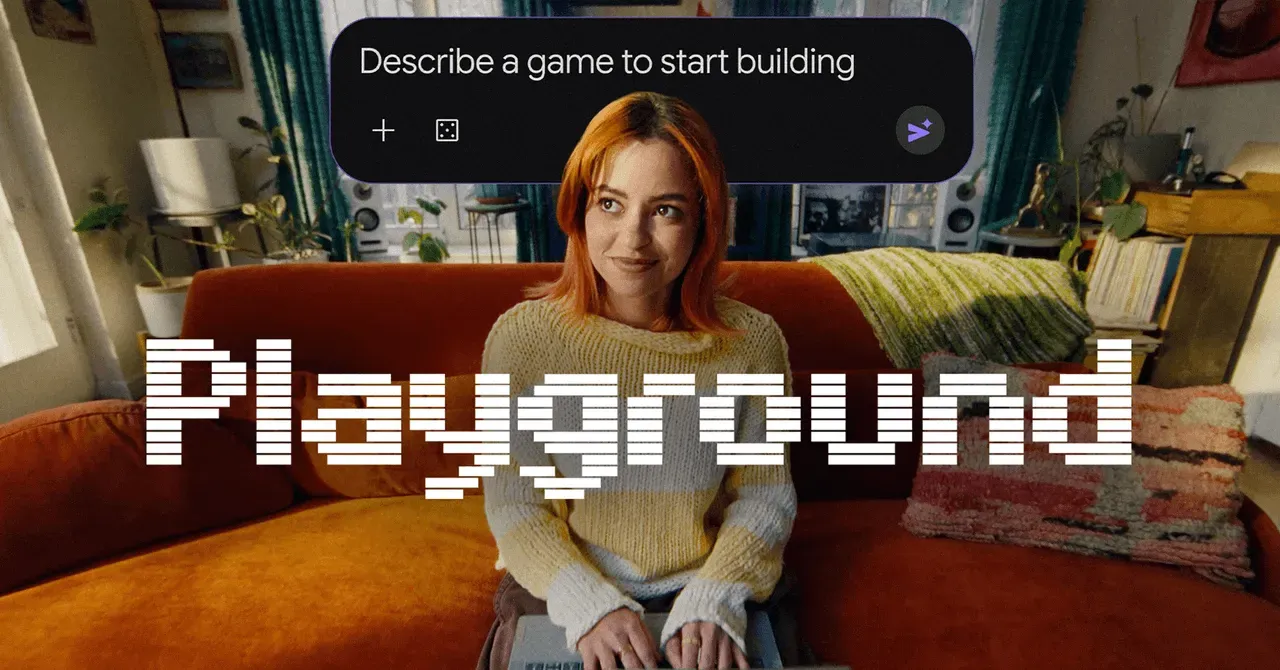
Google has launched an AI-powered tool called Playground that allows users to create simple games without requiring any prior programming knowledge. This experiment is part of Google Labs, a platform showcasing the company's various AI projects that have yet to be integrated into official services or apps.
Playground functions similarly to Meta's Horizon Create service, which was announced in September. It enables users to describe their desired game using plain language, and then generates an in-browser version of the game based on these inputs. Users can further fine-tune the design by adding additional instructions or uploading assets such as photos, videos, or 3D models for reference.
The AI-generated visuals and designs make Playground accessible to those without extensive coding skills or experience in video game development. The process is conversational and highly responsive, allowing users to create games quickly and easily. This feature makes it suitable even for individuals with little knowledge of programming or game development.
In just one day, three playable and stable games were created using Google's AI Playground feature, despite their questionable quality.
The process was straightforward: simply inputting ideas and clicking "Build led to the generation of a farm-themed version of Tetris with pig faces on every block.
To refine this vision, further instructions were given to the AI, specifying that each block should be shaped like a distorted pig.
The dinner party scenario unfolded in a chaotic manner, with guests unable to sit comfortably at the table. Timers ticked away as I struggled to prepare artisanal bruschettas and espresso martinis under intense pressure.
My attempts to provide for my fussy guests were thwarted by difficulties with the controls, resulting in a game-over screen that read PARTY CATASTROPHE. This was a stark reminder of the challenges faced during gameplay.
The lack of attention to dietary options was also pointed out by colleagues, who noted that there was no provision for vegan or dairy-free choices. This oversight seemed particularly glaring given the emphasis on culinary expertise in the game.
Reactions to my failed dinner party were mixed, with some observers expressing amusement at my misfortune while others criticized the game's lack of realism.
The game I created with Google's AI Playground, titled Neon Don, is a top-down, arcade-like shooter with a pulsing synth wave background music. Initially, it was inspired by the rhythm game Beat Saber but evolved into something more similar to Hotline Miami after I provided further instructions to the AI.
I experimented with pushing the content boundaries of what Playground would allow, adding features and systems such as level scaling, boss generation, and improved enemy variety. The AI initially had some minor issues that I addressed by dictating specific changes, including resolving mobility problems like player entrapment.
The game's development process was iterative, with me providing feedback to the AI and it adapting to my suggestions. The result is a unique blend of gameplay elements, showcasing both the capabilities and limitations of Playground's creative capabilities.
The limitations of Google's AI Playground were further highlighted when I attempted to add a Backflip button to my game Neon Don. However, the AI renamed it to Doge flip," a change that was frustrating but not unexpected given the service's usage constraints.
As users of Playground are aware, there is a limit to how many games and iterations you can create before your allowance runs out. Once this threshold is reached, new creations come at a cost, which can be prohibitive for those looking to experiment or refine their ideas without incurring additional expenses.
Despite these limitations, I found that working with Playground did spark an interest in the game development process. The experience of creating and iterating on games using AI tools has piqued my curiosity about what it takes to craft engaging and polished video games.
Using Google's AI Playground has been an experience that oscillates between entertainment and frustration. On one hand, the platform is relatively user-friendly and allows for immediate feedback in real-time, which can be engaging. However, this is where the excitement often ends.
A closer look at the games created with AI Playground reveals a sense of uniformity - menus, music, combat options, and style choices start to feel eerily similar across different genres, indicating that the AI's creative scope might be limited. Ultimately, while it may spark some interest initially, the platform's potential is undercut by its inability to produce truly unique or polished games.
Facts based on reporting originally published by Wired.
You may republish this story, in full or in part, if you credit News Central Site and link to it (licence CC BY 4.0). Photos are not included.