Global demand for fish meal reaches unprecedented levels
A recent book sheds light on how the fishing industry prioritizes profit over people's needs.
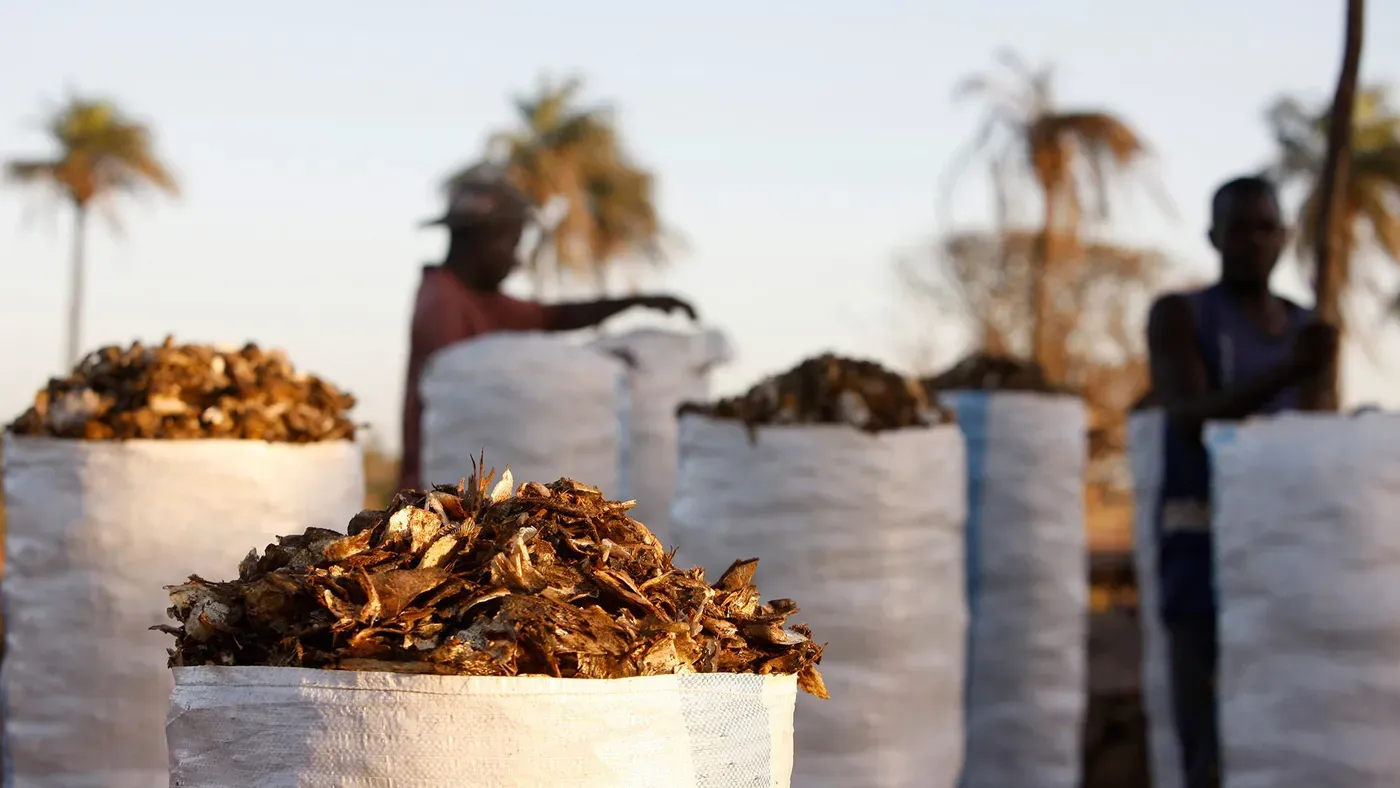
The global demand for fish meal has reached unprecedented levels, leading to a shocking reality where it takes priority over feeding people. Fish meal is a high-protein product created from raw fish and their byproducts, including heads and bones. It is predominantly made from smaller fish species such as anchovies, sardines, and herring, which are cooked, dried, and ground into a powder.
This commercial product is used to feed livestock, farmed fish, and pets worldwide. However, the market for fish meal is complex and influenced by various factors. The fact that vast quantities of staple fish from West Africa are being taken from the sea and turned into fishmeal for farming in Europe and China raises serious concerns about food security.
A recent book, "Every Last Fish: A Deep Dive into the World of Fishes and Fishing", sheds light on this issue. Journalist Rose George explores how the fishing industry prioritizes profit over people's needs. Her research highlights the alarming rate at which fish are being harvested and processed for non-food purposes.
Fish meal is not the only product derived from fish. The industry produces a range of byproducts, including guanine, an ingredient found in personal care items such as bath foam, perfume, and nail products. Fish scales are also used to create gelatine, glue, and squalene, while their air bladders are turned into isinglass, which is used in wine-making.
The use of fish-derived ingredients in various industries has become widespread. They can be found in dietary supplements, glass of wine, and even skincare products. This trend raises questions about the true value of fish as a food source versus its commercial potential.
As the demand for fish meal continues to rise, it is essential to examine the impact on global food security. The fact that smaller fish species are being used to feed livestock and pets while people in Africa go hungry highlights the need for a more sustainable fishing industry.
The lucrative fish by-products industry has become a significant player in the global market, with products like fishmeal being highly sought after. This powder, made from dried and ground fish tissue, is used as feed for various animals, including minks, pigs, cattle, and even fishes themselves. It also finds its way into fertilizers and pet food, making it a versatile product with a wide range of applications.
The industry has undergone rebranding, shifting from the term FMFO (fishmeal and fish oil) to 'marine ingredients', a more vague label that encompasses various fish-derived products. These by-products are often overlooked, yet they form a substantial part of the global market, worth billions of dollars.
According to the Food and Agriculture Organization, fishmeal is defined as the clean, ground, dried tissue of undecomposed whole fish or fish cuttings, without oil extraction. This definition highlights the importance of proper handling and processing in maintaining the quality of the final product.
In addition to fishmeal, other fish by-products are also used as animal feed. These include fish liver and glandular meal, made from dried complete fish viscera; general fish by-products, comprising non-rendered portions of fish such as heads, fins, tails, skin, bone, and viscera; and condensed fish protein digest, produced through the enzymatic digestion of clean undecomposed whole fish or fish cuttings.
The term 'undecomposed' is particularly interesting in this context. Given that most artisanal fishing vessels lack freezer capacity, fish will inevitably decompose within days. This raises questions about the actual sustainability of the fishmeal industry.
In theory, fishmeal should be a product made from parts of fishes that would otherwise be discarded, making it an exemplary example of reduction fisheries. However, the reality is more complex, and the industry's priorities often lie elsewhere.
The fishmeal industry's priorities are starkly at odds with feeding people in need.
In West Africa, it's common for wild fish to be caught and sent to Europe for use as animal feed, rather than being consumed by local populations.
This is despite the fact that a significant portion of these fish could feed millions of Africans. In fact, half a million tonnes of wild fish are caught annually in African waters, which is enough to sustain 33 million people - a number greater than the combined population of Senegal, Mauritania, and The Gambia.
The global picture is equally concerning, with nearly one-fifth of all wild-caught fish being converted into fishmeal or fish oil. Moreover, it's estimated that up to 90% of these fish are suitable for human consumption.
Europe and China are among the largest consumers of fishmeal and fish oil, with the latter accounting for nearly half of global demand. Spain imports significant quantities of fish oil from West Africa, particularly Senegal, while France takes a large share of Mauritania's exports.
The Changing Markets Foundation has investigated the fishmeal industry in several countries, including India, Vietnam, and The Gambia. In each case, they found that foreign factories would first arrive, then take control of local fisheries, pollute the environment, and eventually deplete the fish stocks - all while leaving behind a trail of social and environmental devastation.
Many European retailers have been linked to supply chains that use West African fish for fishmeal or oil production. These companies include Sainsbury's, ALDI, Lidl, and Marks & Spencer in the UK; Auchan, Groupe Casino, Monoprix, and Système U in France; all German ALDIs; and Mercadona in Spain.
While some of these retailers have denied using West African fishmeal or oil in their seafood products, it's unclear how they would be able to verify this claim. The lack of transparency in the supply chain is a major concern for consumer advocacy groups.
The scale of the problem becomes even more apparent when considering that China alone accounts for nearly half of global fishmeal and oil production. Europe also plays a significant role, with many countries importing large quantities of these products.
Sainsbury's, Marks & Spencer, and Mercadona have issued statements denying any involvement in using West African fishmeal or oil in their seafood products. However, the question remains as to how they can guarantee this is indeed the case.
The Changing Markets Foundation has highlighted a surprising lack of transparency regarding the origin and supply chain of farmed seafood products. This makes it difficult for consumers to make informed choices about the sustainability of their food purchases.
In 2019, the foundation produced an investigative report detailing the fishmeal industry in India, Vietnam, and The Gambia. In each country, they found a similar pattern: foreign factories would arrive, take control of local fisheries, pollute the environment, and eventually deplete the fish stocks.
This has significant implications for both human health and the environment. The use of wild-caught fish for animal feed is not only wasteful but also contributes to overfishing and pollution in vulnerable ecosystems.
The European Union's regulations aimed at combating Illegal, Unreported and Unregulated fishing do not cover fishmeal production. This means that the origin of the fish used in these factories is not being tracked or verified. Some Chinese-owned fishmeal factories in Mauritania have their own trawler fleets, allowing them to bypass traditional market channels and sell their catch directly to factories.
Fish processors in West Africa are facing a difficult situation as they struggle to compete with the prices offered by fishmeal factories for certain species like sardinella. Unlike Chinese fishing companies, which receive government subsidies, local fish processors do not have access to similar financial support. This makes it challenging for them to match the prices offered by the factories.
One striking example of the scale of this issue is in The Gambia, where one fishmeal factory accounted for 40% of the country's entire fish catch in a single year. This has raised concerns about the sustainability of local fishing practices and the impact on food security for local communities. The situation highlights the tension between economic interests and human needs.
In Senegal and other West African countries, local fishermen are being drawn into the fishmeal industry because it offers better prices than traditional market channels. However, this is contributing to overfishing and the depletion of smaller fish stocks. Experts warn that this unsustainable practice will have long-term consequences for the region's food security and marine ecosystems.
The International Fishmeal and Fish Oil Organization (IFFO) claims that marine ingredients play a crucial role in global food security. However, critics argue that this is not entirely accurate. They point out that many of these products are used to feed high-value species like prawns and salmon, which are considered luxury foods rather than essential sources of nutrition.
Francisco Marí, an expert from Bread for the World, has challenged the IFFO's claims at a recent workshop on artisanal fisheries in Africa. He argued that the use of fishmeal is not necessary to feed populations in developed countries like the US or Japan, and that it is being used to support a luxury food industry rather than address hunger and malnutrition.
The issue at hand is not just about the sustainability of fishing practices, but also about the distribution of resources and the impact on local communities. As Francisco Marí put it, "We are taking your fish to feed a luxury product that we don't need." This highlights the need for a more equitable approach to managing global fisheries and ensuring that food security is prioritized over economic interests.
The fishing industry's reliance on fish meal has far-reaching consequences, often prioritizing commercial interests over food security for communities that depend on these resources. This is particularly evident in regions where artisanal fisheries are struggling to compete with the high prices offered by industrial-scale fish factories.
In many parts of the world, small-scale fishermen are finding it increasingly difficult to make a living from their catch due to the dominance of large-scale fishing operations and the subsequent demand for low-cost feedstock. As a result, these communities are often forced to sell their fish at very low prices or even abandon their traditional livelihoods altogether.
The global seafood market is characterized by its complexity and opacity, with numerous intermediaries controlling various aspects of the supply chain. This makes it challenging for consumers to understand the true costs and environmental impacts associated with their food choices, allowing unsustainable practices to persist unchecked.
Furthermore, the lack of effective regulation and enforcement mechanisms enables the continuation of destructive fishing practices and allows unscrupulous operators to exploit vulnerable communities and ecosystems. The consequences of this are multifaceted, affecting not only the environment but also human well-being and economic stability in regions heavily reliant on fisheries.
Ultimately, the unsustainable nature of global fish production highlights the need for a more equitable approach to managing marine resources, one that balances commercial interests with social and environmental responsibilities.
Facts based on reporting originally published by Live Science.
You may republish this story, in full or in part, if you credit News Central Site and link to it (licence CC BY 4.0). Photos are not included.