FRB 20240304B detected as most distant fast radio burst ever recorded
Astronomers have pinpointed the source of a powerful flash of radio waves that traveled over 10 billion years across space before reaching Earth, providing a unique window into the early universe.
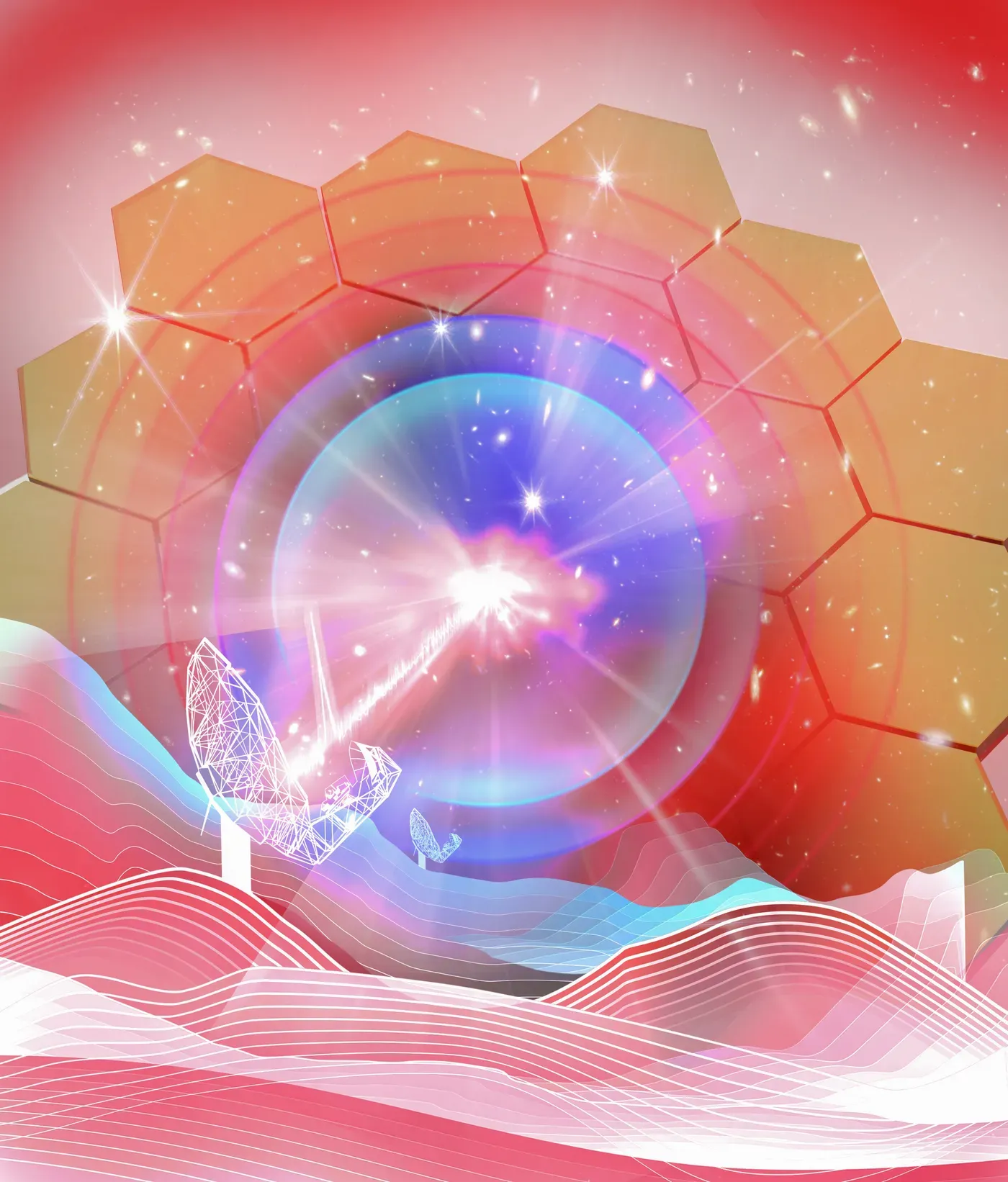
Astronomers have made a groundbreaking discovery in the field of astrophysics by pinpointing the most distant fast radio burst ever detected. The powerful flash of radio waves, designated FRB 20240304B, traveled for over 10 billion years across the vast expanse of space before reaching Earth.
Fast radio bursts are enigmatic events that have been puzzling astronomers for some time. They release an enormous amount of energy in a brief period, lasting only milliseconds, but their origins remain shrouded in mystery. Despite this, researchers continue to study these phenomena to gain a deeper understanding of the universe.
The detection and tracing of FRB 20240304B was made possible by the MeerTRAP project, which utilized South Africa's MeerKAT radio telescope. The team led by Dr. Manisha Caleb and Dr. Themiya Nanayakkara at the University of Sydney identified the host galaxy of the burst using observations from NASA's James Webb Space Telescope.
The discovery has significant implications for our understanding of the universe, particularly in its early stages. The burst originated when the universe was only about 3 billion years old, more than doubling the previous distance record and providing a unique opportunity to study the evolution of galaxies and the matter that fills the space between them.
The team's findings offer a unique window into the distant universe, allowing them to study the evolution of galaxies and the matter that fills them.
Using a combination of sensitive radio observations and powerful infrared imaging, the researchers were able to detect the burst and identify its host galaxy.
The galaxy turned out to be an unexpected source, defying preconceived notions about the environments in which fast radio bursts (FRBs) originate.
Characterized as small, metal-poor, and undergoing intense star formation, the galaxy provides valuable insights into the birthplaces of FRBs.
This discovery is significant because it suggests that at least some FRBs may be born from young magnetars, highly magnetized neutron stars formed when massive stars explode in supernovas.
The detection of an FRB from a record-breaking distance has significant implications for our understanding of these enigmatic events and their role in studying the universe.
Astronomers have long recognized that fast radio bursts could potentially be used to probe the early universe if they are powerful enough, allowing researchers to study regions that would otherwise remain invisible. This concept is now being put to the test with the discovery of an FRB from an unprecedented distance.
The use of the James Webb Space Telescope proved crucial in pinpointing the host galaxy and measuring its distance, a task that was beyond the capabilities of even the largest ground-based telescopes. The unique capabilities of the Webb telescope enabled researchers to make this groundbreaking detection.
As the radio signal traveled across most of cosmic history, it interacted with vast reservoirs of gas and matter between galaxies, carrying valuable information about these structures. This interaction allowed researchers to study regions that would otherwise be difficult to observe directly, providing new insights into the nature of the universe.
The discovery highlights the potential for FRBs to serve as cosmic beacons, illuminating previously inaccessible areas of space and time. Researchers are now eager to push the boundaries further, exploring how close they can get to the first generations of stars in the early universe.
A team of researchers has successfully pinpointed the most distant fast radio burst ever detected, surpassing a record set by astronomers just last year.
The newly discovered fast radio burst, FRB 20240304B, is located at an immense distance, having originated nearly three billion years after the Big Bang. This remarkable find allows scientists to peer further into the universe's history and gain valuable insights into its evolution.
The discovery of this distant event marks a significant milestone in the field of astrophysics, providing researchers with new opportunities to study the early universe and its formation.
Facts based on reporting originally published by Phys.org.
You may republish this story, in full or in part, if you credit News Central Site and link to it (licence CC BY 4.0). Photos are not included.