Galaxy Formation Simulations Reveal Milky Way's Ancient History
New supercomputer models recreate the early universe and show how thousands of small galaxies merged into our galaxy over billions of years.
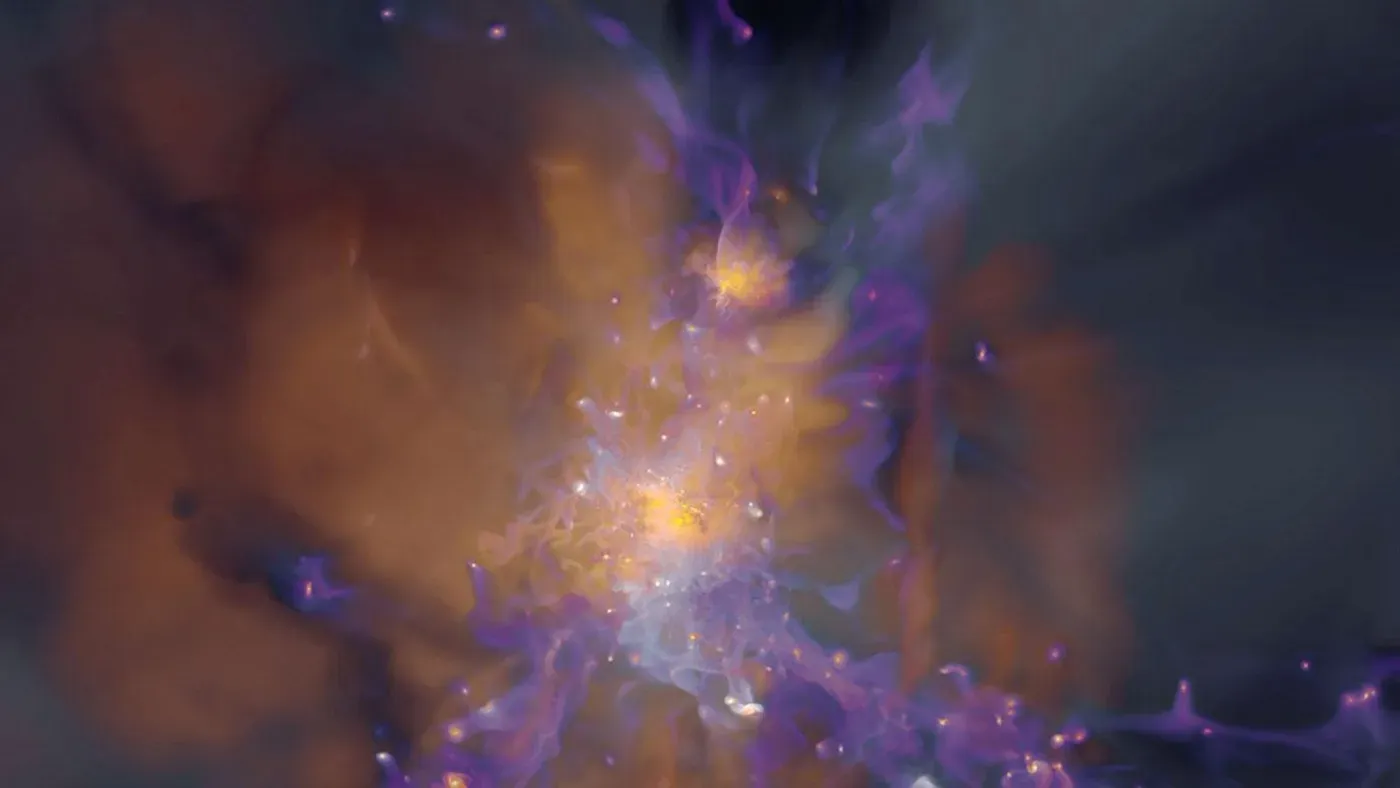
The Milky Way, our home galaxy, has undergone a dramatic transformation over billions of years. According to new simulations, it was once a vast collection of thousands of smaller galaxies that eventually merged into the single spiral shape we see today.
Researchers have been using supercomputer models to recreate the early universe and understand how galaxies evolved over time. These simulations suggest that in the first 2 billion years after the Big Bang, the region that would become our galaxy was comprised of numerous small galaxies with varying sizes and shapes.
The process of galaxy formation is complex and has been influenced by the laws of nature since the beginning of the universe. As these smaller galaxies collided and merged, they eventually formed a single, cohesive galaxy - the Milky Way as we know it today.
Astronomers are eager to gain more insights into the early universe, and this new research provides valuable information on how galaxies like ours came to be. The findings also highlight the importance of understanding the physics that governed the formation of our cosmic neighborhood.
The study's lead researchers have been working tirelessly for three years to develop these simulations, which are some of the most detailed yet attempted. Their work has shed new light on the history of galaxy formation and will likely inform future research into the early universe.
The James Webb Space Telescope has made several groundbreaking discoveries that have challenged current computer models of the early universe. One such discovery is the presence of surprisingly bright galaxies in the distant past, which contradicts previous predictions. These findings suggest that our understanding of galaxy formation and evolution needs to be revised.
To address this gap in knowledge, a team of scientists developed a new suite of supercomputer simulations called Megatron. This sophisticated tool allows researchers to model the behavior of ancient gas, starlight, and chemistry from 180 million years after the Big Bang to 2 billion years later. By doing so, Megatron produces virtual galaxies with distinct light signatures that can be compared directly with real observations made by JWST.
The simulation's predictions are particularly relevant because they cover a similar span of cosmic time as JWST's observations. This allows scientists to cross-reference the simulated data with actual spectral data collected by the telescope, pinpointing areas where current models fall short. By bridging this gap, researchers can gain a more accurate understanding of galaxy formation and evolution.
Megatron also sheds light on the formation and death of the universe's first stars. These ancient stars played a crucial role in forging the essential elements necessary for life as we know it. By comparing simulation results with JWST observations of early galaxies and chemical traces left in ancient stars, scientists can better comprehend how those first stars enriched their surroundings.
The team's work has significant implications for our understanding of the early universe and galaxy formation. By refining current models, researchers can gain a deeper insight into the complex processes that shaped the cosmos in its earliest stages.
The latest simulations from the Megatron collaboration offer a detailed look at the early universe, allowing researchers to test competing models of the first stars in ways that were previously impossible.
These simulations begin 180 million years after the Big Bang, when the universe is still devoid of stars and galaxies, but filled with pristine gas. As time passes, the model captures the emergence of the very first stars, which light up the dark universe and mark the start of "cosmic dawn." This period is characterized by the violent deaths of these early stars, which scatter newly forged heavy elements into the surrounding gas.
The simulation continues for 2 billion years after the Big Bang, but it doesn't capture the entire history of the Milky Way. The galaxy's mergers continued long after this point, and scientists are still discovering remnants of smaller galaxies that have merged with it. One notable example is the recent merger with the Sagittarius dwarf galaxy.
This massive collision began over 6 billion years ago and is still unfolding, illustrating the ongoing evolution of the Milky Way. The simulation provides a unique insight into the complex processes shaping the cosmos in its earliest stages, allowing researchers to refine their current models.
By refining these models, scientists can gain a deeper understanding of how the universe evolved from a gas-filled expanse to the diverse array of galaxies and stars we see today.
The simulation results are helping scientists refine their understanding of how certain physics parameters impact the early universe.
Researchers are also using these simulations to better match up observations from the James Webb Space Telescope (JWST) with computer models of galaxy formation and evolution.
However, the simulations have highlighted areas where current knowledge is incomplete or inaccurate. This has sparked a new wave of curiosity among scientists about what they may be missing in their understanding of the universe's early days.
In response to these findings, researchers are now developing more advanced simulations that will include complex physics phenomena such as active black holes, which JWST has revealed to be surprisingly common in the early universe.
New simulations of galaxy formation have revealed a surprising truth about the Milky Way's past: it was once composed of thousands of smaller galaxies that merged over billions of years. These simulations used advanced computer modeling to recreate the evolution of the universe and the assembly of our galaxy.
The findings suggest that the Milky Way is not unique in its complex structure, with many other galaxies likely having similar histories. This new understanding of galaxy formation will help researchers better comprehend the dynamics of the cosmos and the role of mergers in shaping the modern galaxy landscape. The study's results have far-reaching implications for our understanding of the universe's evolution.
Facts based on reporting originally published by Live Science.
You may republish this story, in full or in part, if you credit News Central Site and link to it (licence CC BY 4.0). Photos are not included.