Ethiopia Demands Withdrawal of Eritrean Troops from Northern State
Tensions between Ethiopia and Eritrea have escalated rapidly in recent weeks, with both countries engaging in war rhetoric.
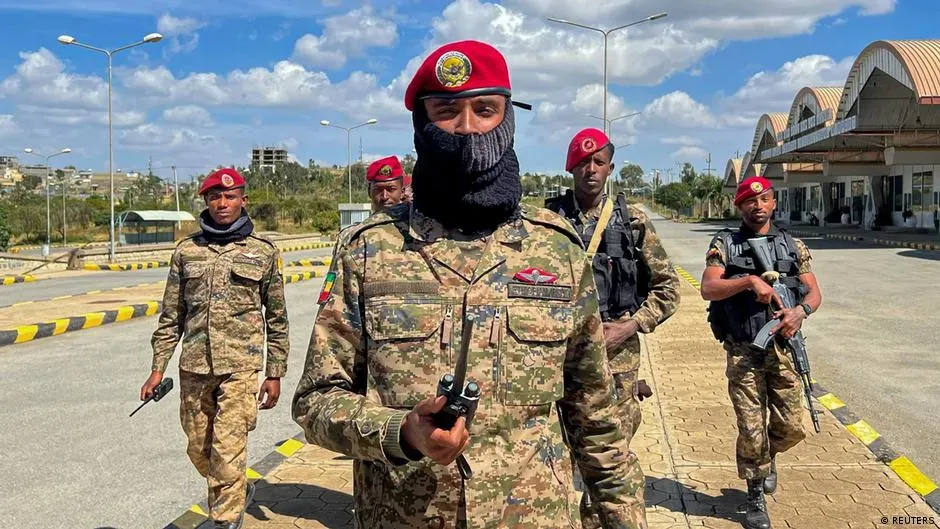
Reports are emerging of a significant presence of Eritrean armed forces in Ethiopia's northernmost state, Tigray. According to sources, an estimated 5,000 to 8,000 Eritrean soldiers are stationed in the region.
Tensions between Ethiopia and Eritrea have been escalating rapidly, with both countries engaging in war rhetoric. The Ethiopian government has taken a firm stance, calling on the United Nations Security Council to demand that Eritrean troops withdraw immediately from its territory.
In a letter dated October 8, Ethiopian Foreign Minister Gedion Timothewos warned of dire consequences if the Eritrean presence continued, stating that Ethiopia had "no option but to defend itself against Eritrea." This ultimatum comes after weeks of deteriorating regional conflict in Tigray.
Eritrea has responded defiantly, with its Minister of Information Yemane Meskel accusing Ethiopia of "incessantly beating the drums of war" on social media platform X. In a post written in Tigrinya, he emphasized Eritrea's sovereignty and warned that any attempt to harm it would be met with severe consequences.
The recent swearing-in of Ethiopian Prime Minister Abiy Ahmed for another five-year term has reignited speculation about his intentions regarding Eritrea's strategic port of Assab. In a statement that has sparked fresh debate, Ahmed emphasized the importance of access to the sea, fueling concerns that he may be planning to take control of the port by force.
The Ethiopian National Defence Forces (ENDF), supported by the Tigray Peace Force militia, have made significant gains in recent months, including the recapture of Mekelle, the capital of the Tigray federal state. However, opposition to Ethiopia's government has found new ways to coordinate efforts across different regions and communities.
One such example is the Tsimdo movement, which emerged from cross-border peace initiatives between activists, religious figures, and local communities in border villages between Tigray and Eritrea in 2025. According to Dr. Jalale Getachew Birru, a senior East Africa analyst with ACLED, the concept of Tsimdo initially focused on grassroots peacebuilding efforts before evolving into a more complex movement.
The Tsimdo movement now encompasses diverse groups within Ethiopia, often defined by ethnic identity and historical grievances against the federal government. As tensions between Ethiopia and Eritrea continue to escalate, concerns are growing about the potential for regional conflict.
The emergence of the Ethiopian Peoples' Forces Alliance for Survival has raised concerns about the potential for further conflict in the region. The alliance, which was proclaimed in September, is a coalition of seven groups seeking to remove the current government and initiate a constitutional dialogue.
Analysts believe that the formation of this new alliance highlights the long-standing issues of unresolved conflict in Ethiopia. Abdurahman Sayed, an expert at the Horn of Africa Centre for Regional Integration, notes that the fighting within Ethiopia has been ongoing for decades.
The Oromo Liberation Army has been involved in conflict for years, while the Amhara region has seen tensions rise over the past three years. The Tigrayans had previously agreed to a ceasefire with the Pretoria agreement, but this failed to address the underlying causes of the conflict and led to renewed fighting.
According to data from ACLED, only three groups within the alliance have been actively involved in recent fighting: the Tigrayan Defence Forces, the Amhara Fano National Movement, and a relatively new ethnic Afar group called Ugugumo.
The Alliance for Survival is heavily reliant on external support to achieve its objectives, according to data from ACLED.
External actors that could potentially back the alliance include neighboring countries such as Sudan, Egypt, Eritrea, and Somalia, each with their own grievances against Prime Minister Abiy Ahmed's government.
Egypt has long-standing issues with Ethiopia over the administration of the Nile River, including concerns about existing dams and those planned for construction.
Sudan also has its own reasons to be dissatisfied with the Ethiopian government, particularly due to alleged support for the Rapid Support Forces militia that is engaged in conflict with the Sudanese army.
The joint declaration issued by the leaders of Sudan, Egypt, Eritrea, and Somalia on October 4 has raised concerns about a potential regional conflict. The document, which emphasizes international law, notably highlights the importance of respecting sovereignty, independence, and territorial integrity in the region.
The Red Sea's governance is also seen as an exclusive responsibility of its littoral states, according to the joint declaration. This collective stance seems to address the security fears expressed by neighboring countries regarding Ethiopia's actions.
Facts based on reporting originally published by DW English.
You may republish this story, in full or in part, if you credit News Central Site and link to it (licence CC BY 4.0). Photos are not included.