Édith Pagot discovered Nazi-run maternity home birth
A woman has found out that she was born in a Nazi-run maternity home during World War II.
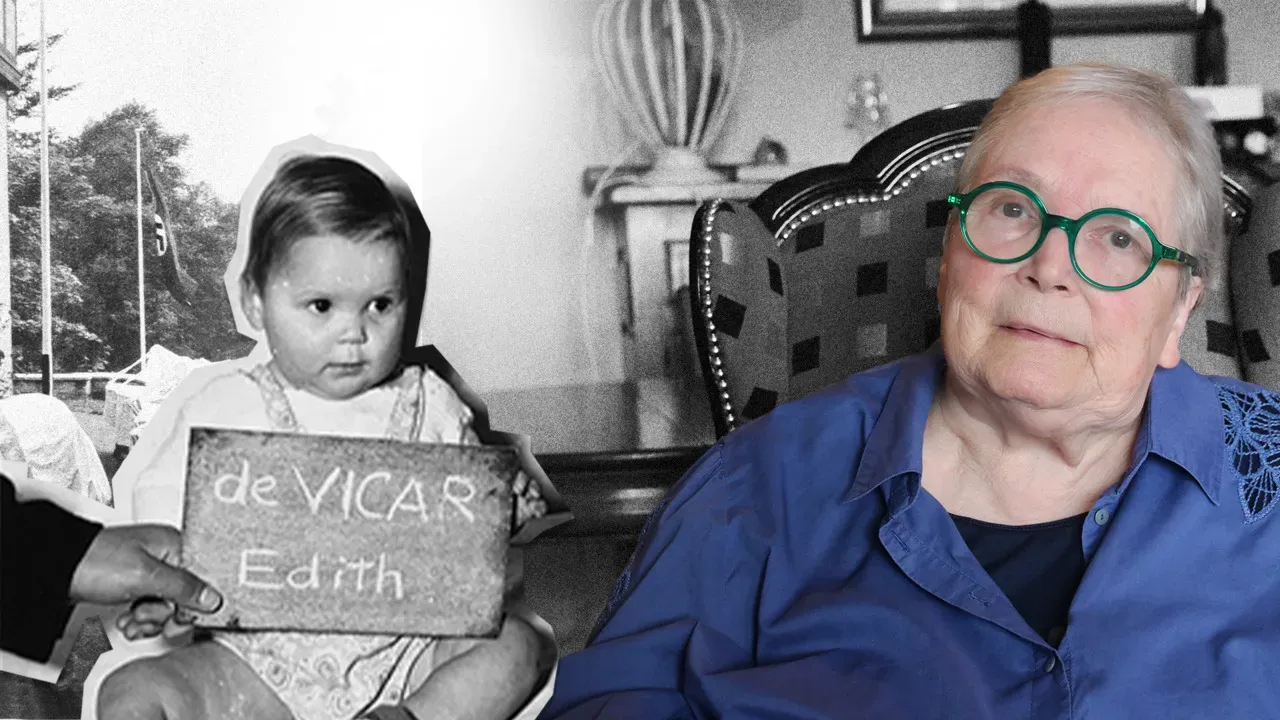
In a shocking revelation, Édith Pagot has discovered that she was born in a Nazi-run maternity home in eastern France during World War II. The disturbing truth emerged when her daughter began researching their family's past earlier this year.
Édith, who was adopted as a child, had never seen a picture of herself as a baby until recently. She now holds a black-and-white photo that shows an 18-month-old baby with the same name and surname as hers. The image has left her with mixed emotions.
According to Édith, the photo was taken at the Indersdorf orphanage in Germany in 1945. At the time, she was known as Édith de Vicar, a name given to her when she was born on April 11, 1944, in a Lebensborn home in France's Oise department.
The picture shows Édith holding a sign with her first and surname on it, which was taken by the orphanage staff. They had hoped to reunite the children with their families using these photographs. However, Édith has now expressed difficulty seeing the sign clearly in the old photo.
Édith's daughter initiated this research into their family history, leading to a series of unexpected discoveries about her mother's past. As they delve deeper, they are uncovering more about the Lebensborn program and its impact on families during World War II.
The Lebensborn homes were notorious for providing Nazi officials with children born out of wedlock or conceived through forced sterilization and rape. The children were then often taken from their mothers to be raised in orphanages or by German families, erasing their true identities and family connections.
The Lebensborn project's sinister purpose was to produce "perfect Aryan children as defined by Adolf Hitler's regime, which established it in 1935. This twisted endeavor aimed at creating a pure race, according to Heinrich Himmler, the mastermind behind these Nazi maternity facilities.
Édith's life has been marked by secrecy surrounding her origins. She was placed with a couple in France's northeastern Lorraine region in 1948 and knew nothing about her true past. Her adoptive parents told her she had been adopted but refused to provide any further information, leaving Édith with unanswered questions.
Years went by, and Édith built a life for herself as a healthcare manager and mother of two children. However, the mystery surrounding her birth remained unsolved, leading her to imagine a scenario where her mother abandoned her without necessarily connecting it to the war.
Émilie Ruffra, Édith's daughter, decided to investigate her mother's past after years of wondering about her origins. As someone who also works in healthcare, she obtained her mother's permission to conduct research and began looking for answers.
A book titled Le Fardeau (The Burden) by Matthieu Niango caught Émilie's attention. The author recounts his investigation into the past of his mother Gisèle, who was born in a Lebensborn home in Belgium. This led Émilie to discover her own mother's birth name, which she had previously only known as her adoptive name.
Émilie's discovery sparked a chain of events that would uncover the truth about her family's history and the role they played in the Nazi regime's twisted endeavor to create an Aryan elite.
Émilie's investigation into her family's past led her to discover striking similarities between her own mother's story and that of Matthieu, a man she had contacted in 2026.
The revelation sent shockwaves through Émilie's life as she struggled to come to terms with the news about her father's alleged involvement with the Nazi regime.
Speaking candidly about the experience, Émilie revealed the emotional turmoil she faced when confronting her mother with the discovery. It was difficult," she said, and it took me a little while to take it in and certainly to accept it.
Émilie's mother, Édith, had also been unaware of her father's Nazi connections until then. Her reaction was equally surprising: "I'd never imagined my father was a Nazi," she confessed.
Despite the initial shockwave, Émilie chose not to let the discovery deter her from uncovering more about her family's past. She continued digging for information, contacting various archives and institutions that might hold relevant records.
The trail led her to investigate the Lebensborn homes, where mothers with relationships with SS officers were subjected to close scrutiny of their racial origins. This included genealogy research and physical appearance assessments.
Émilie discovered that her mother was born in one such facility, Westwald, which was opened by the Nazis in February 1944 at a manor house in Lamorlaye commune near Chantilly, France.
The records from Westwald facility reveal a disturbing truth about Émilie's family past. Twenty-three children were born at this German-run "baby factory in France during World War II, but little is known about their mothers or fathers.
Émilie has been trying to uncover the truth about her mother's past, but it appears that all documents have been destroyed. The only clue Émilie has found is a surname de Vicar, which suggests that her mother was French, but nothing more.
A long journey awaited the children born at Westwald as they were taken to Germany in 1944, as the Allies advanced and the Germans sensed defeat. By April 1945, Édith had arrived at Steinhöring, Bavaria, one of the first Lebensborn homes established by the Nazis.
The photo of Édith was taken among other children her age in a refugee centre near Munich after the war ended. The footage captured a lively scene with kids squabbling over toys and treats, but it's unclear what they were fighting for.
Édith's journey continued as she was transferred to another facility in 1946. On August 5, she finally returned to France among about 10 other children who had been living in poor health at the Indersdorf refugee centre near Munich.
After their repatriation, the French state took steps to erase the children's past by giving them new first names and recording altered places of birth. Édith was now known as Georgette, but she has only a faint memory of that time - getting off a train is all she recalls.
The investigation has revealed a complex and painful past for Édith, but she remains determined to uncover more about her origins.
Months of research have been intense, leaving Édith shaken, yet also feeling freed from a long-held burden.
Her daughter's efforts have shed new light on Édith's early life, including a period spent with a foster family where she felt happy and content.
However, this brief respite was short-lived, as Édith was soon handed over to a childless couple who formally adopted her in 1951.
Édith has kept her original first name, which continues to cause issues when dealing with routine administrative tasks in France, particularly when renewing her identity card.
The bond between Édith and Émilie has grown stronger since they began sharing their experiences of being born in a German-run baby factory" during World War II.
Their lives have been intertwined in ways beyond just family ties, as they both recall the trauma and hardship endured in Commercy. They often speak on the phone about their past, having participated together in commemorations last October to mark the 80th anniversary of their return to France.
The process of sharing their story has not only brought them closer but also helped Édith come to terms with her past, as Émilie proudly notes that her mother's strength and determination continue to inspire her.
Facts based on reporting originally published by France 24 English.
You may republish this story, in full or in part, if you credit News Central Site and link to it (licence CC BY 4.0). Photos are not included.