Astronomers capture dying star using radio observations from ALMA
Astronomers have captured a dying star in the midst of transformation using radio observations from the Atacama Large Millimeter/submillimeter Array, offering insights into the process.
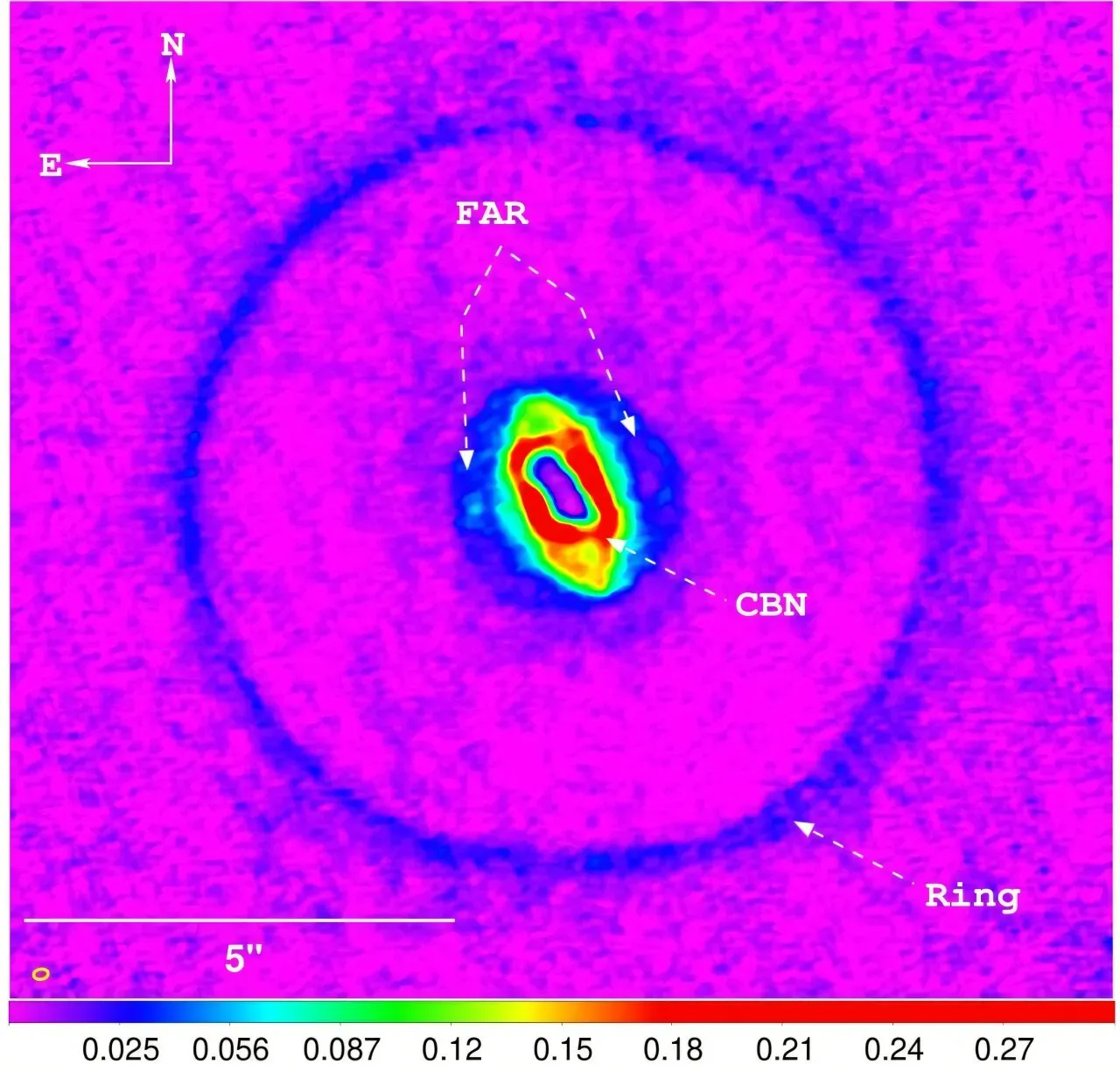
Astronomers have captured a dying star in the midst of a dramatic transformation using radio observations from the Atacama Large Millimeter/submillimeter Array (ALMA). The data reveal a ring that marks the star's final outburst, offering valuable insights into the process. This discovery is part of ongoing research published on the arXiv preprint server.
Most stars in our solar system's mass range die as planetary nebulae, leaving behind colorful remnants visible in deep space images. However, there is a puzzle surrounding this process: these slow-moving gas shells often appear non-spherical, taking various shapes such as bipolar or elliptical forms.
The prevailing theory suggests that the shaping of these gas shells occurs due to interaction with a binary companion star. The fast-moving jets launched by this interaction likely sculpt the slower wind from the inside out during the short preplanetary phase.
This process is thought to occur in the brief period leading up to the formation of a planetary nebula, and further research into this phenomenon could provide valuable information about stellar evolution.
Astronomers are working to improve simulations of a critical process in stellar evolution by gathering high-resolution data on specific objects. This effort is being undertaken through the PANORAMA survey, which utilizes the Atacama Large Millimeter/submillimeter Array (ALMA) telescope.
The study focuses on objects like IRAS 06530, a preplanetary nebula that has already been imaged by the Hubble Space Telescope and is expected to become a glowing planetary nebula. This particular object is of interest due to its carbon-rich composition and bipolar structure.
Researchers used ALMA to capture detailed observations of IRAS 06530, tracking the movement of various molecules such as carbon monoxide to determine their density, temperature, and mass. By analyzing the gas speeds, they were also able to infer the age of each structure and the rate at which the star was shedding material.
The team's analysis revealed a significant finding in terms of the star's brightness, with estimates suggesting that its original mass is between 1.6 and 3.4 times that of the sun. This information provides valuable insight into the star's evolution.
A striking feature observed in the high-resolution images obtained by ALMA is a large circular ring with a radius of approximately 16,950 times the Earth-sun distance. This ring is thought to be a remnant of the star's last brief flare-up near the end of its life, which caused a temporary decrease in mass-loss rate that was followed by an increase before the star entered its next phase.
A dying star is being closely observed by astronomers as it undergoes a significant transformation in its final stages of life. The star's center features two distinct components: one is a nebula with a doughnut-shaped torus that has formed within the last 700 years, displaying unusual carbon, oxygen, and nitrogen ratios.
The fainter component between the torus and a surrounding ring consists of curved arcs that contain most of the mass, significantly more than the central nebula or the ring. This structure bears resemblance to spiral patterns seen around certain red giant stars with binary companions, hinting at the presence of a hidden companion star about 155 to 340 times farther from Earth than our sun.
The formation of the central region is thought to be influenced by interaction between the star and its companion, resulting in fast, collimated jets that sculpt the wind from within. However, if this mechanism is responsible for creating nonspherical preplanetary nebulae, astronomers would typically expect to detect fast outflows in their spectra.
Astronomers have not found any signs of such fast-moving material with speeds above 16.5 km/s in IRAS 06530's spectrum, nor a compact dusty disk at the star's position.
The team of researchers is puzzled by their findings on IRAS 06530, a star in its final stages of life. Despite expectations that high speeds would be evident in the star's spectrum, none were detected beyond 16.5 km/s. This has led them to propose an alternative explanation for the brief jets observed.
The large separation between the two stars in this system makes it unlikely for strong interaction to occur, unless their orbits are significantly elongated. In such a scenario, the companion would need to come very close to the primary star before any significant effect is felt.
Estimates suggest that even at a distance of 75 times the Earth-sun distance, gas accretion onto the companion could still provide enough energy to power outflows from the system. Furthermore, this same companion may be responsible for creating the observed arcs if its orbit is indeed elongated.
The combination of the ring, arcs, and central nebula creates a complex system with a rich history that still holds many unanswered questions.
The ALMA telescope has captured a rare glimpse of a dying star as it transforms into a pre-planetary nebula. The observations reveal a complex system with a ring of gas and dust surrounding the central star. This ring is thought to be the remnants of the star's last outburst, which occurred just before its transformation.
The combination of the ring, arcs, and central nebula creates a dynamic and evolving environment that continues to shape our understanding of stellar evolution. Further study of this system may uncover new insights into the physics of pre-planetary nebulas and the final stages of a star's life cycle.
Facts based on reporting originally published by Phys.org.
You may republish this story, in full or in part, if you credit News Central Site and link to it (licence CC BY 4.0). Photos are not included.