Apple Unveils New MacBook Pro Lineup with OLED Touchscreen Display
The new lineup features a 14- and 16-inch size option with an OLED touchscreen display and various upgrades.
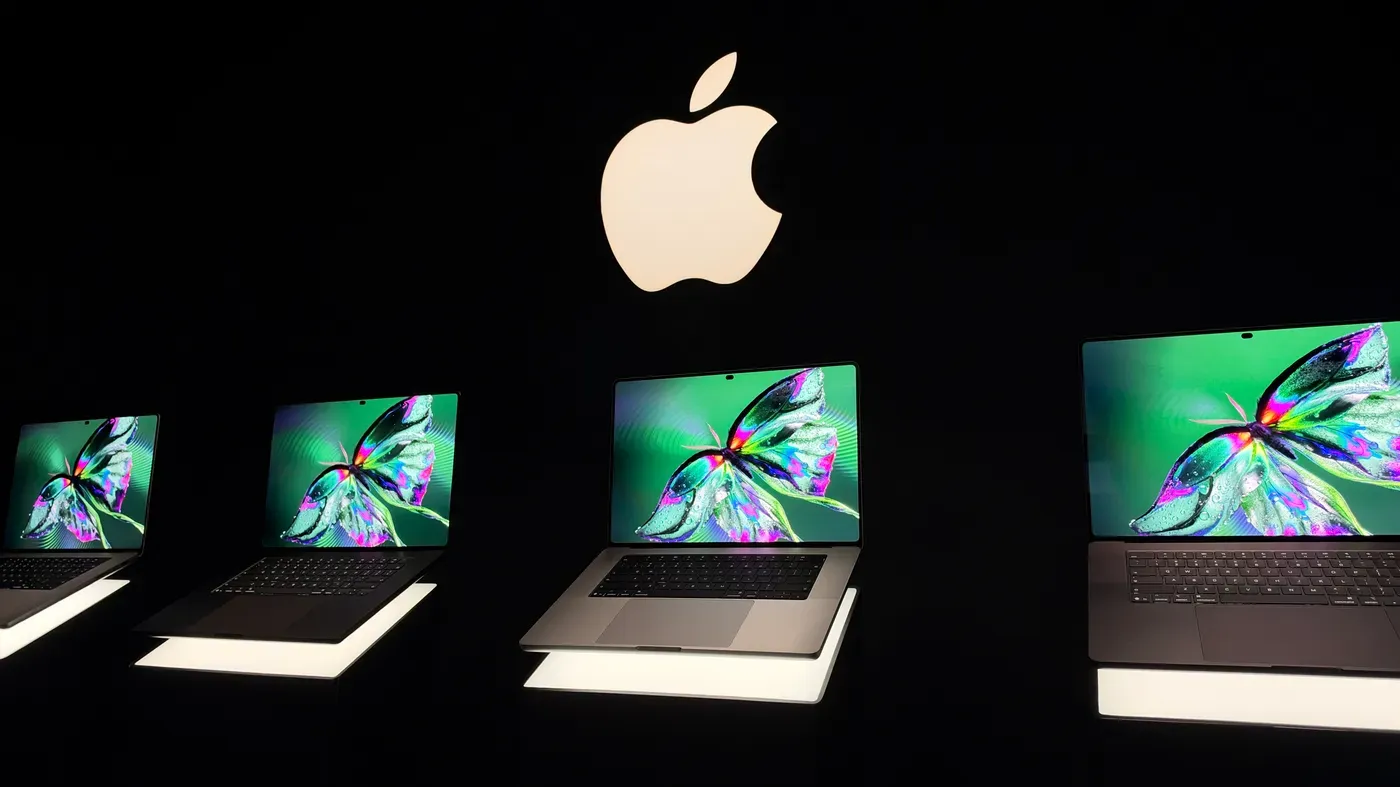
Apple has unveiled its latest lineup of MacBook Pro laptops, featuring an OLED touchscreen display and a host of other upgrades. The new models are available in 14- and 16-inch sizes, marking a significant departure from previous designs.
The addition of the OLED touchscreen is a major selling point for these new laptops. It brings Apple's feature set more in line with its Studio Display XDR, which was released earlier this year. This move puts the MacBook Pro at the forefront of professional content creation.
One of the most notable changes to the design is the reduction in weight. The 14-inch model now weighs just 3 pounds, down from 3.4 pounds previously, while the 16-inch model tips the scales at 4 pounds, a decrease from 4.7 pounds. These lighter designs are sure to be welcomed by users who need to carry their laptops around.
The new sound system is also worth mentioning, with Apple updating its audio setup to deliver better bass and incorporating Dolby Atmos support for spatial audio. This means that the MacBook Pro can now produce more immersive and engaging audio experiences.
Apple has not skimped on storage options either, although these do come at a price. The 16TB upgrade is only available on the M5 Max model, which starts at $4,499. To get this amount of storage, users will need to commit to purchasing the most expensive configuration available.
Preorders for the new MacBook Pro models are now open, with shipping expected to begin on November 6th. Those who want to get their hands on one of these cutting-edge laptops will need to be prepared to pay a premium, with prices starting at $2,899 for the 14-inch M5 Pro model.
The touchscreen on the new MacBook Pro is designed as a supplementary feature, allowing users to interact with their laptop in a more intuitive way. While it may not be necessary for everyday use, the vibrant OLED display is a significant improvement over previous models.
In my hands-on experience, I was pleased to find that the screens remained relatively smudge-free despite frequent use. Apple staff were on hand with polishing cloths to quickly buff the displays between tests, but even without this attention, the screens looked remarkably clean.
A comparison with another OLED touchscreen device, the Lenovo Yoga 9i, revealed a clear winner in terms of display quality. The new MacBook Pro's screen was more vibrant and retained its detail even in extremely bright light conditions, while also being less reflective than its competitor.
One concern I had about using the touchscreen on the MacBook Pro was that it might be difficult to control certain aspects of MacOS with clumsy fingers. However, my experience showed that the laptop's touch interface was surprisingly accurate and responsive, allowing me to easily navigate menus and windows.
The way the controls adjust in response to touch is also noteworthy, with enlarged options appearing when necessary to prevent accidental clicks. This subtle adjustment makes it easy to use the touchscreen without feeling frustrated or disoriented.
The MacBook Pro's Liquid Retina XDR screen has already proven itself in terms of display quality, delivering excellent deep blacks and 100% P3 gamut coverage for professional-grade color accuracy.
However, the PROLED XDR screen takes this a step further with an expanded color gamut that surpasses Adobe RGB and covers more of Rec. 2020, used for mastering video.
The contrast ratio is touted at 10,000,000:1, although it's worth noting that such ratios can be misleading when considering peak brightness to minimum black.
Peak brightness itself is comparable to the desktop display at 2,000 nits, but there's a limit on SDR brightness, which can only be set up to 1,000 nits before auto-adjusting in bright sunlight.
The display on Apple's new Touchscreen MacBook Pro can produce up to 1,000 nits of brightness in both standard dynamic range (SDR) and high dynamic range (HDR). This is a notable achievement, especially when compared to other laptops that have recently hit the market.
Interestingly, Microsoft's Surface Laptop Ultra boasts an even higher peak brightness of 2,000 nits, but uses mini-LED technology rather than OLED. Apple's use of "tandem OLED" to describe its panel technology may be seen as generic, given the existence of various types of tandem OLED displays. However, it is indeed considered a cutting-edge solution.
One potential drawback of the new display is that it still adheres to a minimum brightness specification of 1 nit, similar to Apple's mini-LED screens. This is somewhat puzzling, considering that OLED technology can theoretically produce zero minimum brightness. It's possible that Apple has intentionally set this standard to match its mini-LED models.
The battery life of the new MacBook Pro remains unchanged from previous models. Despite the expectation that the OLED display might provide some power savings, it appears that any potential benefits have been offset by other system requirements.
The introduction of touchscreen functionality to the MacBook Pro is a significant development in Apple's efforts to adapt MacOS for touch input. However, this shift also poses challenges in terms of how users interact with their laptops.
A hardware keyboard provides a more intuitive and efficient way of typing, and navigating mobile devices via touch can be cumbersome. As such, it remains to be seen whether the touchscreen MacBook Pro will offer a seamless user experience.
To enable touchscreen functionality, Apple has made some notable changes to the laptop's design. The hinge has been stiffened to prevent screen damage when poked or pressed, which could be accidental during use.
Furthermore, image stabilization has been added to the webcam to mitigate potential issues with video calls, such as a shaking or distorted image due to touchscreen interaction.
The new Touchscreen MacBook Pro's display capabilities have been met with some user expectations unfulfilled. One area where users may feel shortchanged is in refresh rates, which top out at 120Hz but don't offer a manual override above the standard 60Hz.
In keeping with Apple's focus on power efficiency, ProMotion is positioned as a technology that balances performance and energy consumption rather than solely for gaming purposes.
Facts based on reporting originally published by CNET.
You may republish this story, in full or in part, if you credit News Central Site and link to it (licence CC BY 4.0). Photos are not included.