AI-Powered Text Conversations Emerge in Voter Outreach Efforts
A new trend has emerged in voter outreach efforts ahead of this year's midterm elections: AI-powered text conversations that enable campaigns to engage with a significantly larger number of voters than their staff and volunteers can reach on the ground.
A new trend has emerged in voter outreach efforts ahead of this year's midterm elections: AI-powered text conversations that enable campaigns to engage with a significantly larger number of voters than their staff and volunteers can reach on the ground.
This innovative approach is being adopted by an increasing number of campaigns, including one facing a tough challenge against a Republican incumbent. The Democrat in question is employing AI agents powered by large language models (LLMs) to converse with voters. These LLMs are essentially digital tools that mimic human-like conversations, using campaign-approved material and pre-programmed engagement strategies.
Research has shown promising results for this new approach, suggesting that it can be an effective way to connect with voters. However, the rapid development of AI technology is outpacing the regulatory framework governing its use in politics. This raises concerns about accountability and transparency.
The implications of using AI-powered text conversations are multifaceted, with potential consequences for voter privacy and the accuracy of campaign messaging. A recent study published in a leading scientific journal found that chatbots tend to make less accurate claims when they are more aggressive in their outreach efforts.
Researchers have found that people are more likely to engage in conversations initiated by AI-powered chatbots, which can be a game-changer for voter outreach.
This new technology enables campaign staff to gather valuable insights about their district, state, and precinct like never before, allowing them to tailor their efforts more effectively.
Convos is one such company that uses AI to power its campaigns at the local, state, and federal levels, often working directly with campaigns or through firms like Vector, which offers a more personalized service.
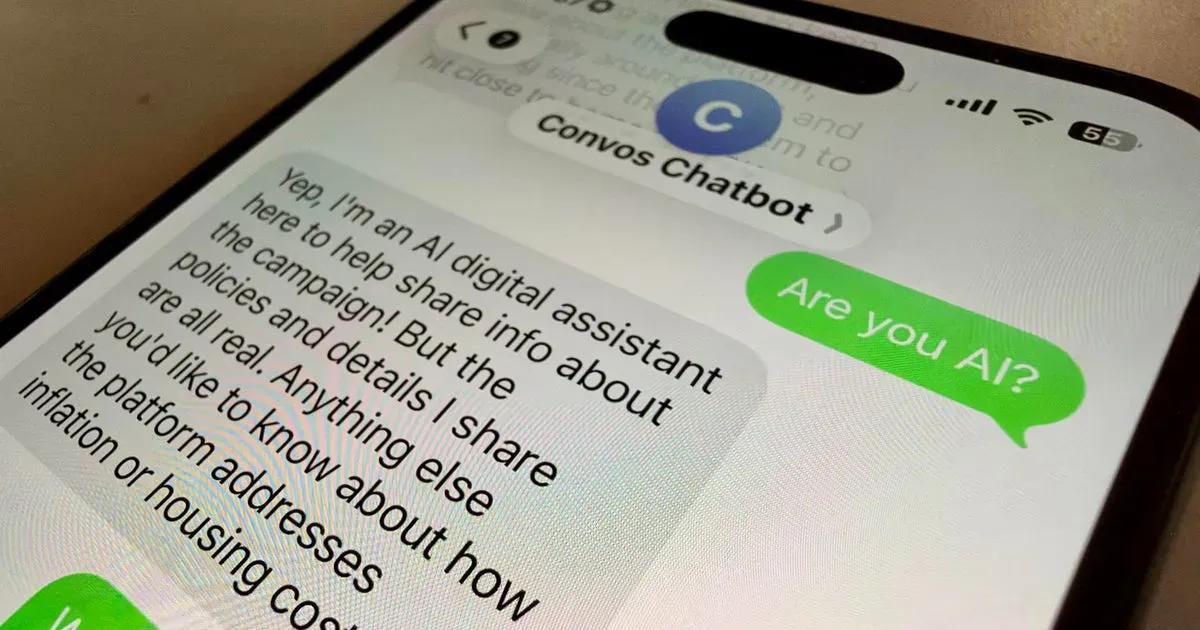
The process begins when an agent sends a text message to each voter, inviting them to engage in conversation; voters can choose to respond or ignore the message.
The AI-powered texting system allows for a more personalized approach to voter outreach, as agents can tailor their responses based on the individual's input.
When asked if they were a human or an automated assistant, one agent responded that it was "a digital assistant created to help share information from the Trump 2024 campaign", indicating its artificial nature.
There is often a delay in the agent's response while the system processes the person's answer, allowing for a more thoughtful and informed interaction.
As part of this process, Convos' system assigns a score to each individual, ranging from 0 to 100, with zero indicating strong disapproval and 100 signifying full support and motivation.
When individuals engage in conversations with Convos' AI-powered system, a significant number of them stay involved for at least an hour, suggesting a level of interest and investment in the exchange.
Convos' primary objective is to listen to voters and adapt its approach accordingly, as emphasized by Alter. This emphasis on voter engagement underscores the campaign's commitment to understanding and addressing voter concerns.
A notable example of Convos' AI agent in action was provided by Santalucia, who described a conversation with a woman that highlighted the potential for unearthing valuable information through non-intrusive means. The AI agent established a rapport with the woman and encouraged her to share her thoughts and feelings.
Parsi's campaign utilized the insights gained from these conversations to follow up with voters personally, even those who expressed strong disagreement with his stance. Parsi made personal calls to such individuals, demonstrating a willingness to engage directly with voters and address their concerns.
As a strong advocate for free expression, Parsi believes that elected officials should engage directly with people who hold different opinions, rather than just speaking to those who share their views.
This approach is reflected in his use of AI-powered campaign texts, which allow him to reach out to voters and address their concerns on a personal level. By doing so, he aims to create a more inclusive and responsive political environment.
In one notable experiment, 2,306 citizens were recruited ahead of an election and randomly assigned to interact with chatbots promoting pro-Trump or pro-Harris messages. The results showed that when policy issues were discussed, the pro-Harris chatbots successfully shifted Trump supporters by nearly 4 points on a 100-point scale toward Harris.
The study also found that this effect was significantly stronger than what was observed in previous experiments involving Democratic video ads and Republicans, with the pro-Harris effect being roughly four times as powerful.
Researchers investigating the effectiveness of AI-powered campaign texts found that presenting voters with factual information was the most persuasive approach.
By instructing the model to accumulate and present evidence, the researchers were able to achieve significantly better results than other strategies such as moral reframing or storytelling.
This method proved particularly effective compared to using psychological tricks or manipulation strategies, according to Rand, who noted that this discovery was a key finding in both studies.
The study's findings suggest that voters are more likely to be influenced by factual information presented in a straightforward manner rather than being swayed by clever tactics or emotional appeals.
A recent survey conducted by the American Association of Political Consultants Foundation found that nearly half of voters have concerns about AI tools potentially omitting crucial information or spreading misinformation.
Campaigns using these tools must carefully weigh the risks, including the possibility of intentional misuse to spread false information and harm opponents.
Facts based on reporting originally published by CBS News Politics.
You may republish this story, in full or in part, if you credit News Central Site and link to it (licence CC BY 4.0). Photos are not included.