A Novel Approach to Tissue Engineering Using Kirigami Techniques
Researchers at the University of Illinois Chicago's College of Engineering have developed a novel approach to creating complex shapes that mimic tissue forms found in the human body by applying principles from kirigami.
Researchers at the University of Illinois Chicago's College of Engineering have developed a novel approach to creating complex shapes that mimic tissue forms found in the human body by applying principles from kirigami, a paper-folding technique inspired by origami.
The team's innovative strategy involves using kirigami techniques to generate intricate patterns and curvatures that could be used for tissue engineering and wound healing. This technology has the potential to create artificial tissues with complex geometries, allowing for more effective treatment of damaged or diseased tissues.
Kirigami itself has been applied in a wide range of fields beyond the elementary school classroom, including deployable structures for spacecraft and semiconductors. The technique gives flat materials new stretchability and flexibility characteristics, enabling them to be reshaped without altering their composition.
The team's research was published in Cell Biomaterials under the title "A 4D Bio-Kirigami Strategy for Engineering Complex Tissue Curvatures", with Kaelyn L. Gasvoda and colleagues as authors.
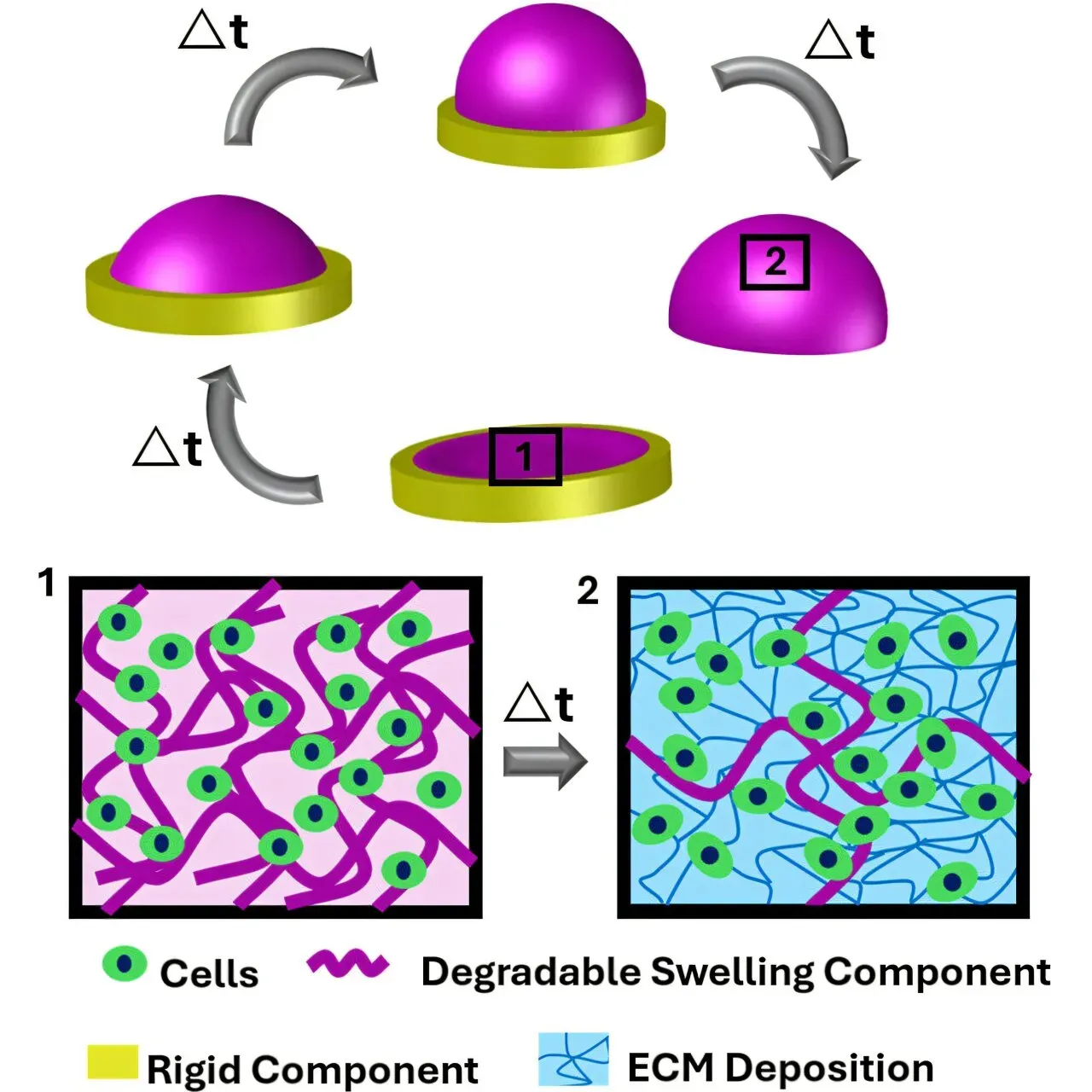
Researchers are pushing the boundaries of tissue engineering by exploring new methods to create complex shapes that mimic human tissues. In a laboratory focused on developing innovative strategies for repairing damaged or diseased tissues, researchers began fabricating constructs engineered to change their shapes over time.
These constructs can develop into tissue-like structures with precisely defined geometries without requiring additional manipulation from the researchers. The team achieved this through programmed shape transformations, allowing them to create intricate structures that mirror the complex architectures of human tissues.
The goal was to design structures where they could precisely guide how they form and transform, enabling the creation of more complex shapes with controlled self-patterning and bending. This approach is particularly relevant in tissue engineering, as human tissues have intricate three-dimensional shapes closely linked to their functions.
By recreating native structures and functions, researchers hope to develop more effective treatments for a range of conditions, including those related to cartilage, bone, tracheal, and vascular tissues. The focus on complex geometries is critical in this field, as it can lead to the development of new therapies and treatments that better mimic the body's natural tissues.
The challenge of replicating complex structures has hindered traditional tissue engineering approaches. These intricate features are crucial for mimicking the body's natural tissues and developing effective therapies. By exploring alternative methods, researchers sought to create constructs that could change their shapes over time.
A key aspect of this new approach was designing a structure with a rigid outer framework that would maintain its shape in the culture medium, while allowing the inner regions to absorb and expand without compromising cell viability. This delicate balance is essential for supporting long-term cell growth and differentiation.
To achieve this, the team employed a hydrogel-based platform consisting of gelatin and alginate derivatives. Using photolithography, they patterned light to create areas with varying crosslinking densities within the materials. This precise control enabled the researchers to manipulate how different parts of the constructs expanded and deformed over time.
The next step in this research involves evaluating the platform's performance in animal models. This will be a crucial test of its potential for clinical applications, where it could lead to breakthroughs in tissue engineering and wound healing.
The new 4D biofabrication technology has shown great promise for engineering tissues with complex three-dimensional architectures.
This is made possible by the use of kirigami-patterned, cytocompatible hydrogels that can autonomously bend, fold and transform into intricate shapes.
The potential applications of this technology are vast, particularly in tissue engineering where it could lead to breakthroughs in wound healing.
Facts based on reporting originally published by Phys.org.
You may republish this story, in full or in part, if you credit News Central Site and link to it (licence CC BY 4.0). Photos are not included.