Vincent van Gogh's "The Starry Night" Timeline Revised
A team of South Korean researchers has proposed a revised timeline for Vincent van Gogh's iconic painting "The Starry Night", suggesting that it may have been inspired by actual celestial events observed by the artist.
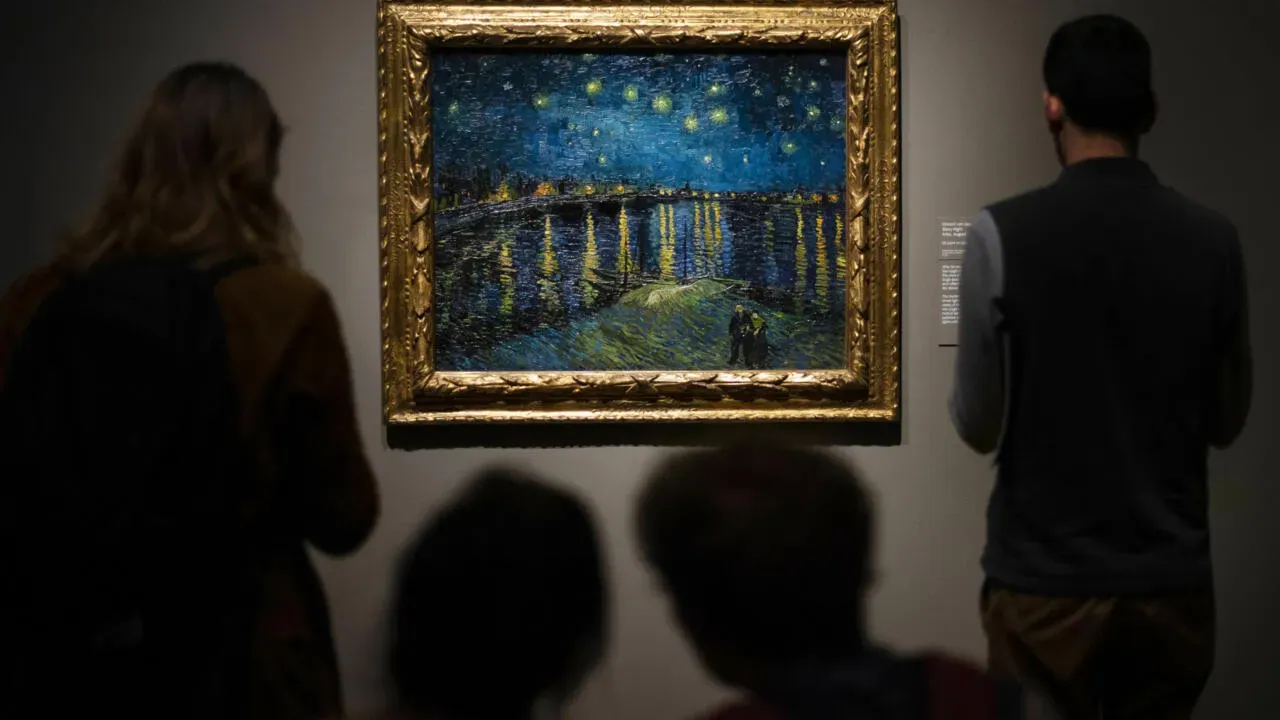
A team of South Korean researchers has proposed a revised timeline for Vincent van Gogh's iconic painting "The Starry Night. The findings suggest that rather than being purely imaginative, the artwork may have been inspired by actual celestial events observed by the artist.
Art historians have traditionally believed that the stars in Van Gogh's masterpiece were fictional or dated to June 1889 based on his location and other details. However, a closer examination of the painting reveals discrepancies between the depicted moon phase and astronomical records for that time period.
A South Korean research team has conducted extensive forensic astronomy to match the painting with actual night skies from the late 19th century. Their analysis indicates that the scene in The Starry Night closely resembles a predawn sky over Saint-Remy de Provence, France.
According to their findings, the stars and moon in Van Gogh's painting align with a specific celestial event observed around July 22, 1889. This date is a month later than the commonly accepted timeframe for the post-impressionist masterpiece.
The research team's conclusions challenge traditional assumptions about the creative process behind The Starry Night. If their findings are confirmed, it would suggest that Van Gogh was not merely using his imagination but rather drawing from actual observations of the night sky.
A team of researchers led by Elijah Jeong-hyun Kim is challenging the widely accepted date for Vincent Van Gogh's iconic painting The Starry Night. The study published in Scientific Reports disputes that the painting was created in June 1889, shortly after Van Gogh checked into an asylum.
Kim, who is also a doctoral candidate at Kyung Hee University, argues that the sky depicted in the painting closely resembles the night sky on July 22, 1889. This date is more plausible, Kim claims, given the moon's phase and other celestial conditions present during that period.
The researchers suggest that Van Gogh may have been inspired by the changing night sky over several days leading up to July 22. No two skies are the same, Kim notes in an email, emphasizing the dynamic nature of the night sky.
A closer examination of Vincent van Gogh's Starry Night has led scientists to propose a revised timeline for when the iconic painting was created. Their research suggests that the night sky depicted in the artwork is not from June 1889 as previously thought, but rather from July.
Kim and his team made this determination by studying the celestial bodies visible in the painting and comparing them with historical records of the night sky around that time. They found that on July 22, 1889, the moon was in a specific phase and the Hyades star cluster in the constellation Taurus was rising in the east alongside Venus.
This alignment is consistent with what would have been visible to van Gogh if he had painted the scene from his bedroom window at Saint-Rémy-de-Provence. The researchers also analyzed weather patterns for that time period, concluding that the sky would likely have been clear enough for him to observe these celestial features.
The team's findings are based on a careful and interdisciplinary study of historical records, including letters exchanged between van Gogh and his brother. These letters provide additional clues about the timing of the painting, such as references to cicadas, which are more active in warmer weather, consistent with July rather than June.
The analysis of van Gogh's Starry Night" has provided new insights into the artist's creative process. The studio painting is likely a composite of multiple nights, as Aragon notes, rather than a single observation.
Aragon's observations highlight the significance of van Gogh's attention to detail in capturing the sky. The broader message is that the painting is not simply a product of imagination but rather an attempt to accurately depict reality. This suggests that van Gogh spent considerable time observing and studying the night sky.
The research has also sparked personal interest among the scientists involved, with Kim expressing a desire to see the original painting in person at the Museum of Modern Art in New York.
Facts based on reporting originally published by France 24 English.
You may republish this story, in full or in part, if you credit News Central Site and link to it (licence CC BY 4.0). Photos are not included.