Orangutans Value Learning More When in Good Mood
A study from Indiana University has found that orangutans tend to value what they learn more strongly when in a good mood, similar to humans.
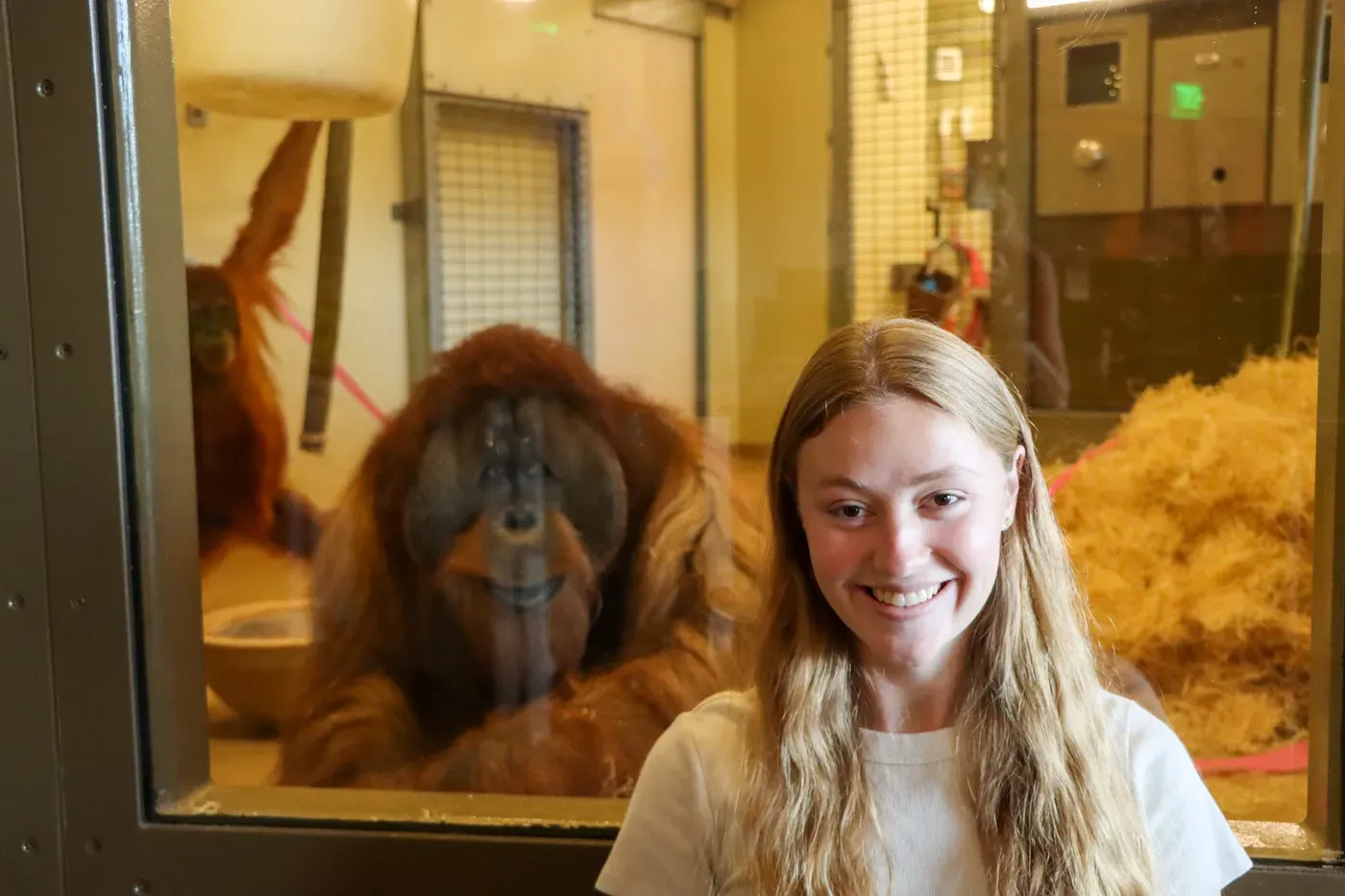
A groundbreaking study from Indiana University has shed new light on how positive emotions influence learning in great ape species. Researchers found that orangutans, when in a good mood, tend to value what they learn more strongly. The study, led by postdoctoral researcher Daan Laméris and professor of animal behavior Erica Cartmill, aimed to explore the evolutionary origins of this trait in non-human primates.
In humans, it's well established that positive moods enhance learning and make experiences more memorable. However, scientists have largely overlooked how this phenomenon plays out in other great ape species until now. By investigating orangutans specifically, researchers hoped to gain a deeper understanding of the underlying mechanisms driving this behavior.
Laméris designed an experiment to test whether hearing laughter while learning would increase an orangutan's value for the reward. The study took place over five consecutive days, with each day building on the previous one. On certain days, food rewards were consistently hidden under one type of material, while on other days, they were never found under a different type.
The researchers presented the orangutans with two bowls containing various materials to dig through in search of a reward. The setup was intentionally varied to keep the animals engaged and curious. As the study progressed, it became clear that the environment and presentation of rewards played a significant role in shaping the orangutans' behavior and learning patterns.
The study's findings have significant implications for our understanding of how positive emotions influence learning across different species. By exploring this phenomenon in great apes, researchers can gain valuable insights into the evolutionary roots of this complex trait. The next part of this investigation will delve deeper into the results and their broader significance.
The experiment continued to explore the influence of laughter on the behavior of orangutans. On days two and four, a new material was introduced alongside the unrewarded material that had been presented earlier. This new material covered the reward on both occasions. The goal was to see if the introduction of this new material would affect the orangutans' decision-making process.
The researchers found that the orangutans had learned to associate rewards with both wood chips and yarn, as they were equally likely to hide food under either material. However, a subtle difference existed between the two materials: one was accompanied by the sound of laughter, while the other was not.
On day five, the researchers brought back the two materials that had previously hidden rewards. The orangutans were then given a choice between the two materials, and surprisingly, they preferred the material associated with laughter. This suggests that hearing laughter influenced their decision-making process in some way.
The presence of laughter seemed to put the orangutans in a more positive mood. As a result, they valued the reward more when it was hidden under the material accompanied by laughter. This is an interesting finding, especially considering the social behavior of orangutans.
The study's results have significant implications for our understanding of the role of laughter in shaping behavior. Even among relatively nonsocial animals like orangutans, laughter appears to play a crucial part in influencing mood and decision-making processes.
The study of laughter in animals has led researchers to discover its significance in influencing mood and decision-making processes, even among species considered relatively nonsocial.
When orangutans hear laughter, they tend to value rewards more, a finding that echoes the way humans attach sentimental value to certain experiences or foods due to positive associations. For instance, someone might prefer their grandmother's pancakes not because they are objectively the best, but because of the fond memories associated with eating them in her presence.
The researchers aimed to measure the value placed on laughter and mood by studying animals, as the scientific community often focuses on negative emotions like fear and grief. This imbalance contributes to a narrative that nonhuman life is primarily driven by competition and survival, rather than complex social interactions and experiences.
By exploring the role of positive emotions in animal lives, researchers sought to uncover moments that shape the existence of species with which we share our planet. The study suggests that it's not just about mere survival, but also about forming connections, memories, and relationships that give life meaning.
The study found that orangutans who heard laughter responded more positively to rewards than those who didn't hear it. This suggests that social cues can influence an animal's perception of value and motivation.
Orangutans who were exposed to play vocalizations associated rewards with higher pleasure and satisfaction, leading to improved memory recall.
Facts based on reporting originally published by Phys.org.
You may republish this story, in full or in part, if you credit News Central Site and link to it (licence CC BY 4.0). Photos are not included.