US-China Trade War Continues with No Signs of Resolution
The ongoing trade war between the US and China shows no signs of resolution despite President Trump's warnings that China would face "big trouble" if it didn't agree to a more reciprocal trade arrangement.
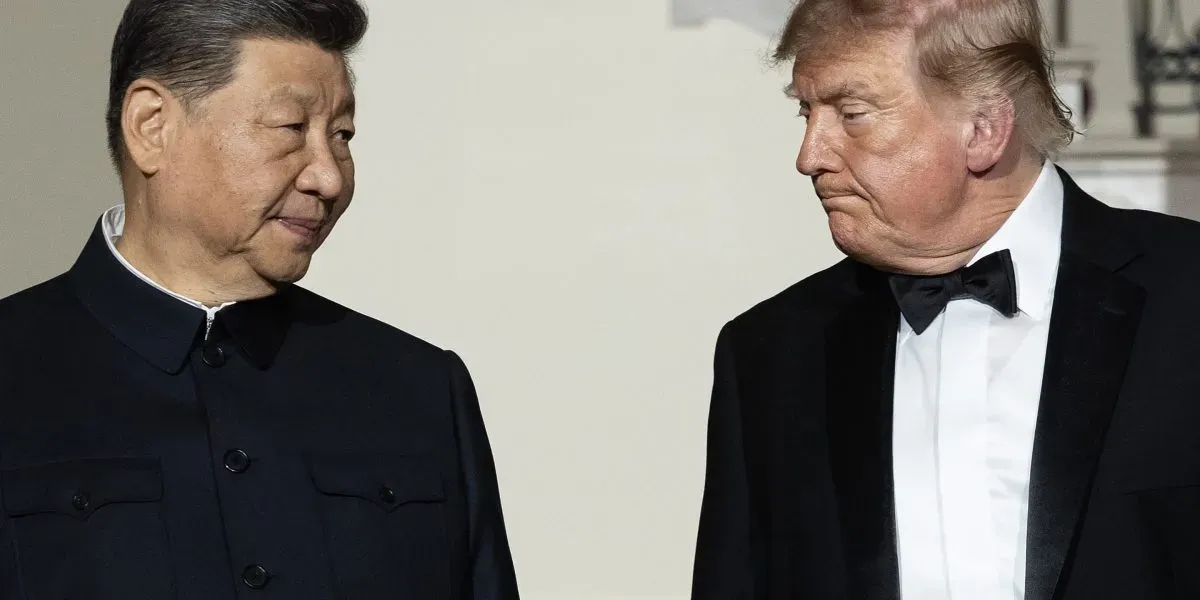
The US-China trade war has been ongoing for nearly two years now, with President Trump imposing tariffs on Chinese exports in an effort to rebalance the trade relationship between the two countries.
As part of this plan, Trump claimed that foreign exporters would bear the brunt of increased costs, rather than American consumers. He also warned China that it was headed for "big trouble" if it didn't agree to a more reciprocal trade arrangement.
However, despite these warnings, China's economy has continued to grow at a faster pace than the US. According to recent data from Goldman Sachs, China's real GDP grew 4.5% year-on-year in the third quarter, exceeding market expectations of 4.4%.
This growth is particularly notable given that a significant portion of Chinese exports are subject to tariffs imposed by the US. In fact, it appears that around 88.8% of Chinese exports are subject to these tariffs.
Meanwhile, US economic growth has been lackluster, with GDP increasing at just 2.5% and 2.2% in the first and second quarters of this year, respectively.
China's economic growth may be outpacing that of the US, but the country still has a long way to go in terms of its overall economic size and per capita income. According to data from the International Monetary Fund (IMF), China's GDP per capita stands at $15,370, a fraction of the US' GDP per capita of over $95,000.
Despite these disparities, China is making strides in managing its budget deficit. Recent fiscal data indicate that China has been tightening its belt, with combined revenues from the general public budget and government-managed funds increasing by 1.4% year-over-year. Meanwhile, expenditures have fallen by 3.5% year-over-year.
This trend suggests that China's estimated augmented fiscal deficit (AFD) is narrowing, decreasing from 11% of GDP in December 2025 to 9.4% in September 2026 on a 12-month moving average basis. While this may not be cause for celebration, it does indicate a positive shift in the country's fiscal policy.
In contrast to China's efforts to reduce its budget deficit as a share of GDP, US policymakers have yet to agree on targets to achieve similar reductions. However, the Congressional Budget Office's long-term budget projections suggest that the US is already operating from a relatively smaller basis, with total deficits averaging 7.2% of GDP over the next three decades.
These numbers highlight the complexities and nuances surrounding economic growth and fiscal management in both China and the US. While one country may be experiencing faster economic expansion than the other, it's clear that there are still significant differences to address between these two global economic powers.
The trade tensions between the US and China may be easing, but it's clear that the high tariff rates imposed by both countries are still having an impact on their economies.
According to recent data from the Peterson Institute for International Economics (PIIE), Chinese tariffs on US exports currently stand at 31.9%, while US tariffs on Chinese imports sit at a higher rate of 35.2%. This indicates that despite some progress in reducing trade tensions, significant barriers remain to free trade between the two nations.
However, China's economic performance continues to defy expectations, with its exports growing by 36.3% in September compared to the same period last year - the fastest rate since February.
Facts based on reporting originally published by Fortune.
You may republish this story, in full or in part, if you credit News Central Site and link to it (licence CC BY 4.0). Photos are not included.