Taiwanese Author Wins 2026 International Booker Prize
Yang Shuang-zi's book "Taiwan Travelogue" won the 2026 International Booker Prize, marking a significant milestone for Taiwan in the international literary scene.
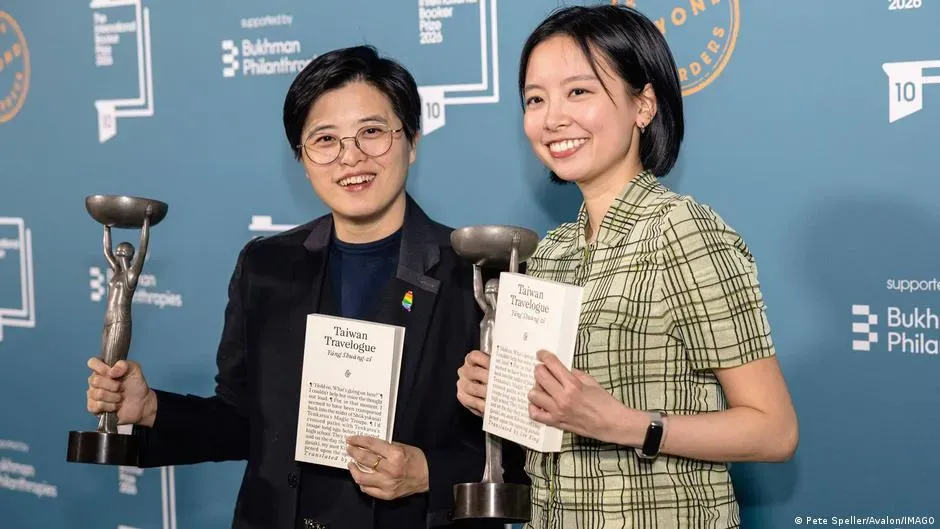
A Taiwanese author's win at a prestigious literary award has highlighted the complex geopolitics surrounding Taiwan's cultural presence on the global stage.
Taiwanese author Yang Shuang-zi's book "Taiwan Travelogue recently took home the 2026 International Booker Prize, marking a significant milestone for the country in the international literary scene. However, this achievement is not without its challenges and controversies.
The translation of the book into English was handled by Lin King, who has been vocal about her decision to prioritize translating works from Taiwan over other Sinophone literature. In an acceptance speech at the award ceremony, she expressed concerns about the implications of her choice for the future of Taiwan's cultural presence abroad.
Lin King stated that she made the decision in 2022, around the time of Russia's invasion of Ukraine, and has continued to prioritize Taiwanese authors since then. Her comments suggest a sense of urgency and anxiety surrounding the situation in Taiwan, where many are worried about their country's sovereignty being threatened by external forces.
The book itself tells the story of a young Japanese writer visiting Taiwan in 1938, and explores themes of history, culture, and identity through the relationship between the visitor and her Taiwanese interpreter.
The reaction from China's Taiwan Affairs Office was swift after the announcement of the 2026 International Booker Prize winner. The office emphasized that writers from both sides of the Taiwan Strait must adhere to a national perspective and acknowledge historical facts, particularly the suffering inflicted upon the Chinese people by Japan's war of aggression.
China views Taiwan's growing cultural influence as a threat to its stance on the island. From Beijing's perspective, it is unacceptable for Taiwan's voice to gain prominence in international forums. This sentiment underscores China's long-held position that Taiwan is an integral part of China and will eventually be reunified under its rule.
Taiwanese culture is not a homogeneous entity, as demonstrated by the complex historical influences that have shaped its identity. Yang's work highlights the presence of indigenous, Japanese colonial, and local Han influences on Taiwanese culture, challenging the notion that it is merely an offshoot of Chinese culture.
The controversy surrounding Yang's German book tour this October was sparked when her interpreter significantly shortened certain statements during a Munich event at the Literaturhaus. The interpreter later admitted to oversights in translation but denied intentionally deleting content due to their political stance or the situation in Taiwan.
Beijing continues to assert its claim over Taiwan, threatening to use force to bring the island under its control. In contrast, Taiwan's democratically elected president has consistently rejected Beijing's assertion that its laws apply to Taiwan. This tension is exacerbated by Taiwan's de facto independence since 1949, when it established its own government, military, and legal systems despite ongoing pressure from Beijing.
Taiwan's cultural presence is being increasingly restricted, particularly when it comes to international events. This trend is evident in various sectors, including literature and sports. For instance, Taiwanese barista Lin Shao-hsing, also known as Bala, won the 2026 World Latte Art Championship in the United States.
However, soon after his win, all references to Taiwan were removed from the official World Coffee Championships website. Instead of representing Taiwan, Bala was listed as competing for the competition body of Chinese Taipei. This term is often used in international contests, such as the Olympics, but it's not commonly used in Taiwan itself.
The move raises questions about China's efforts to suppress Taiwanese identity and presence on the global stage. According to a 2026 poll by National Chengchi University's Election Study Center, most people in Taiwan identify as Taiwanese, while only a small minority identifies as Chinese.
This trend is not limited to cultural events; it also extends to high-level diplomatic visits. In 2024, Czech intelligence officials revealed that China had allegedly planned to stage a car collision during Taiwanese Vice President Hsiao Bi-khim's visit to Prague. The incident was reportedly part of a larger plan by Chinese diplomats and intelligence officers working out of the Chinese embassy in Prague.
The implications of these actions are far-reaching, as they suggest that China is actively seeking to restrict Taiwan's cultural presence on the international stage. This tension is further exacerbated by Taiwan's de facto independence since 1949, when it established its own government, military, and legal systems despite ongoing pressure from Beijing.
The recent arrest of a woman in California on allegations of spying on the son of Taiwan's president has sparked concerns about China's intentions towards Taiwan's cultural presence globally.
According to the US Department of Justice, the woman had traveled to Seattle in 2025 under instructions from Beijing, where she monitored the Taiwanese president's son and his family by capturing photos, video footage, and license plate information. The arrest highlights the ongoing tension between China and Taiwan, with China exerting pressure on Taiwan through various means.
China's Ministry of Foreign Affairs has pushed back against allegations of espionage, stating that they oppose the hype" surrounding such cases and any attempts to smear or vilify China. Dr. Lai noted that since Taiwan is not recognized as a sovereign state by international bodies, China may use its soft power to restrict Taiwan's visibility without necessarily violating international law.
Facts based on reporting originally published by DW English.
You may republish this story, in full or in part, if you credit News Central Site and link to it (licence CC BY 4.0). Photos are not included.