Superconductors show complex electronic behavior near magnetic vortices
Researchers from Tsinghua University and others studied cobalt-doped barium iron arsenide to understand its electronic states.
Superconductors have shown great promise in developing various technologies such as medical devices and particle accelerators due to their ability to carry electric current with zero electrical resistance.
These materials can be divided into two categories: type-I superconductors, which repel magnetic fields entirely, and type-II superconductors, which allow magnetic fields to penetrate via regions called vortices. Each vortex carries a fixed amount of magnetic flux, with electrical currents circulating around its center.
In an iron-based superconductor, researchers from Tsinghua University, Southern University of Science and Technology, Boston College, and other institutions investigated electronic states near the centers of these magnetic vortices. Their study focused on the behavior of charge stripes in this material.
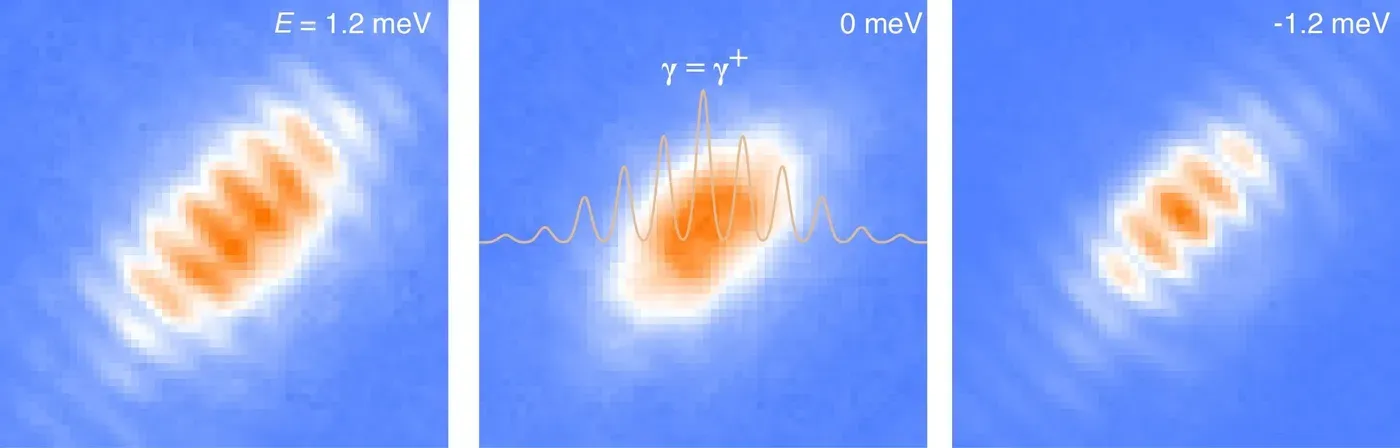
The researchers observed that the strength of these charge stripes increases significantly around the vortex centers, indicating a strong connection between the stripes and the vortex states. This phenomenon was found to be closely linked to two distinct types of vortex states present in the superconductor.
The researchers focused on cobalt-doped barium iron arsenide, a type-II superconductor with the formula Ba(Fe₀.₉₄Co₀.₀₆)₂As₂. This material was chosen for its thin films, which are ideal for studying magnetic vortices and their electronic properties.
The team used spectroscopic-imaging scanning tunneling microscopy to map the electronic properties of the superconducting films at different energies. This technique involves moving a fine tip just above the surface of the material to create detailed images of its electronic structure.
Cobalt-doped barium iron arsenide contains 6% cobalt in place of iron in its crystal lattice, making it a unique and interesting subject for study. The researchers were particularly interested in exploring the emergent electronic states that arise from the interaction between magnetic vortices and the superconducting material.
The team's initial goal was to search for vortex bound states and possible Majorana zero modes in 122-type iron pnictides, but they made an unexpected discovery instead. They found that charge stripes are closely intertwined with different vortex states in these materials.
The researchers used low-temperature scanning tunneling microscopy and spectroscopy to study the electronic states around many vortices in optimally doped Ba(Fe 0.94 Co 0.06 ) 2 As 2 superconducting films.
By mapping these electronic states with atomic-scale precision, they identified a repeating pattern of electronic charge stripes that became stronger as they approached vortex centers. This pattern was closely intertwined with the distinct types of vortex states present in the material. The researchers distinguished two types of vortex states based on the positions of their centers relative to the stripe pattern.
One type of vortex state hosted a zero-energy state, which the researchers identified as a Majorana zero mode. This finding is significant because it has implications for topological quantum computing and other applications that rely on these exotic modes. The presence of Majorana zero modes in these materials could be used to develop new technologies.
The study highlights the complex relationship between electronic stripes and vortex states in this specific iron-based superconductor. Further research may explore whether similar relationships exist in other type-II superconductors, which could have important implications for our understanding of superconducting materials and their applications.
The researchers' findings suggest that electronic stripes and vortex states are intricately connected in superconductors. According to Xu-Cun Ma, a co-author of the study, the team's observations reveal how topology, charge order, and superconductivity interact at the nanoscale.
The presence of Majorana zero modes, charge stripes, and pair-density modulation within a single magnetic vortex has significant implications for our understanding of superconducting materials. The recent research by Song, Liu, Ma, and their colleagues may pave the way for controlling bound states in certain superconductors.
To further explore these interactions, the team plans to investigate why charge stripes select different types of vortices and how they couple with Majorana states. Understanding this behavior could lead to new methods for manipulating Majorana zero modes.
The researchers' ultimate goal is to uncover the underlying mechanisms that govern the relationships between electronic stripes, vortex states, and Majorana zero modes in iron-based superconductors. This knowledge may be crucial for developing innovative applications of superconducting materials.
Researchers have made a significant discovery about superconducting materials, finding that electronic stripes are linked to unusual vortex states within these substances.
These findings could hold the key to developing new applications for superconducting materials, which exhibit zero electrical resistance under certain conditions. The study's authors suggest that their research may be crucial for creating innovative uses of superconductor materials, enabling them to tap into their full potential.
The discovery is significant because it reveals a previously unknown connection between electronic stripes and vortex states in iron-based superconductors. This knowledge may lead to breakthroughs in various fields, including energy storage and transmission, medicine, and advanced technologies. The research also sheds light on the fundamental properties of superconducting materials, paving the way for further study and exploration.
Facts based on reporting originally published by Phys.org.
You may republish this story, in full or in part, if you credit News Central Site and link to it (licence CC BY 4.0). Photos are not included.