Significant Discovery Made About Histone Role in Sperm Development
Researchers at Kyushu University have found that a specific histone subvariant, H3mm15, is crucial for regulating gene expression during spermatogenesis.
Researchers at Kyushu University have made a significant discovery about the role of histones in sperm development. A team led by Professor Akihito Harada found that H3mm15, a specific type of histone H3.3 subvariant, plays a crucial part in regulating gene expression during spermatogenesis.
Histones are protein molecules that act as spools around which DNA is wrapped, organizing the genome and controlling gene activity. H3.3 is a variant of histone H3 that is incorporated into chromatin independently of DNA replication and is associated with active genomic regions.
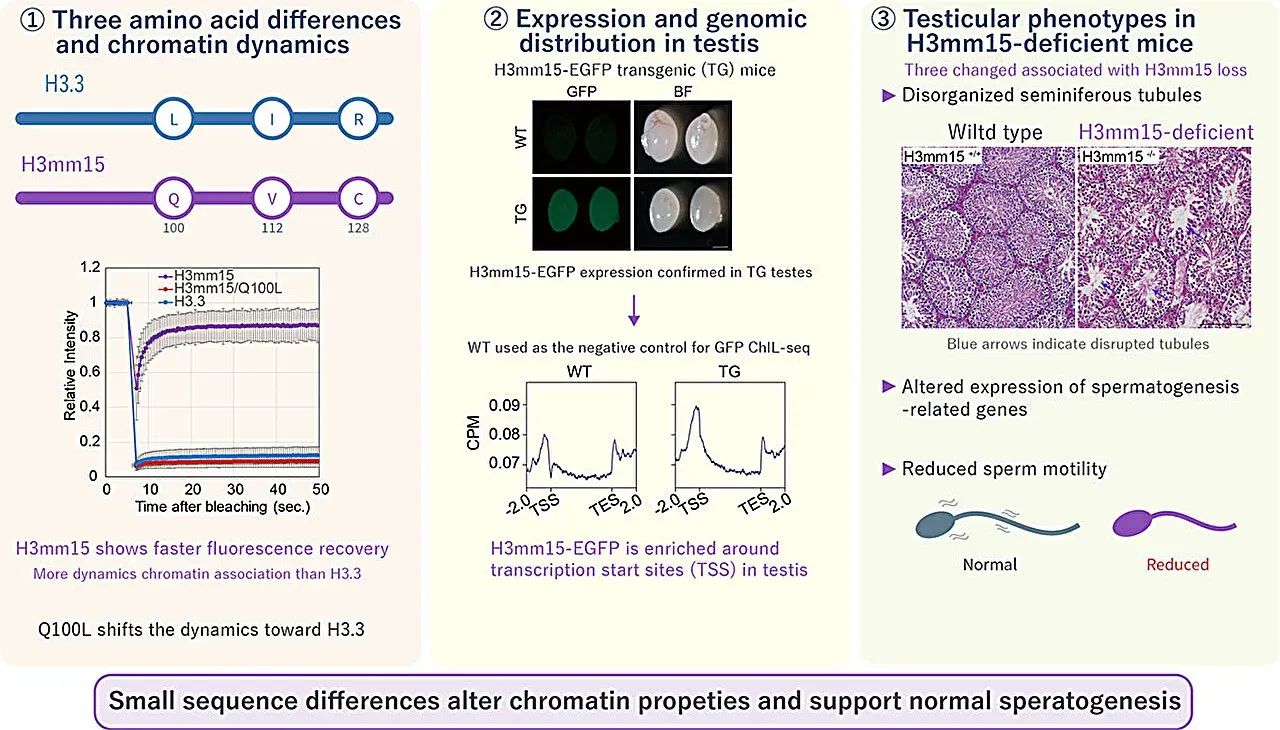
The researchers had previously identified several closely related H3.3 subvariants in mice, including H3mm15, which differs from conventional H3.3 at just three amino acids. RNA analyses revealed that the gene encoding H3mm15 is predominantly expressed in the testis, raising questions about its distinct biological functions.
A deeper investigation into the function of H3mm15 was conducted by Professor Harada's team, collaborating with researchers Qianmei Wu, Yasuyuki Ohkawa, and Tatsuya Takemoto. Their findings shed light on the importance of this specific histone subvariant in sperm development.
The researchers' observations suggest that small differences in histone amino acid sequence can have significant effects on biological functions, a crucial insight into the regulation of gene expression during spermatogenesis.
Mice lacking a specific histone protein variant called H3mm15 exhibited disorganized testis structures where sperm develop.
Their sperm motility was also reduced and there were significant changes in gene expression related to spermatogenesis. The altered genes were particularly those involved in the transition from mitosis to meiosis, an essential step in sperm development.
In cultured cells, H3mm15 was incorporated into chromatin less efficiently than another histone protein variant called H3.3, but showed a higher concentration near gene promoters where transcription begins.
Analysis of transgenic mouse testes also revealed high levels of H3mm15-EGFP around the start sites of gene transcription. This suggests that H3mm15 plays an important role in regulating gene expression during spermatogenesis.
The structural and biochemical properties of H3mm15-containing nucleosomes were found to be less stable than those containing H3.3, contributing to more dynamic chromatin association.
The discovery of a distinct histone subvariant, H3mm15, has shed light on its role in regulating gene expression during spermatogenesis.
The findings suggest that this specific histone variant plays a crucial part in establishing specialized chromatin environments necessary for normal sperm development.
According to Harada, understanding the retention of closely related histone subvariants may provide insights into how cells create distinct chromatin properties through variations in genomic localization and stability dynamics.
Further studies are needed before considering applications of H3mm15 to humans, but this research could ultimately help researchers interpret epigenetic abnormalities linked to impaired spermatogenesis.
Facts based on reporting originally published by Phys.org.
You may republish this story, in full or in part, if you credit News Central Site and link to it (licence CC BY 4.0). Photos are not included.