Siarhei Tsikhanouski Released from Belarusian Custody Sparks Rift within Opposition Family
A rift has emerged within the family of prominent Belarusian dissident Siarhei Tsikhanouski, a development that is likely to have significant implications for the country's opposition in exile.
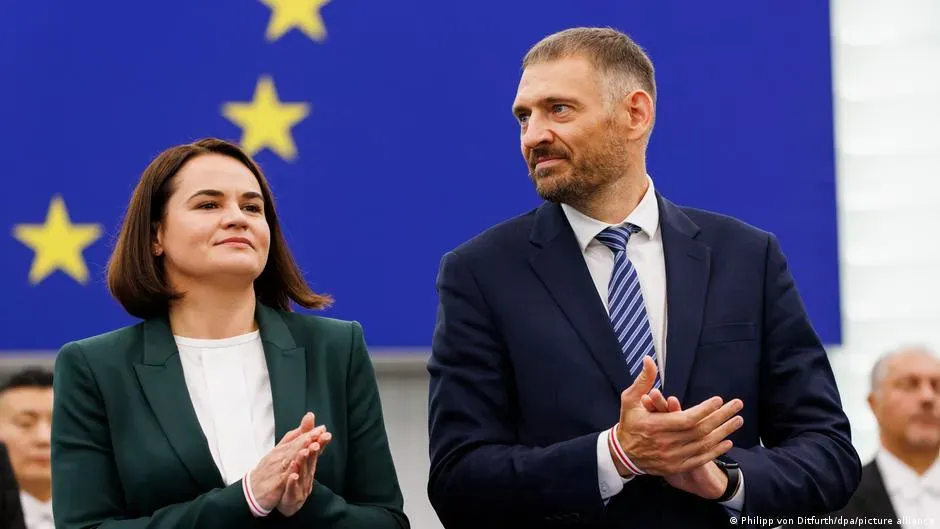
A rift has emerged within the family of prominent Belarusian dissident Siarhei Tsikhanouski, a development that is likely to have significant implications for the country's opposition in exile.
Siarhei Tsikhanouski, 48, was arrested by authorities in May 2020 after announcing his intention to challenge long-serving President Alexander Lukashenko in the upcoming presidential election. His wife, Sviatlana Tsikhanouskaya, took up his cause and ran as a joint candidate for the opposition, but their efforts were ultimately thwarted by allegations of widespread vote-rigging.
In August 2020, Lukashenko was declared the winner of the election in a result that sparked massive protests across Belarus. Despite facing brutal suppression, thousands of people fled into exile, with Tsikhanouskaya becoming the leading representative of the democratic movement outside the country.
Following nearly five years behind bars, Siarhei Tsikhanouski was released in June 2025 and subsequently taken out of the country against his will. Since then, he has reactivated his YouTube channel, using it to denounce not only Lukashenko's regime but also Sviatlana Tsikhanouskaya's office.
Tsikhanouski's online presence has drawn thousands of followers, who tune in to watch him stream his thoughts on current events. In one recent broadcast, he claimed that while the European Union had bestowed a certain level of legitimacy upon his wife, she did not enjoy similar support from ordinary Belarusians living under Lukashenko's rule.
Tsikhanouski has proposed establishing a supervisory board under the label United Office of Democratic Forces to oversee grant funds distribution. This board would comprise former presidential candidates, protest leaders, and iconic figures from the revolution, including himself and his wife. According to Tsikhanouski, such a body could provide at least some legitimacy, granted by Belarusians.
Tsikhanouski has also downplayed his wife's role in the opposition movement. He described her as a "technical candidate who received votes from those opposed to Lukashenko, but noted that she had negligible support due to her lack of recognition and political experience. Her candidacy was allowed because she did not pose a threat to the regime.
When asked about his goals, Tsikhanouski declined to comment and referred to his livestreams instead. As he resides in the US, he is currently unemployed, by his own account. At the beginning of summer, he stated that he was learning English, preparing for university studies, and writing a book while living in Los Angeles.
Tsikhanouski's children have temporarily stayed with him in the US, but they now attend school in Poland, where his wife resides. This arrangement allows them to continue their education despite their father's relocation.
The establishment of such a supervisory board would require coordination among various opposition groups and figures, some of whom may be skeptical about Tsikhanouski's proposal. The effectiveness of the proposed board remains uncertain, given the complexities of Belarusian politics and the challenges facing the opposition in exile.
Sviatlana Tsikhanouskaya has maintained a stance of neutrality regarding her husband's personal life, even before their public dispute came to light.
When asked about Siarhei Tsikhanouski's activities in the past, Sviatlana often directed inquiries to him directly, rather than commenting herself. This approach suggests that she prefers to keep family matters private and separate from her professional responsibilities as a leader of the Belarusian democratic forces.
In an interview with DW in December 2025, Sviatlana acknowledged the complexities of her husband's situation, stating that his experiences during the five years he spent in prison have understandably left him deeply traumatized. As a result, she chose not to publicly comment on their family issues or make any statements about Siarhei's allegations.
The Belarusian opposition has faced numerous challenges and crises under the Lukashenko regime, which has been in power for over three decades. Sviatlana Tsikhanouskaya's leadership role has come under scrutiny more than once, but she and her team have consistently managed to navigate difficult situations.
Siarhei Tsikhanouski's transformation into a critic of his wife's leadership is likely to be seen as unusual by many, including Sviatlana's international partners. Political scientist Yury Drakakhrust described Siarhei as having returned to his own style and approach, which may not align with conventional practices in the opposition movement.
The rift within the Tsikhanouski family has significant implications for the Belarusian opposition in exile. Political scientist Yury Drakakhrust notes that Tsikhanouski's insistence on being the key figure of the 2020 events may not be enough to turn back the wheel. He believes that even if Tsikhanouski was indeed central, his current actions would have limited impact.
Drakakhrust questions whether Tsikhanouski's past popularity would translate into tangible benefits today. He suggests that if hundreds of thousands of Belarusians were to watch his livestreams and participate in local groups associated with him, it might be possible to reverse the situation. However, Drakakhrust remains skeptical about this scenario.
The current state within the democratic forces is described as a crisis" by Drakakhrust. He doubts that Tsikhanouski can reach an agreement with all members of his proposed supervisory board. Furthermore, his wife's establishment of assets and resources through her office has created a separate dynamic.
Tsikhanouskaya's status has been elevated to the point where she is received at high levels, both domestically and internationally. She is regarded as a leader for Belarus and its democracy, rather than just one among several democratic leaders from the country. This distinction sets her apart from other exiled actors from the 2020 election campaign.
Drakakhrust points out that not only Tsikhanouskaya but also others who participated in the 2020 election campaign are in exile. However, they have yet to achieve a similar level of representation or access to resources as she has. According to Drakakhrust, it is her political stature that matters most in this context.
The Belarusian government appears to be taking a wait-and-see approach as internal conflicts within the opposition continue to escalate. They view these disputes with a sense of irony, often allowing them to simmer and intensify without intervening.
By doing so, the authorities are essentially sowing discord among their opponents, making it more challenging for them to present a unified front against the regime. This strategy underscores the government's confidence in its ability to maintain control, at least for now. The opposition in exile will have to navigate these internal divisions if they hope to regain momentum and challenge the status quo.
Facts based on reporting originally published by DW English.
You may republish this story, in full or in part, if you credit News Central Site and link to it (licence CC BY 4.0). Photos are not included.