Sascha Braunig Exhibits Artwork at Portland Art Museum
The exhibition showcases a diverse range of works by artist Sascha Braunig, including paintings and sculptures that explore societal expectations placed on women.
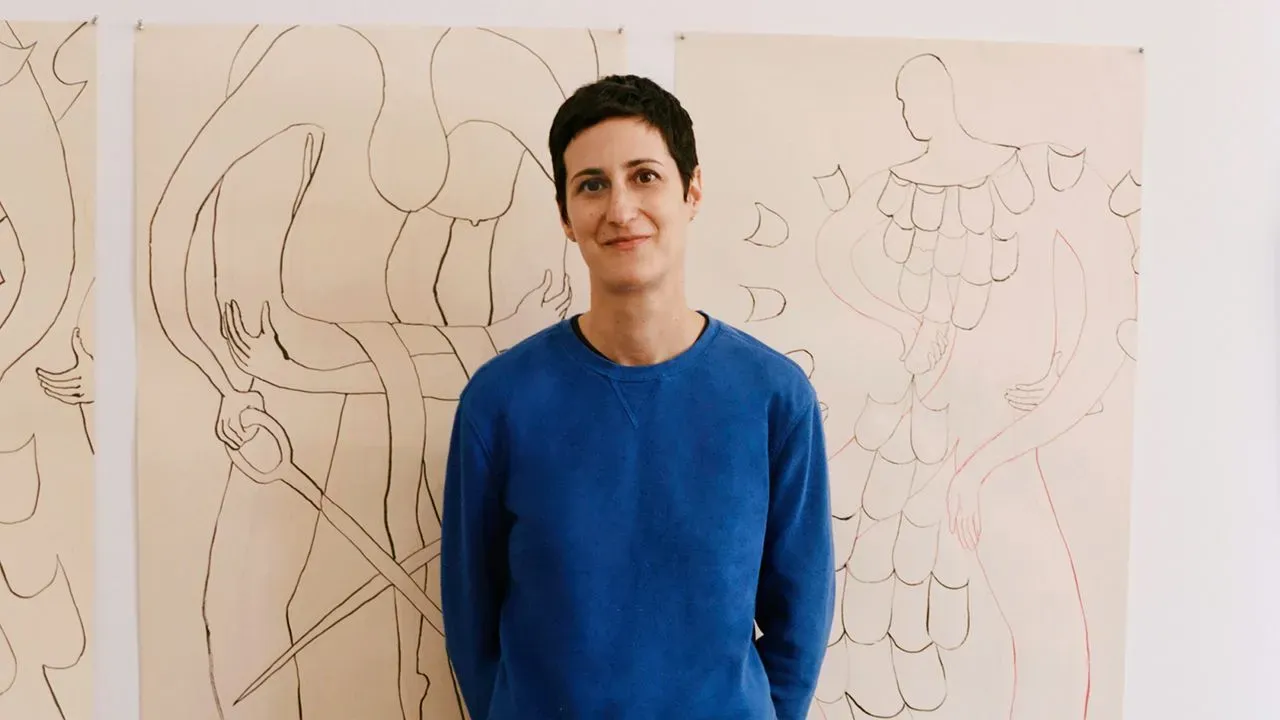
Sascha Braunig's paintings are notorious for provoking strong reactions in viewers, a mix of fascination and unease that can be palpable.
Her goal is to create a physical response in those who see her work, she explains.
Braunig achieves this by juxtaposing vibrant, almost playful colors with twisted, unsettling forms, faces and bodies often bound by wiry tendrils that seem to writhe like living things.
These figures frequently appear to be hiding from view, their features blurred as they recede into the surrounding background.
The artist's unique style has been on display for nearly two decades, she splits her time between New York and Maine, where she paints with a distinctive verve.
Since earning her MFA from Yale in 2008, Braunig has shown her work at numerous prominent galleries and institutions, including Foxy Production in Manhattan.
In addition to solo exhibitions, her paintings have also been featured in group shows like the New Museum Triennial and MoMA PS1.
Braunig's art often grapples with the societal expectations placed on women, she seeks to expose the tension inherent in conforming to these norms.
She examines how women are perceived and presented in society, highlighting the contradictions and complexities of femininity.
Braunig's work often explores the tensions between opposing forces.
Her artistic vision is deeply intertwined with societal influences and cultural imagery, as she herself acknowledges. She delves into the complexities of gender performance and bodily control in her art. The Portland Art Museum will be hosting Braunig's most extensive exhibition to date, which promises to showcase a diverse range of works.
The show features over 45 pieces, including paintings, sculptures, drawings on paper, and sketchbooks, all of which demonstrate Braunig's unique approach to the arts. This solo exhibition at the Portland Art Museum marks her first institutional show in Maine. Sayantan Mukhopadhyay, a curator at PMA, notes that Braunig stands out in the local art scene for her singular style.
Braunig's work defies easy categorization, often blurring the lines between opposing concepts. This is precisely what draws people to her art, according to Mukhopadhyay. Olivia Smith, whose gallery now represents Braunig, highlights the artist's ability to create an abstraction that can be perceived as both delicate and forceful.
Braunig's creative process begins with a drawing, which she later transforms into a three-dimensional model through embellishment. This intricate model-making technique allows her to bring her sketches to life in a tangible form. The subsequent step involves illuminating the model and painting what she observes, effectively merging the physical and visual aspects of her art.
The use of clay resin, wire, and paper in Braunig's maquette process imbues her works with a tactile quality that is both captivating and thought-provoking. As seen in paintings like Warm Leatherette, this technique allows her to create visually striking pieces that seem to leap off the canvas. The resulting artwork is not only aesthetically pleasing but also invites the viewer to engage with it on a deeper level.
Braunig's fascination with femininity as a performance is a recurring theme throughout her work. By setting up a scene, complete with velvet curtains and klieg lights, she effectively stages an idea that challenges traditional notions of identity. This theatrical approach underscores the notion that gender, like art itself, is a deliberate construction.
Growing up in British Columbia, Canada, Braunig was encouraged by her parents to explore her creative side. Her father, a dentist, and mother, a nurse, both nurtured their own artistic interests outside of work, creating an environment where creativity thrived at home. Braunig's love for art began early on, with Pee-wee's Playhouse being a particular source of inspiration that rivalled the influence of museums in shaping her artistic vision.
Braunig's formative years were shaped by early exposure to art institutions, but it was Cooper Union in New York City that truly caught her attention. The school had a notable history of nurturing artists like Lee Krasner and Wangechi Mutu. Her decision to attend the prestigious institution was likely influenced by its reputation for fostering artistic talent.
The allure of New York City was undeniable for Braunig, who found it the perfect environment in which to hone her craft. With its vibrant art scene and endless creative possibilities, the city seemed tailor-made for a budding artist like herself. Her passion for the city was so all-consuming that she jokes about being "totally in love with it - although this ardor may have also had a darker side.
After completing her studies at Cooper Union, Braunig went on to Yale before moving to Maine in 2010. The decision to relocate to a less expensive area proved to be a turning point for her artistic development. By escaping the high costs of living in New York City, she was able to focus on building her unique style without the burden of multiple jobs.
Braunig's exposure to various art movements has clearly had an impact on her work, with many observers drawing parallels between her style and Surrealism. While acknowledging these influences, Braunig is quick to emphasize that her art is not a dreamlike fantasy but rather a deeply personal expression. Her recent output has taken a more autobiographical turn, reflecting a renewed focus on exploring her own experiences and emotions.
As Braunig transitioned out of that challenging period last year, she began creating paintings that were more deeply personal than ever before.
Her recent show Cauldron at Magenta Plains was a testament to this shift in focus, with its title referencing the tumultuous and transformative nature of midlife as a messy, stew-like experience.
In her painting My Death", Braunig described it as an explicit self-portrait that explores her own reanimation - a process of emerging from the void of creative block into a new state of being.
The result is a complex and multifaceted work that is both haunting and beautiful to behold, with elements of life force and rejuvenation.
Braunig has employed the recurring motif of tentacles in her work once again, but this time they are depicted as a life-giving force connected to a sleeping Braunig figure.
The concept of torsion, a twisting motion around an axis, has been reimagined by Braunig in her latest work, where it takes on a more figurative meaning.
A fleshy pink figure stands at attention within a gray box, its tiny torso twisted and contorted as if wrung out to dry. The muscular back of the figure faces away from the viewer, while its knees are bent in a dramatic plié. Tentacles of orange and yellow outline its exaggerated form.
The figure's head is abruptly truncated by the ceiling of the box, and its arms stop short at the elbows, as if encountering an invisible barrier. The sense of confinement is palpable, but Braunig leaves room for interpretation: has the figure been trapped, or has it somehow managed to break free from its shadowy encasement?
Facts based on reporting originally published by Vogue.
You may republish this story, in full or in part, if you credit News Central Site and link to it (licence CC BY 4.0). Photos are not included.