Raphael Warnock Directs Resources Towards Scott Colom's Campaign
US Senator Raphael Warnock is personally directing resources and donors towards the campaign of Mississippi local prosecutor Scott Colom in his bid for a seat in the state.
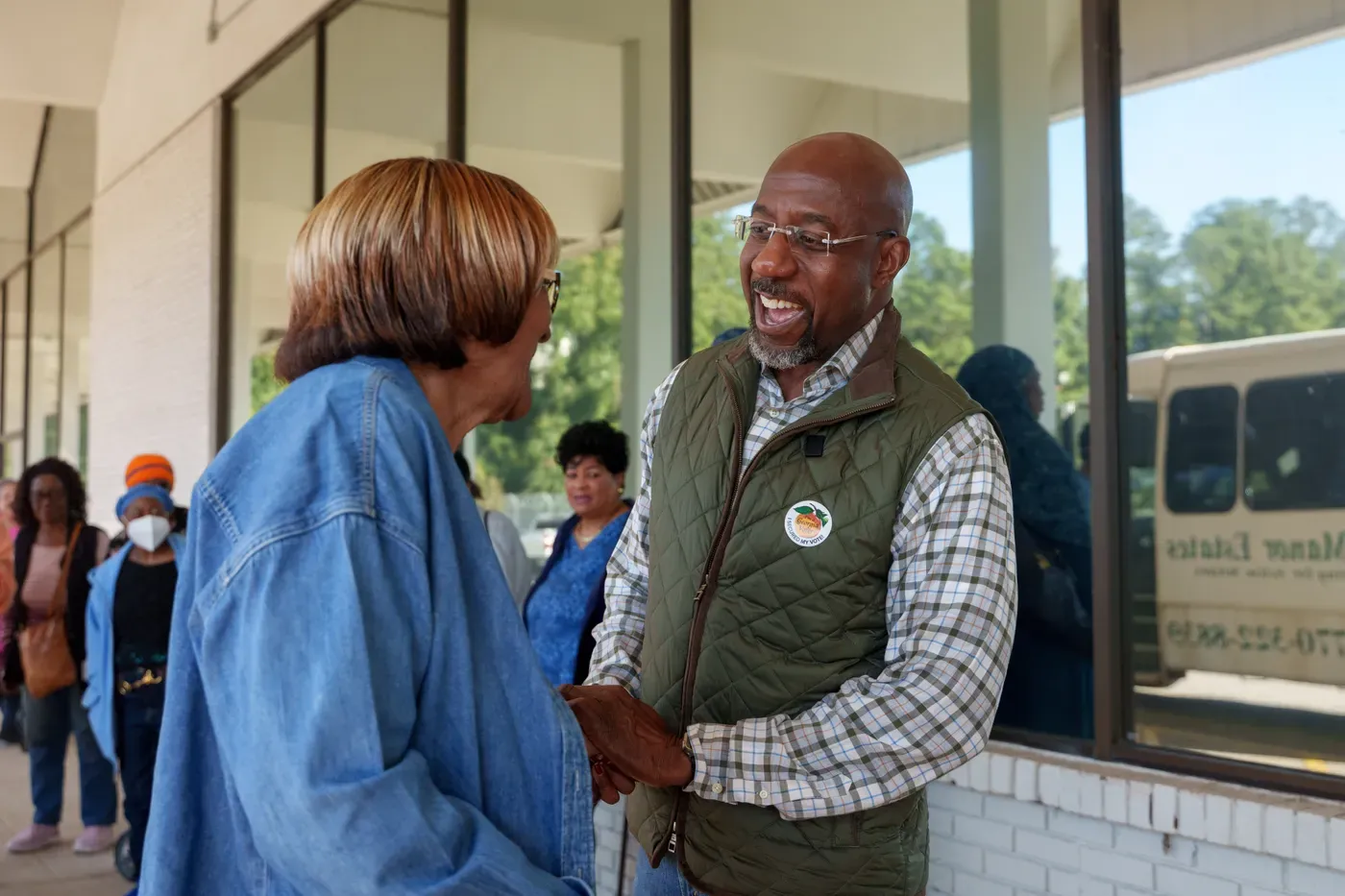
Raphael Warnock is making a bold move in his bid to boost Democratic chances in the South by throwing his weight behind Scott Colom's campaign in Mississippi.
Colom, a local prosecutor, has managed to close the gap with Republican Senator Cindy Hyde-Smith in recent polls and Warnock is keen to capitalize on this momentum. He has been personally directing resources and donors towards Colom's campaign, trying to fill the gap left by the party's lack of dedicated support for the race.
Warnock has raised over $500,000 directly for Colom's campaign committee and has also been hosting fundraising events to steer top Senate Democrats' donors towards the Mississippi contest. His efforts have not gone unnoticed, with some donors expressing surprise at Warnock's focus on this previously ignored region.
In an April donor breakfast, Warnock warned that the party was "sleeping on the importance of the Mississippi contest, prompting laughter from the crowd as they realized he was serious about their chances in the South. He urged them to resist the Democratic tendency to ignore the region and instead expand into traditionally red states.
Warnock's efforts are part of a broader strategy to capitalize on an unusually favorable midterm environment for Democrats, with more traditionally Republican states now seen as up for grabs. His criss-crossing of Mississippi and other Southern states aims to convince party leaders to shore up support among Black voters ahead of 2028 elections.
A new kind of Southern strategy" is what Senator Raphael Warnock aims to implement for Democrats in the South. This approach draws inspiration from former President Richard Nixon's plan to capitalize on white backlash against the civil rights movement.
The challenge lies in Mississippi, where Republicans hold control over all state government branches and Donald Trump won by a significant margin in 2024. It's been decades since the last Democrat was sent to the Senate from the state, with the last instance being in 1982.
National Democrats are already stretched thin, dedicating resources to competing on an expanded Senate battleground map. This has led to prioritization of contests like Iowa, Alaska, and Maine over Mississippi, where fundraising efforts have yielded only $5 million so far this cycle.
Even if Warnock's support for Colom does not yield a win, the South remains a crucial region in terms of delegate count for 2028. Black voters are also key players in Democratic primaries across the region, making it an essential area for party strategists to focus on.
Warnock's travels across the South have taken him to Mississippi, where he's been meeting with local candidates and pitching a vision for his party's future. In doing so, he sees parallels between Georgia's 2020 Democratic wins and emerging conditions in Mississippi that could be ripe for growth.
As Warnock views it, Democrats' failure to invest in Black voters, the core of their coalition, will lead to diminishing returns on election day. He believes that investing now is crucial to reclaiming votes from those who shifted towards Republicans in 2024.
Mississippi's demographics make it a key battleground: over 35% of its population identifies as Black, and recent elections have shown strong Democratic candidates reaching around 45% of the vote. However, none have managed to win, due in part to the state's long history of polarized voting along racial lines.
The Supreme Court's decision to gut the Voting Rights Act has sparked concern among Democrats, but some see a silver lining: Black voters are increasingly turning out at the polls. This surge could potentially reshape Mississippi's politics and create new opportunities for Democratic candidates.
As Warnock travels through the South, he's acutely aware of the challenges ahead, but also sees potential for growth in states like Mississippi where demographics and voting trends suggest a shift towards Democrats may be underway.
Warnock wants Democrats to focus on the South, starting with a push for increased investment in states like Mississippi where demographics suggest a shift towards Democrats may be underway.
The party must demonstrate its commitment to loyal Democratic voters, particularly Black voters who share similar aspirations as other constituents, according to Warnock. This involves building trust and understanding that their needs are being addressed, he emphasized.
Colom faces an uphill battle in Mississippi, with the incumbent Hyde-Smith leading in polls; however, Democrats have historically poured funds into traditionally red states during election season. Despite this strategy, Mississippi has not yet received significant investment from the party.
Warnock acknowledged that more resources and time are required to establish a robust grassroots infrastructure in the state, similar to what has been successful in Georgia. He expressed concern that current efforts fall short of potential, given the state's demographics and voting trends.
Despite these challenges, Warnock remains optimistic about the prospect of growth in Mississippi, citing the party's efforts as a starting point for forcing Republican candidates to compete.
Colom has been vocal about his desire for national Democrats to prioritize his Senate campaign.
Mississippi is often overlooked by party leaders despite its competitive nature and Colom's own efforts to highlight its potential.
The state has historically been a battleground in federal elections, with several key contests having gone either way in recent years.
Colom believes that if the party were to focus more resources on Mississippi, it could make a significant difference in the outcome of his campaign.
He emphasized the need for attention and funding to match the competitiveness of the state.
Some Democratic groups have begun to take notice of Colom's efforts, with American Bridge pouring over $2 million into the race earlier this month.
A single megadonor is also set to split $7 million between Colom's campaign and others, as reported by a major newspaper recently.
Several top Democrats have shown their support for Colom by planning visits to the state before Election Day.
Former Vice President Kamala Harris and former Secretary of Transportation Pete Buttigieg are both scheduled to visit Mississippi.
Senate Majority Leader Chuck Schumer and Democratic Senatorial Campaign Committee chair Kirsten Gillibrand have hosted fundraisers for Colom, according to a source familiar with the events.
Delaware Sen. Lisa Blunt Rochester has also campaigned alongside Colom in the state.
While these efforts are appreciated by Colom's campaign, they still pale in comparison to the tens of millions spent in other states.
The Democratic Senatorial Campaign Committee and Senate Majority PAC have both issued statements praising Colom as a strong candidate but citing resource constraints.
As Senator Raphael Warnock continues his efforts to boost Democratic candidates in Southern states, he is seeing firsthand the stark contrast between what Democrats can achieve when they invest heavily in these regions and what happens when resources are scarce.
In Mississippi, where Colom is running against incumbent Republican Senator Cindy Hyde-Smith, Democrats are struggling to compete with limited funding. In a statement, Hyde-Smith's campaign manager, Jake Monssen, pointed out that the Democratic candidate was expected to have substantial resources at his disposal.
Meanwhile, in North Carolina, Warnock visited on Thursday and witnessed a different story altogether. There, Democratic Senate nominee Roy Cooper is dominating his Republican opponent Michael Whatley in fundraising and polling, thanks to significant investment from national Democrats.
The contrast between these two states highlights the challenges Democrats face when trying to compete in the South, where demographics, income levels, and population sizes differ significantly from more traditional battleground states.
Facts based on reporting originally published by Politico.
You may republish this story, in full or in part, if you credit News Central Site and link to it (licence CC BY 4.0). Photos are not included.