Prehistoric Engravings Discovered in Spanish Cave
A group of tourists wearing wetsuits stumbled upon a hidden side gallery while visiting Cova de la Font Major, leading researchers to discover hundreds of prehistoric engravings.
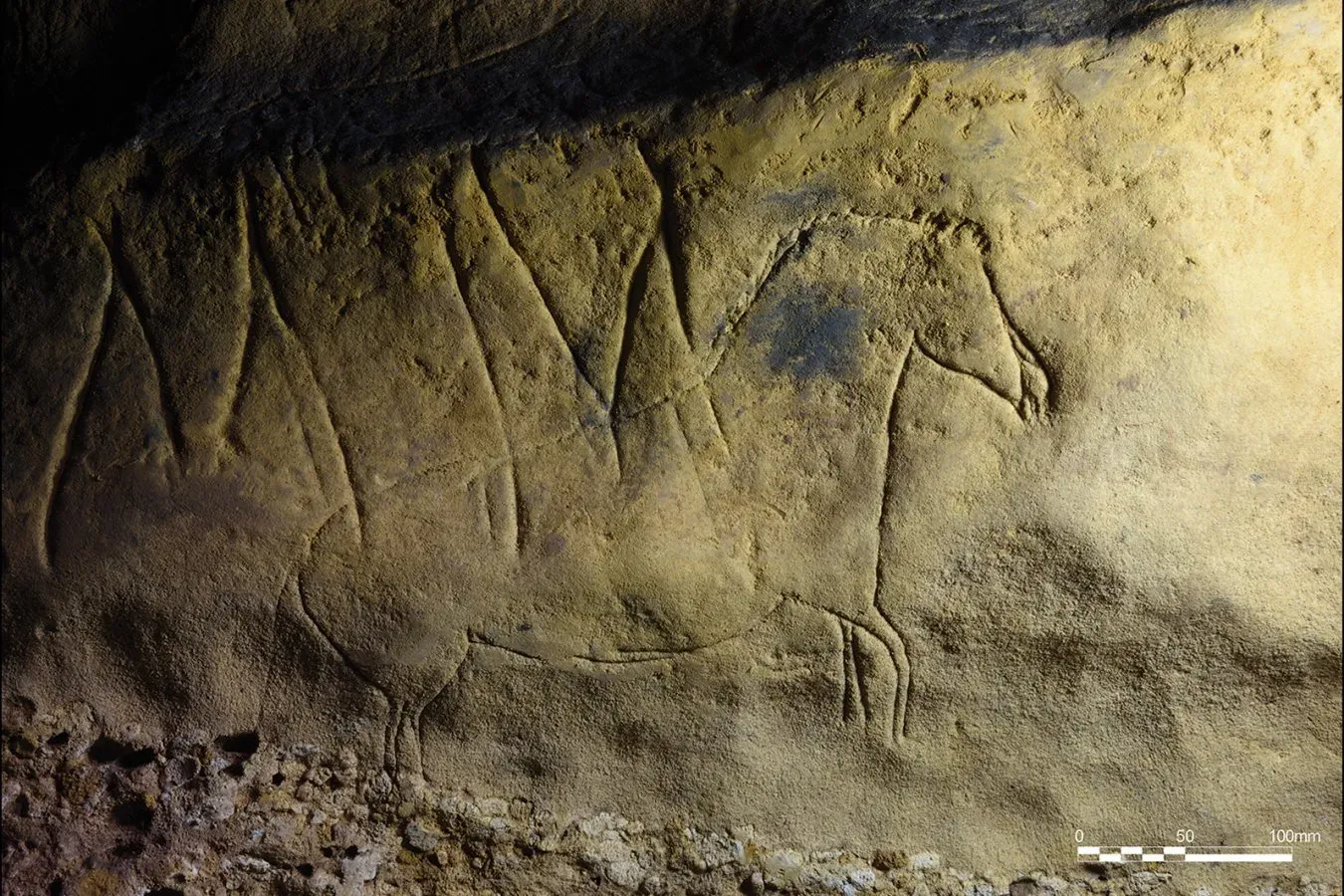
A remarkable discovery has been made in a Spanish cave where hundreds of prehistoric engravings have gone unnoticed for decades. The images were found at Cova de la Font Major, a popular tourist attraction west of Barcelona.
The cave's rock art was stumbled upon by Josep Maria Vergès from the Catalan Institute of Human Paleoecology while he was working at the site. A group of tourists wearing wetsuits had emerged from a nearby opening that led into a small side gallery, drawing his attention.
Vergès investigated further and found the walls covered with names and dates engraved by people who had passed through since 1957. He removed his helmet to examine them more closely and used a headlamp to illuminate the wall with raking light, creating shadows in the incised grooves.
The rock art at Cova de la Font Major is not just a collection of random engravings; it includes dozens of prehistoric animal images.
The cave's walls revealed more than just ancient artwork - they also showed the skill and attention to detail of prehistoric artists. Vergès noticed that many of the engravings were figurative representations of different animals, adding depth to the collection.
Among the animal figures discovered so far are 55 distinct motifs, including a representation of a bear with ears shown in frontal perspective and with a slightly open mouth. This level of detail is a testament to the artistic skill of prehistoric humans. The engravings have been found alongside human occupation dating back between 26,000 and 41,000 years.
Researchers are now faced with the challenge of accurately dating the engravings themselves. While it's difficult to pinpoint an exact age for each engraving, based on their style, art experts believe that many of them are likely over 19,000 years old.
The cave's rock art has sparked debate among experts about its meaning and significance. Some engravings depict animals, while others appear to be non-figurative symbols or patterns. The team identified groups of lines arranged in various configurations, including twos, threes, fours, and even up to 40 straight, parallel lines.
These arrangements have led to numerous theories among experts about their possible meanings. Some believe they may represent abstract concepts or natural phenomena, while others think they could be symbols or codes used by the ancient artists. The exact significance of these engravings remains unclear, leaving room for further research and interpretation.
The discovery has also shed new light on the distribution of Palaeolithic art in western Europe. Previously, there was a gap in knowledge about this region's rock art, but the findings from this cave help to fill that gap. The age of the rock art is yet to be determined, but it is clear that it was created by a Palaeolithic culture.
Experts are excited about the new discoveries at this site and others like it, which reveal evidence of an ancient painting tradition. This find has significant implications for our understanding of human artistic expression in prehistoric times, with many of the engravings likely dating back more than 19,000 years.
Facts based on reporting originally published by New Scientist.
You may republish this story, in full or in part, if you credit News Central Site and link to it (licence CC BY 4.0). Photos are not included.