Andes Hantavirus Infection Mechanism Uncovered
Scientists have made significant progress in understanding how the Andes hantavirus infects human cells by identifying a novel mechanism of receptor capture during infection.
A recent outbreak on a cruise ship has highlighted the urgent need for effective treatments against Andes hantavirus, which killed three passengers and left 13 others severely ill earlier this year.
The virus's lack of approved vaccines or treatments makes it a significant public health concern, with scientists at Albert Einstein College of Medicine leading the charge in understanding its mechanisms. Researchers from Institut Pasteur and LSU Health Shreveport collaborated on a study published in Nature, shedding light on how the virus interacts with human cells.
According to Kartik Chandran, co-corresponding author of the study, his team had previously identified that Andes virus uses a specific protein on the cell's surface, called a receptor, to infect human cells. However, they were unable to determine exactly how the virus recognized this receptor eight years ago.
The latest research from Chandran and colleagues has now solved this puzzle, revealing a novel way in which the virus captures its receptor during infection. This breakthrough could potentially lead to effective therapies against Andes virus and other hantaviruses by targeting the resulting viral vulnerability.
Chandran is a professor of microbiology and immunology at Einstein and holds several prestigious titles, including the Gertrude and David Feinson Chair in Medicine and the Harold and Muriel Block Faculty Scholar in Virology.
Hantaviruses are a diverse group of viruses primarily carried by rodents and can cause severe respiratory illnesses in humans.
The Andes virus stands out from other hantaviruses as it has been known to spread between people through close contact, often resulting in serious illness or death.
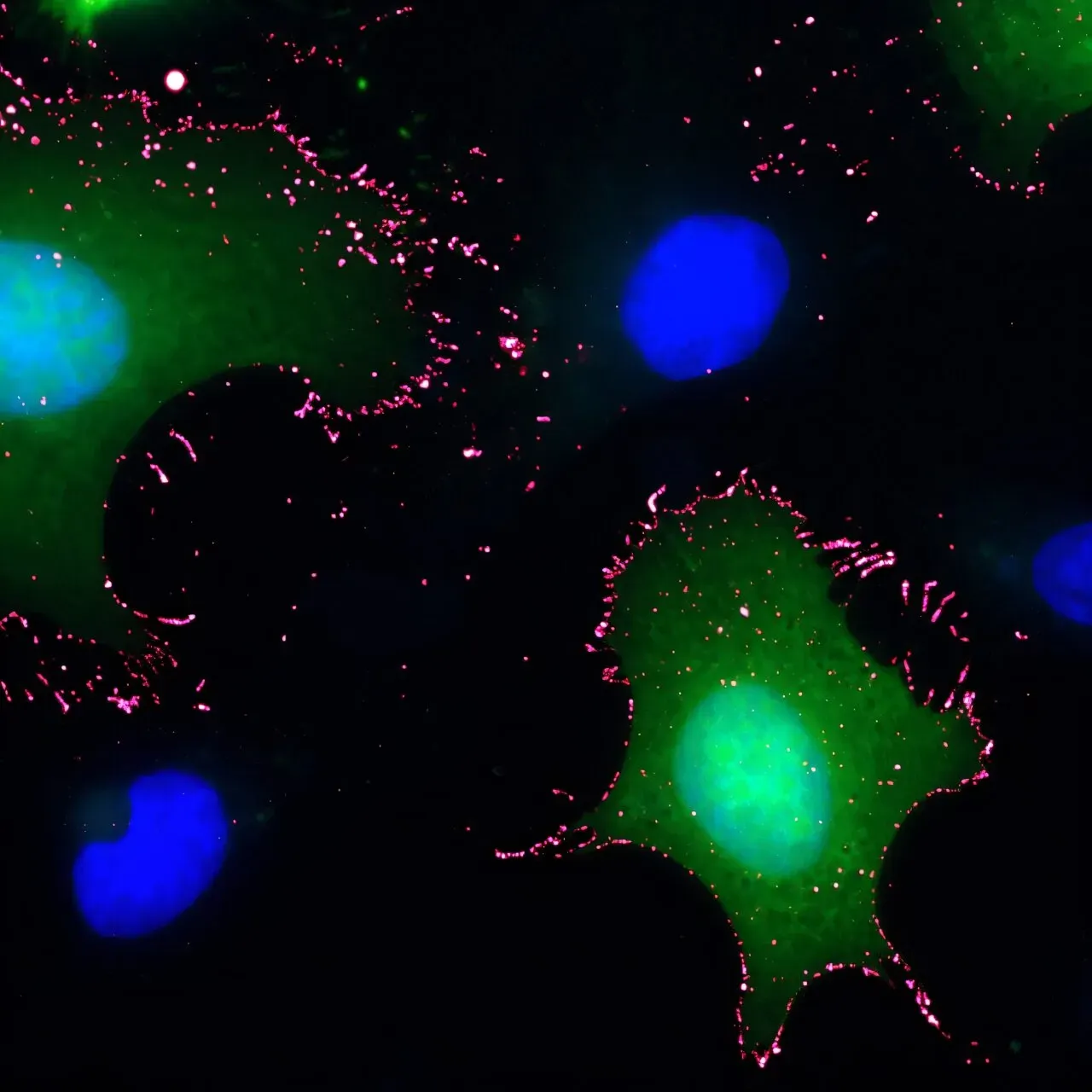
To infect human cells, the Andes virus relies on its surface spike protein attaching to a specific receptor called PCDH1. This receptor acts as a gateway for the virus to enter and multiply within the cell.
The researchers had previously identified PCDH1 as the key target for the Andes virus's spike protein, but a crucial question remained unanswered: how exactly does this attachment occur?
In contrast to most viruses, hantaviruses exhibit an unusual characteristic, where their spike proteins do not form in the same way as those of other viruses.
The researchers used advanced techniques to study how the Andes virus attaches to human cells at the very beginning of infection.
To achieve this, they employed cryo-electron microscopy to obtain a detailed image of the virus's structure, and developed new methods to stabilize its unique square-shaped spike in a test tube.
This square-shaped arrangement is made up of four identical protein units that are locked together, unlike many other viruses which have individual protein units that can bind directly to their receptors.
The researchers used an artificial intelligence-designed scaffold to help keep the Andes virus spike intact and stable during the experiment, allowing them to observe its interaction with a key receptor called PCDH1.
The researchers have made significant progress in understanding how the Andes hantavirus attaches to human cells by binding to a specific receptor called PCDH1.
A key discovery was that a single molecule of PCDH1 embeds itself into the heart of the virus spike by binding into a deep groove or pocket at its center, allowing for a stable interaction.
This finding has important implications for designing treatments that block the virus's attachment to human cells, as it reveals the molecular specifics of the interaction between the virus and the receptor.
The researchers noted that the depth of this pocket also helps explain how the virus limits antibody access, making it harder for antibodies to prevent the virus from binding to PCDH1.
The same pocket can accommodate the receptor while restricting antibody access, due in part to the long, slender shape of PCDH1, which allows it to reach deep inside.
The research team has identified a potential weakness in the Andes hantavirus that could be targeted by new antiviral medicines.
By exploiting this vulnerability, scientists may be able to block the virus's ability to attach to human cells and cause disease. This approach is based on the understanding of how human antibodies interact with the virus, as well as the development of "long and skinny" molecules that can reach deep into the protein pocket where the virus binds.
The creation of these targeted molecules could provide a blueprint for the development of new treatments against the Andes hantavirus and its close relative, Sin Nombre virus. This is particularly urgent given the severity of disease caused by these viruses in the Americas.
Researchers believe this work will contribute to the discovery of new protective strategies that can effectively combat these high-consequence pathogens.
Facts based on reporting originally published by Phys.org.
You may republish this story, in full or in part, if you credit News Central Site and link to it (licence CC BY 4.0). Photos are not included.