NASA's DART Spacecraft Collision with Dimorphos Visualized
A European Space Agency presentation has released images captured by the Hera spacecraft showing the aftermath of the DART mission's collision with Dimorphos.

NASA's DART spacecraft made headlines five years ago when it intentionally collided with Dimorphos, an asteroid orbiting Didymos, in a mission to alter its trajectory. The experiment was deemed a success, marking the first time humans had moved the orbit of a celestial object. This groundbreaking achievement has now been visualized through images released by the European Space Agency.
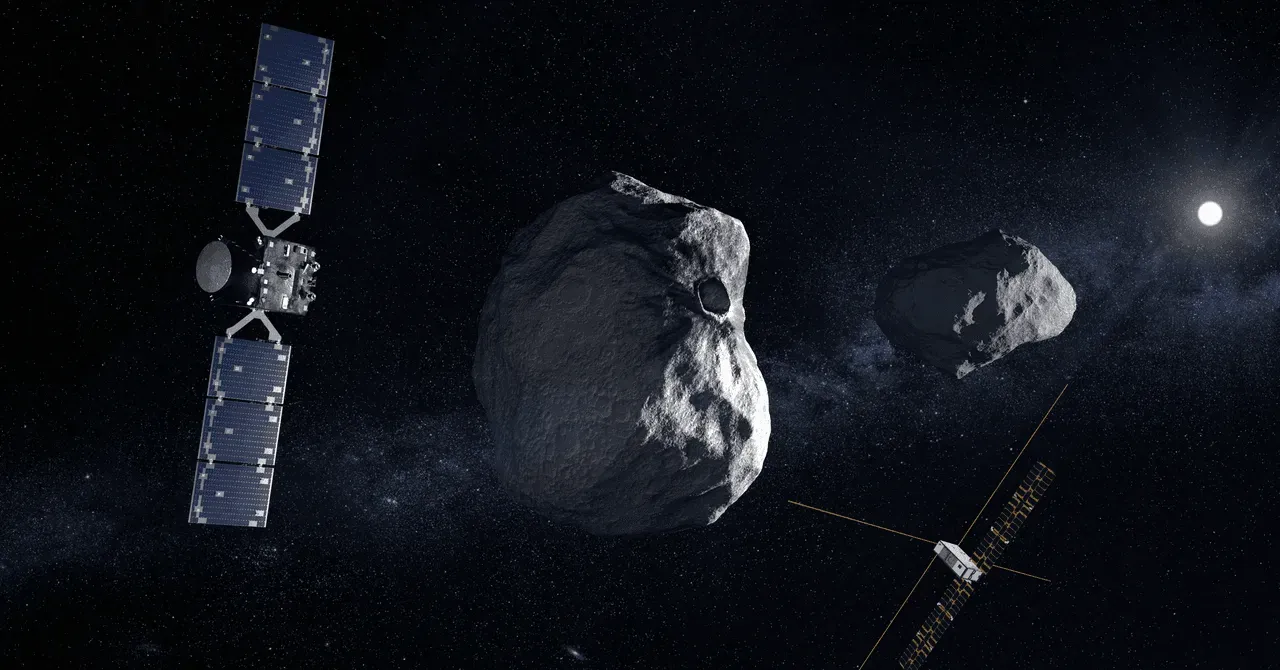
The ESA's presentation on Tuesday offered a rare glimpse into the aftermath of the collision, showcasing the damage inflicted on Dimorphos. Captured by the Hera spacecraft, which was launched in October 2024 and spent two years studying the asteroid from close range, these images provide valuable insights into the effects of the mission. The Hera mission involved multiple components, including CubeSats designed to measure, map, probe, and eventually land on Dimorphos.
Prior to the collision, telescopes on Earth and the Hubble Space Telescope were the only instruments capable of observing the impact and the resulting debris cloud. However, these observations were limited in their ability to assess the extent of damage or any potential changes to the asteroid's orbit. The lack of high-resolution images made it difficult for scientists to fully understand the effects of the mission.
The European Space Agency's presentation has shed new light on the consequences of the DART mission, providing a detailed visual record of the collision and its aftermath. Further analysis of these images will likely reveal more about the impact and the asteroid's response to the collision, offering valuable insights for future space exploration and asteroid manipulation missions.
The collision between DART and Dimorphos was a complex event to predict and analyze. Initially, estimates suggested the impact would create a relatively small crater, approximately 20 meters in diameter. However, images captured by Hera revealed that the damage was far more extensive than anticipated.
The extent of the destruction is evident from the before-and-after comparison. The asteroid's original shape resembled an egg, but after the collision, it appears to have been transformed into a deviled egg or kidney bean-like structure. This significant change in shape underscores the immense force unleashed by DART's impact on Dimorphos.
The effects of the collision extend beyond the physical transformation of the asteroid. Scientists had expected Dimorphos to remain tidally locked to its parent body, Didymos, similar to how our moon is tied to Earth. However, images from Hera have confirmed that Dimorphos now exhibits a more erratic rotation pattern, defying initial predictions.
The new observations provide valuable insights for future space missions aimed at manipulating asteroids. Researchers will carefully study the data collected by Hera to better understand the consequences of such collisions and refine their strategies for asteroid manipulation.
The unexpected outcome of the DART impact on Dimorphos has provided a welcome surprise for the ESA's Hera mission team. Initially, it was thought that the asteroid would maintain its tidally locked position, but new images reveal a radical change in Dimorphos' rotation.
According to Michael Kueppers, ESA Hera Mission Specialist, the asteroid now appears to be spinning erratically, as if undergoing rapid rotation. This unusual behavior is likely due to the massive impact caused by DART, which has disrupted Dimorphos' previous stable rotation pattern.
The unexpected change in Dimorphos' rotation has significant implications for the Hera mission's objectives. Ian Carnelli, ESA mission manager, notes that this new development will enable the Hera spacecraft to capture images of Dimorphos from multiple angles, providing valuable insights into its composition and structure.
The presence of debris surrounding the two asteroids is another unexpected discovery made by the Hera team. Despite initial concerns about a clear debris field, Kueppers reveals that over 100 boulders have been identified, marked as white dots in the provided image.
The Hera mission has already yielded three significant discoveries in its first 20 days, a remarkable start to what is expected to be a six-month journey.
Despite being an engineering challenge, NASA's planetary defense test has been deemed an overwhelming success, with the agency's predictions about the asteroid's orbit being significantly surpassed. The team had hoped to shorten Dimorphos' orbit by at least 73 seconds, but ultimately achieved a reduction of nearly 33 minutes and 15 seconds.
The large amount of debris created as a result of the impact played a crucial role in amplifying the effect, scientists have found. This unexpected outcome has been studied closely, providing valuable insights into the physics involved in such collisions.
More images and discoveries are expected to emerge from the Hera mission in the coming months, offering further opportunities for scientific analysis and exploration.
The Hera mission has provided scientists with valuable insights into the effects of colliding a spacecraft with an asteroid. The impact altered the orbit of Didymos and its moon, Dimorphos, causing them to shift in their path around the sun by approximately 11.7 microns per second.
This subtle change may seem insignificant at first glance, but it has a cumulative effect over time. In fact, it adds up to about 1 kilometer every 2.7 years, which could potentially be used to steer large asteroids away from Earth's orbit with enough time and the right strategy.
The findings also indicate that the impact was more severe than initially estimated, providing valuable data for NASA and the European Space Agency to analyze and incorporate into future plans for asteroid deflection missions.
Facts based on reporting originally published by CNET.
You may republish this story, in full or in part, if you credit News Central Site and link to it (licence CC BY 4.0). Photos are not included.