Measles No Longer Eliminated in US According to CDC Data
The United States is no longer considered to have eliminated measles due to a surge in cases across the country, with over 5,400 reported so far this year.
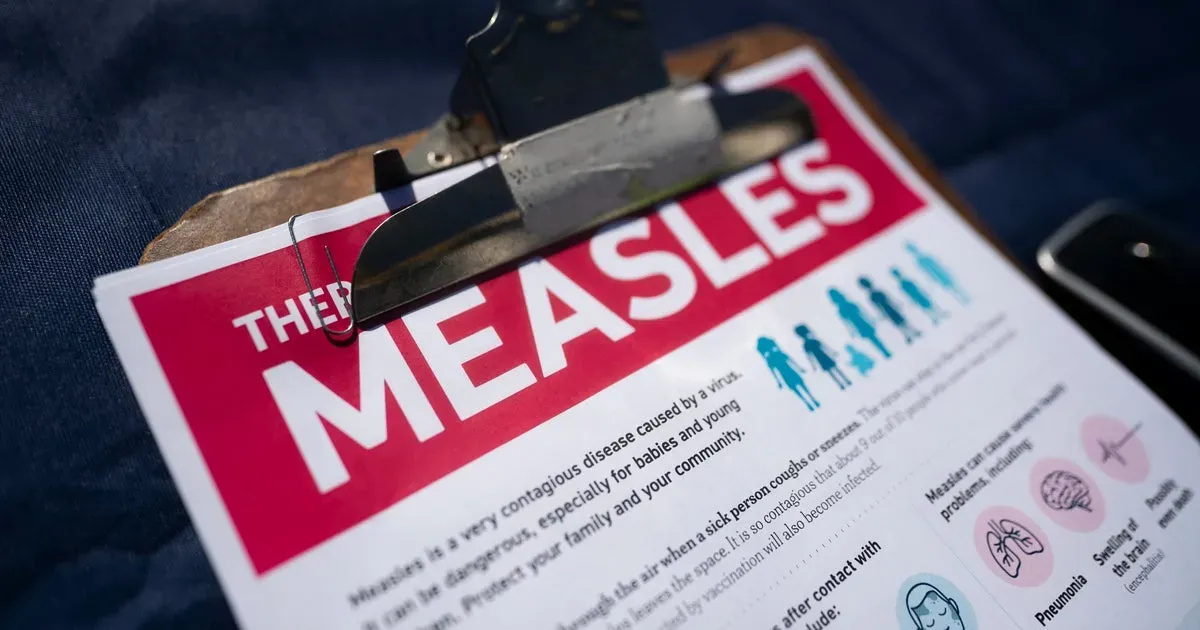
The United States is no longer considered to have eliminated measles, a status it had held since 2000. This change in classification comes after a surge in measles cases across the country. Researchers familiar with the decision confirmed this information on Saturday.
Measles cases are rising rapidly nationwide, with over 5,400 reported so far this year. This number is more than double the total from last year and marks a significant increase in just one year. The Centers for Disease Control and Prevention (CDC) has been tracking these numbers closely.
The Pan American Health Organization, which serves as a regional office for the World Health Organization, covers North and South America. On Tuesday, the agency will hold a news conference to discuss its findings on measles cases in the region.
According to CDC data, about one-third of this year's measles cases are linked to outbreaks that began last year and continue to spread today.
The Centers for Disease Control and Prevention (CDC) data reveals a stark reality: the ongoing surge in measles cases across the US has led to a critical erosion of population immunity. This decline is particularly evident in areas where vaccination rates have been consistently low.
According to medical experts, losing measles elimination status means that the disease's spread can now be sustained within the population, posing a significant threat to public health. The consequence of this shift is that individuals who are not vaccinated become increasingly vulnerable to infection. In such scenarios, even small outbreaks can quickly escalate into larger, more complex chains of transmission.
Dr. Céline Gounder explained that when a region has achieved measles elimination status, its high vaccination rates typically prevent the disease from spreading rapidly. However, with significant gaps in population immunity, the risk of exposure and infection increases significantly. "It means ERs and pediatricians need to consider measles in anyone with a fever and rash, whether they've traveled overseas or not," Gounder emphasized.
The loss of measles elimination status has also been described as a setback for the nation's public health infrastructure by Dr. Omer Awan, a trained epidemiologist. He pointed out that this development requires healthcare providers to re-evaluate their approach to diagnosing and managing patients presenting with fever and rash symptoms.
The resurgence of measles cases in the US has led to a reversal of its measles elimination status, a concerning development for public health officials.
To regain this status, countries must demonstrate a high level of vaccination coverage and effective surveillance systems to quickly detect and respond to outbreaks.
According to experts, maintaining a vaccination rate of at least 95% is crucial to preventing the spread of measles, along with having robust laboratory capacity and prompt response mechanisms in place.
Maintaining these measures would require significant efforts from healthcare providers, policymakers, and the public to ensure that accurate information about vaccines reaches everyone.
The easing of vaccination opt-out rules has been implemented in nine states, allowing individuals to bypass school immunization requirements more easily since 2025. This shift has led to a noticeable increase in kindergarten vaccination rates in states that have eliminated non-medical exemptions.
A notable trend is emerging as legislatures reconvene in January, with the possibility of further changes to vaccination policies on the horizon. Meanwhile, some states are seeing an uptick in vaccination rates among kindergarteners, rising by 2 to 4 points compared to previous years.
The Centers for Disease Control and Prevention has been tracking measles data since 1912, revealing a disturbing pattern. Each year, approximately 6,000 measles-related deaths were reported during the first decade of data collection. Prior to widespread vaccination efforts, it's estimated that nearly 3 to 4 million people contracted measles before reaching their 15th birthday.
In response to these trends, public health measures have been employed to contain outbreaks, as seen in 2015 and 2018-19. The Disneyland outbreak was linked to unvaccinated individuals who had traveled overseas, while the New York outbreak was eventually brought under control through targeted interventions, including restrictions on vaccine exemptions.
The surge in measles cases across the United States has led to a significant increase in hospitalizations and deaths. According to CDC data, there were 245 hospitalizations, mostly among children, last year, resulting in three measles-related fatalities.
A total of 44 states have reported infections, with the number of cases reaching its highest level in over three decades. The situation is particularly concerning, given that almost all cases are linked to individuals who had not received a vaccination against the disease.
The CDC has reported 43 new outbreaks so far this year, with about a third of the total cases tied to ongoing outbreaks from last year. These outbreaks have been identified as clusters of three or more related cases.
Measles is highly contagious and typically affects those who are unvaccinated for the disease, making them most at risk of contracting it.
Measles can cause severe infections in the lungs and brain, leading to serious health consequences for those who contract it.
Two doses of the MMR vaccine have been proven through extensive medical research to be highly effective at preventing measles, making vaccination a crucial tool in controlling outbreaks.
For certain individuals, such as pregnant women or people with weakened immune systems, getting vaccinated against measles is not an option, and they rely on herd immunity to protect them from the disease.
Facts based on reporting originally published by CBS News Health.
You may republish this story, in full or in part, if you credit News Central Site and link to it (licence CC BY 4.0). Photos are not included.