Massive Protest Against Government Plan for Public Media Funding
Tens of thousands of protesters gathered in Prague's Letná Park on Sunday to voice their opposition to a government plan that would overhaul the funding of public broadcasters.
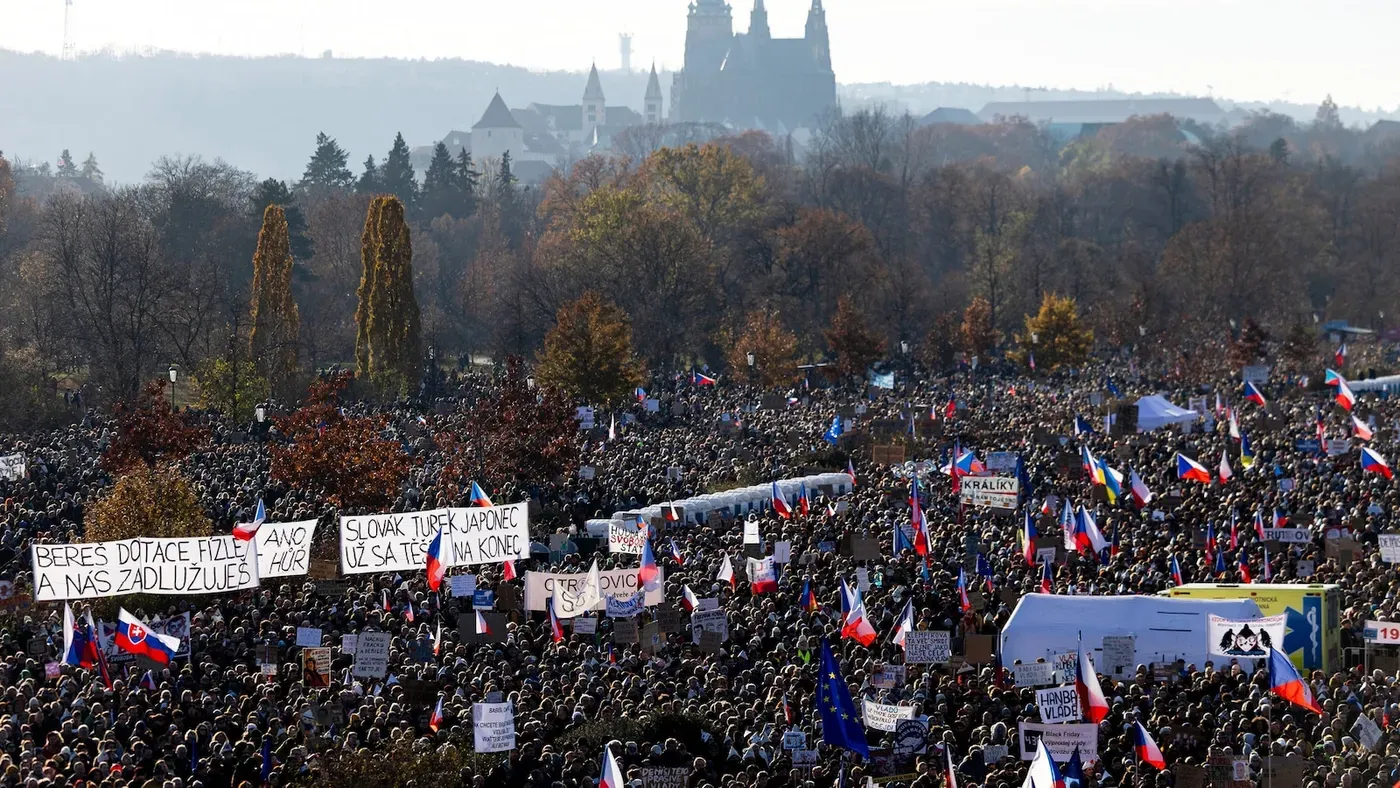
Tens of thousands of protesters gathered in Prague's Letná Park on Sunday to voice their opposition to a government plan that would overhaul the funding of public broadcasters. The massive rally drew an estimated 350,000 people, making it one of the largest demonstrations in recent Czech history.
The protesters, who were largely peaceful and enthusiastic, expressed concern that the government's plan would erode media independence and democracy. They argued that the current system, which relies on regular fees paid by individuals, households, and businesses, is more transparent and accountable than the proposed state budget-based financing model.
The rally was a powerful reminder of the country's rich democratic heritage, particularly its Velvet Revolution in 1989, when huge crowds gathered at Letná Park to demand an end to communist rule. The protesters' demands were clear: they wanted the government to withdraw its plan and preserve the independence of public media.
As the lead organizer Mikuláš Minář pointed out, "We do witness here something extraordinary today." His words reflected the sense of urgency and determination that characterized the rally, which was organized by the Million Moments for Democracy group.
The proposed overhaul of public media funding has sparked widespread concern among Czech citizens, who see it as a threat to their democracy.
Critics argue that the plan would give the ruling coalition too much control over the media, allowing them to manipulate information and suppress dissenting voices. This fear is not unfounded, given the examples set by populist governments in neighboring countries like Slovakia and Hungary.
The speed at which the plan was pushed through the lower house of Parliament on October 24 has only added to the sense of unease. Lawmakers limited the opposition's speaking time to a mere 4:36 a.m., effectively silencing their voices before voting on the bill.
Public media employees, backed by labor unions, universities, students, churches, artists, athletes, and international organizations, took to the streets in protest, with thousands gathering to demonstrate against the rushed process. The strike that followed on November 3 highlighted the depth of opposition to the plan.
The European Parliament has also weighed in on the issue, debating media freedom and the rule of law in the Czech Republic. EU Justice Commissioner Michael McGrath emphasized the need for transparent and objective criteria in funding public service media.
The Czech government's plan to overhaul funding for public media has sparked widespread protests across the country, with thousands gathering in major cities to express their disapproval. Despite the opposition, Prime Minister Babiš remains committed to pushing forward with the proposal.
Babiš' ANO movement returned to power after last year's election, forming a coalition with two smaller parties: Freedom and Direct Democracy, known for its anti-migrant stance and pro-Russian leanings, and Motorists for Themselves. The government has been at odds with key EU policies on environmental issues and migration, as well as rejecting financial aid for Ukraine.
Critics of the government have also targeted its defense policy, accusing it of failing to meet NATO's spending requirements and demanding the resignation of Defense Minister Jaromír Zůna. The protests demonstrate a growing discontent among Czech citizens towards their government's handling of various issues.
Facts based on reporting originally published by ABC News International.
You may republish this story, in full or in part, if you credit News Central Site and link to it (licence CC BY 4.0). Photos are not included.