Mars Canyon System Found to be Experiencing Tectonic Activity
A new study has revealed tectonic activity in Mars' Valles Marineris canyon system despite previous assumptions about the planet's geological inactivity.
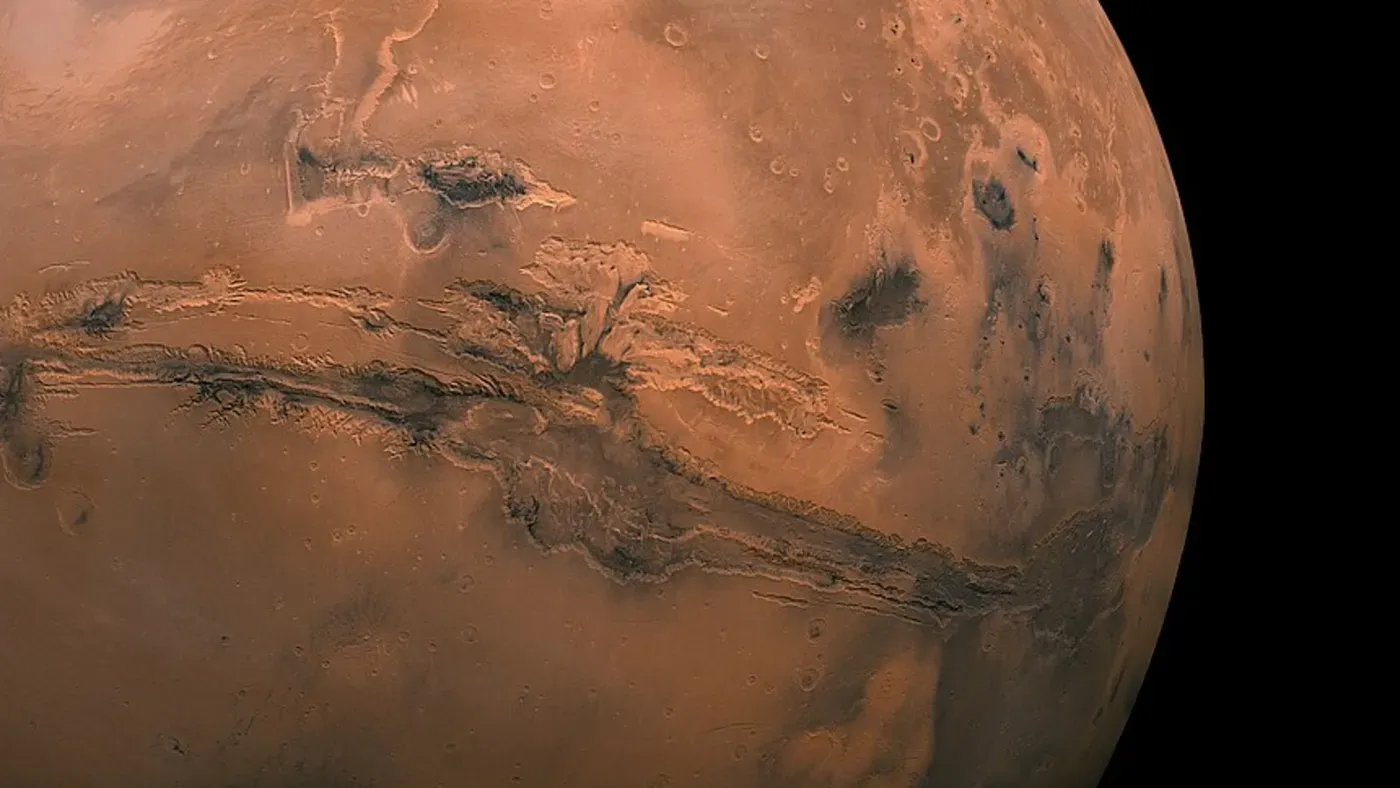
A groundbreaking discovery has revealed that Mars' largest known canyon system, Valles Marineris, is still experiencing tectonic activity despite the Red Planet's geological inactivity. This finding contradicts previous assumptions about Mars' geology.
NASA's InSight lander detected a powerful marsquake on August 25, 2021, which was initially identified as S0976a. The quake was notable not only for its immense power but also for its unusual characteristics. Unlike most marsquakes triggered by meteorite impacts near the lander, S0976a originated from the opposite side of Mars.
The new study, published in Nature Communications on October 15, reexamined the seismic wave data and found that the quake's source was a fault line running below Valles Marineris.
The discovery of tectonic activity in Valles Marineris, one of the most impressive geological formations in our solar system, has shed new light on the Martian surface.
Valles Marineris is an enormous network of interconnected gullies and ravines that stretches for approximately 2,500 miles, making it roughly ten times longer than the Grand Canyon. Its sheer scale is awe-inspiring, with some sections reaching widths up to 20 times greater than its Earthly counterpart.
The massive chasm's depth also poses a significant challenge, as it can reach depths of up to five times that of the Grand Canyon. This means that anyone attempting to climb out would face an arduous task, potentially taking several months to complete.
This enormous geological structure has long been considered a "dead world, with its tectonic activity thought to be inactive for millions of years. However, recent seismic data suggests otherwise, revealing the presence of hidden crustal cracks that are still capable of producing significant movement.
The Mariner 9 Chasm on Mars stretches across the planet's surface like a massive scar, visible from space. Its sheer size is awe-inspiring, and it is situated near the Tharsis region, which boasts some of Mars' most impressive geological features. Among these are the towering volcanoes that dominate the Martian landscape, including Olympus Mons, the largest volcano in the solar system. This colossal structure stands at an incredible height, dwarfing our own Mount Everest by a factor of three.
The presence of such massive volcanoes on Mars is a testament to the planet's past geological activity. Scientists believe that Mars was once geologically active and may have even been more dynamic than Earth. The sheer scale of these volcanic formations suggests that Mars was capable of producing immense tectonic movement in the distant past.
However, recent seismic data has revealed some surprising information about the Martian surface. It appears that the planet's crust is not as static as previously thought. In fact, there are hidden cracks and fissures beneath the surface that are still capable of producing significant movement.
The reason for Mars' relatively unchanged surface over the past 3 billion years is attributed to its smaller size and slower cooling core. This means that the Martian core and mantle have cooled much faster than Earth's, resulting in less dynamic activity.
Mars' crust is not as lifeless as previously thought, with new research suggesting that tectonic activity may still be present on the Red Planet.
The discovery of fault lines on Mars has long been seen as evidence of a planet in decline, but these are actually giant cracks in its crust rather than boundaries between tectonic plates. Some of these faults are visible at the surface, and they provide valuable clues about the planet's internal dynamics.
Researchers have identified a slip-strike marsquake" where blocks of crust move horizontally past each other along a steep fault line. This type of seismic activity is significant because it indicates that tectonic forces may still be at work beneath Mars' surface.
The researchers used data from NASA's InSight lander to pinpoint the epicenter of the marsquake, which occurred between 12 and 25 miles below Valles Marineris. The team simulated several alternative explanations for the seismic activity but concluded that a slip-strike marsquake was the most plausible explanation.
Researchers analyzing data from NASA's InSight lander have identified a massive chasm on Mars that shows signs of ongoing tectonic activity.
The finding is significant because multiple lines of evidence point to seismic activity in the region, known as S0976a. This suggests that the chasm is not just a static geological feature, but an area where the Martian crust is still being shaped by forces deep beneath the surface.
The discovery has implications for our understanding of Mars' geology and raises hopes that similar tectonic activity could be detected on other planets in the solar system, potentially revealing new insights into their internal dynamics.
The discovery of a gigantic chasm on Mars has significant implications for our understanding of the planet's geology, and it appears that the tectonic activity responsible for its formation is still ongoing.
A recent study has revealed that seismic waves generated by marsquakes have traveled through the core of Mars, providing valuable insights into the planet's internal structure. This information was gleaned from archived data collected by NASA's InSight lander before it ceased operations in December 2022 due to a dust storm that covered its solar panels.
The study suggests that the chasm on Mars is still experiencing tectonic activity, which could potentially be detected on other planets in our solar system. This raises hopes of uncovering new insights into their geology and composition.
Facts based on reporting originally published by Live Science.
You may republish this story, in full or in part, if you credit News Central Site and link to it (licence CC BY 4.0). Photos are not included.