Hydrogen Peroxide Production Efficiency Boosted by New Catalyst
A light-activated catalyst has been developed, significantly enhancing efficiency in hydrogen peroxide production. This breakthrough could reduce the environmental footprint of an important chemical feedstock widely used across various industries.
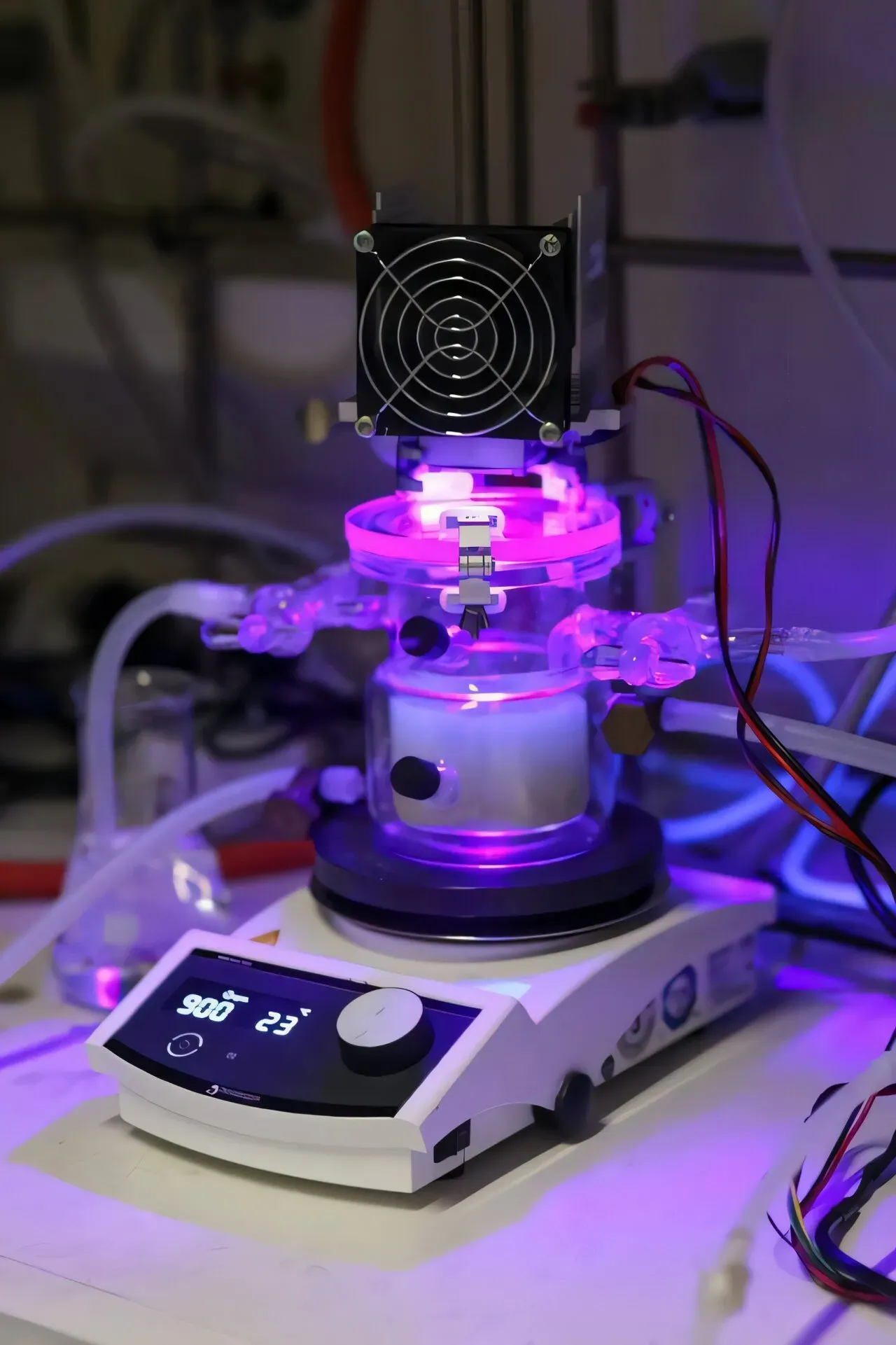
A breakthrough in sustainable production has been achieved with the development of a light-activated catalyst that significantly enhances efficiency in hydrogen peroxide production. This versatile chemical feedstock is widely used in various industries due to its environmental benefits.
Hydrogen peroxide is an oxidizing agent that breaks down into harmless water and oxygen when decomposed, making it an attractive "green chemical" for use in wastewater treatment, household disinfection, and medical applications. As demand continues to rise, production volumes are increasing, but the current industrial process has a substantial environmental footprint.
The traditional anthraquinone process used to produce hydrogen peroxide is energy-intensive and contributes significantly to carbon emissions. In contrast, photocatalysis offers a promising alternative that harnesses light energy to drive chemical reactions without relying on fossil fuels.
Photocatalysts are materials that absorb light and use its energy to facilitate chemical reactions. The efficiency of these reactions depends on the ability of charges generated by light to move through the material and remain available for driving the reaction.
The research group behind this innovative photocatalyst decided to explore how its properties could be optimized from the outset, during the assembly process. This involved rethinking the traditional approach to creating these materials, where the focus is on modifying their chemical composition.
To achieve this goal, the researchers turned to organic-inorganic ionic cocrystals, which offer a level of precision in predicting the distribution of ions within the crystal structure. By using this approach, the team developed a new material called CALiK, a crystalline carbon nitride that belongs to the polyheptazine imide (PHI) class.
CALiK contains lithium and potassium ions arranged in a specific spatial environment, which is a significant departure from conventional production methods where these ions are introduced randomly. This precise arrangement of ions was already present in the cocrystals used as precursors for carbon nitrides.
The researchers were drawn to this approach because it allowed them to study the influence of the synthesis strategy on material properties independently of chemical composition. By comparing CALiK with materials produced using other methods, they could isolate the effects of the chosen synthesis route.
A key aspect of this work is that the cocrystals used as precursors for carbon nitrides contain the same chemical components as those typically employed in conventional production methods. This similarity makes it easier to understand how the ions are distributed within the material and how their arrangement affects its properties.
The development of CALiK represents a significant step forward in understanding the relationship between synthesis strategy and material performance, which could have far-reaching implications for photocatalyst design and optimization.
The spatial arrangement of ions within the catalyst is crucial for its performance, according to researchers who have developed a new material that outperforms existing ones in producing hydrogen peroxide under light activation.
The optimized material, CALiK, contains two types of cations and achieves significantly better results than comparable materials. It produces around three times as much hydrogen peroxide as the conventionally prepared comparison material KPHI, and about 40% more than a top-performing material that contains only one type of cation.
When exposed to light at a specific wavelength, CALiK demonstrates an exceptional ability to convert photons into electrons that drive the chemical reaction. Its apparent quantum yield is measured at 58%, the highest among the catalysts compared in this study.
The researchers attribute the improved performance of CALiK to its unique ion arrangement, which enables charges generated by light to separate more effectively and remain available for a longer period. This allows for a more efficient use of oxygen during the reaction.
Further calculations suggest that the spatial distribution of lithium ions within CALiK creates an environment conducive to oxygen activation, facilitating the chemical process. While these findings are based on simplified models, they offer valuable insights into optimizing polymeric photocatalysts during their synthesis.
The research team has made significant strides in optimizing the synthesis of polymeric photocatalysts for the sustainable production of hydrogen peroxide. They found that ionic cocrystals can be programmed to create spatially organized structures within carbon nitrides, which significantly enhances their catalytic activity.
This innovative approach enables the efficient photosynthesis of hydrogen peroxide, a crucial step in various industrial processes. The findings offer valuable insights into optimizing polymeric photocatalysts during their synthesis and have the potential to make sustainable production more efficient.
Facts based on reporting originally published by Phys.org.
You may republish this story, in full or in part, if you credit News Central Site and link to it (licence CC BY 4.0). Photos are not included.