Groundbreaking Discovery Made at Penascosa Rock Art Site
Archaeologists have unearthed small stone tools used by prehistoric hunter-gatherers near ancient engravings in Portugal's Côa valley.
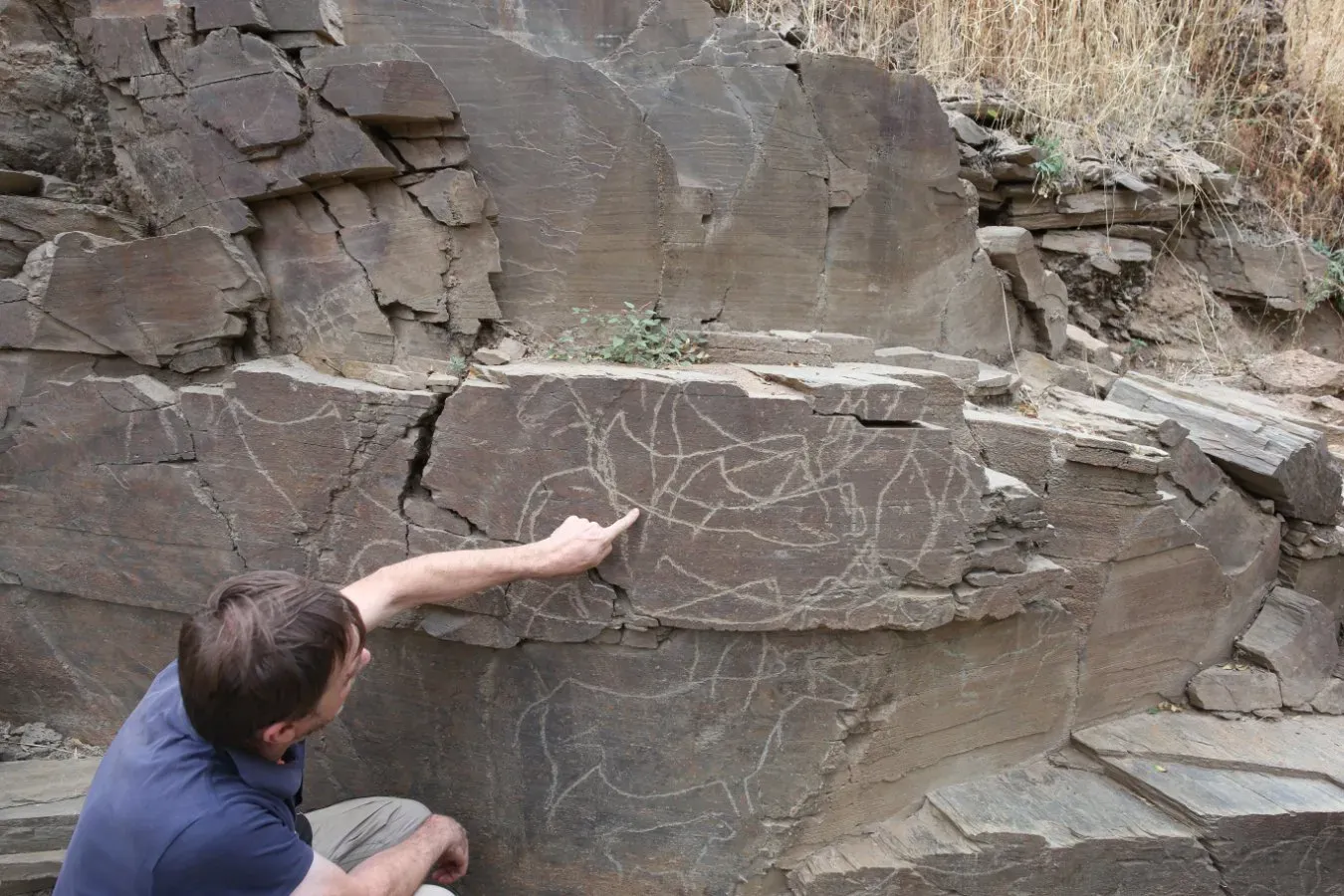
Archaeologists have made a groundbreaking discovery at the Penascosa rock art site in Portugal's Côa valley. Under the early morning light, a faded carving of an aurochs, a wild ox that roamed the region during the last ice age, can be seen on one of the engravings.
The team, led by Thierry Aubry from the Côa Park Foundation, has been excavating beside the engravings for three weeks. Their search was focused on finding ancient tools that could help them understand the purpose of the valley's oldest rock art.
On their final day of digging, they finally unearthed what they were looking for: small pieces of stone used as hunting weapons by prehistoric hunter-gatherers. These tiny blades are a significant find and provide crucial evidence about the people who created the engravings.
Aubry is thrilled with the discovery, saying that this technology dates back to 26,000 years ago. The presence of these tools near one of the most important rock art panels in the Côa valley suggests that art was not just a sacred or remote activity but an integral part of daily life for our ancestors.
The excavation has also uncovered other remains, including flaked tools and hearths, indicating that people made fire and used various utensils close to the engraved panel. This finding lends weight to Aubry's theory that "they were living inside the art".
These stone tools offer valuable insights into the social context in which the rock art was created and viewed. They reveal how it influenced interactions between groups of people who came to Côa to hunt and interact, shaping their encounters in meaningful ways.
The sheer scale of the rock art at Côa valley is a significant discovery in itself, with over 17 kilometres of river valley featuring intricate engravings that date back thousands of years.
These engravings were first unearthed in 1991 and have since been found to be remarkably well-preserved despite being exposed to the elements. According to researcher Luís, this is due to a combination of factors, including the dry climate and lack of human disturbance.
The presence of these open-air rock art sites has led to a fundamental shift in our understanding of prehistoric human culture, with many experts now believing that such art was not limited to cave settings but was instead often displayed in public areas. This concept, dubbed a "Copernican revolution" by Luís, has far-reaching implications for the field of archaeology.
The Côa valley discovery has also prompted a new wave of exploration and research into similar sites across the Iberian peninsula and beyond. Stylistically similar engravings have been found in locations as distant as the Nile valley, suggesting that this form of artistic expression was widespread among prehistoric cultures.
Further research at Côa has focused on understanding why hunter-gatherers chose to create such a large number of engravings in this particular location. To shed light on this question, researchers have been investigating signs of occupation during the late Gravettian period at nearby Penascosa.
The search for evidence of human presence at Penascosa was initially met with skepticism due to concerns about the site's vulnerability to flooding and subsequent erosion. However, researcher Thierry Aubry is adamant that such obstacles can be overcome through careful excavation and analysis.
Despite initial doubts, researchers have made significant progress in uncovering the history of occupation at Penascosa, with a wealth of new information yet to be revealed. Further study of this site is likely to provide valuable insights into the lives and practices of prehistoric hunter-gatherers.
Archaeologists have been excavating a unique rock art site in Portugal's Côa valley, and their latest findings are shedding new light on the lives of prehistoric hunter-gatherers.
The team has discovered evidence of an ancient campsite, including fire-damaged rocks and flaked stone tools that date back to the late Gravettian and early Solutrean periods. This is significant because it shows that people were living at Penascosa during a time when the landscape was being monumentalised through rock art.
The presence of these tools suggests that hunter-gatherers were sitting around fires, manufacturing survival technologies as they went about their daily lives. This is not unlike the practices of certain Aboriginal Australian communities who continue to use rock art in similar ways today.
A particular tool made from three stone flakes was found at Penascosa and is estimated to be around 26,500 years old. It's a fascinating example of the kinds of artefacts that have been left behind by our ancient ancestors.
Further excavation revealed buried slabs of schist that had once formed a natural overhang, which the hunter-gatherers used as shelter until it collapsed due to heat from their campfires.
The sequence of artefacts uncovered at Penascosa provides a unique window into human history in the region, tracing the course of events from the Palaeolithic period right through to Roman times.
The team of archaeologists excavating Penascosa has made a significant discovery that sheds new light on the origins and significance of the site's unique rock art.
A key piece of evidence in orienting Penascosa within the social landscape of ancient Iberia is a collection of flint bladelets, which have been found to come from distant regions.
The team discovered that one of these bladelets originated from central Spain, at least 150 kilometres away from Penascoa, while another came from central Portugal, an even more substantial distance of over 200 kilometres.
This convergence of materials from such far-flung areas suggests that the Côa valley played a pivotal role in a vast network of exchange that spanned half of Iberia around 27,000 years ago.
The style similarities between the art at Penascosa and other sites in northern Spain or even as far away as the Rhône valley in France indicate that rock art functioned as a shared code of representation.
This shared code of representation was part of an extensive network of people who exchanged information, personnel and objects across vast distances.
The Côa valley may have been more than just another node in this network; its unique location at the border between the Atlantic coast and the Iberian interior makes it a prime candidate for being an important meeting place.
Archaeologists have long argued that the Côa valley was a social aggregation site where hunter-gatherers from across the region would come together to meet, hunt and interact.
The rock art found in the Côa valley is believed to have played a significant role in interactions between distant groups of hunter-gatherers.
At Fariseu, one of the decorated sites in the valley, archaeologists have discovered evidence that these groups repeatedly lived among the artworks, although they have yet to find occupation layers dating back to the late Gravettian period when the site's earliest engravings were created.
The artwork at Fariseu is characterized by a repeating series of motifs consisting of four female aurochs, each accompanied by a calf and apparently moving towards the nearby river. This composition has sparked debate among scholars about its purpose and meaning.
Archaeologists suggest that the images may have been used to establish relationships with other groups, highlighting the significance of the artwork in these interactions.
Some researchers propose that the Côa valley artists used animal motifs to represent humans, while others believe that the artworks conveyed information about large herbivores and how to hunt them.
The inclusion of young aurochs calves in the composition may indicate that the images depict specific moments in time, such as hunting behaviour during a particular season.
The unique rock art site discovered in the Côa valley has sparked new insights into the lives of ancient hunter-gatherers. The inclusion of young aurochs calves in the composition may indicate that the images depict specific moments in time, such as hunting behaviour during a particular season.
As people came together at these engraved sites, the artwork may have played a crucial role in facilitating interactions between different groups. This could have helped to foster cooperation and shared knowledge among strangers, ultimately benefiting their survival and hunting efforts.
Freelance archaeologist Paul Bahn notes that discoveries made in the Côa valley over the past three decades have significantly altered our understanding of Palaeolithic rock art. He points out that most of this ancient artwork was created outdoors, rather than exclusively within caves for ritual purposes.
By shifting our perspective and viewing these images as an integral part of everyday life, archaeologists can gain a deeper understanding of the lives and experiences of ancient hunter-gatherers.
Facts based on reporting originally published by New Scientist.
You may republish this story, in full or in part, if you credit News Central Site and link to it (licence CC BY 4.0). Photos are not included.