Protesters Flood European Streets Over Rising Living Costs
Thousands of protesters took part in demonstrations across several European countries over the weekend, voicing their discontent with rising living costs and demanding action from governments to alleviate the financial burden on citizens.
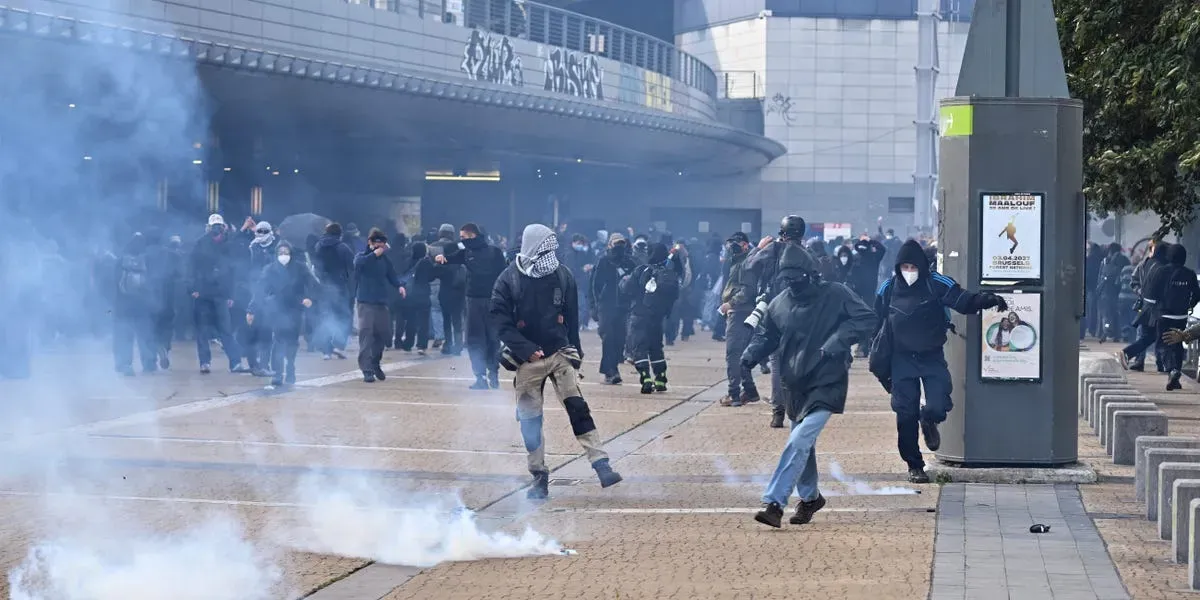
Protesters flooded the streets of major European cities over the weekend, voicing their discontent with rising living costs.
Clashes broke out in Brussels between protesters and police as demonstrators demanded action from their governments to alleviate the financial burden on citizens. The situation was particularly intense in Belgium's capital, where images captured violent confrontations between protesters and law enforcement.
The protests were not isolated to one country; France was also at the epicenter of civil unrest. However, other European nations such as Portugal, Italy, and Belgium witnessed significant demonstrations. Thousands took part in these gatherings, which often turned into riots.
Rising energy prices have been a major contributor to the escalating costs, with some attributing this increase to the ongoing conflicts between the US and Iran, as well as Russia and Ukraine. Demonstrations in Belgium and France were initially sparked by students but quickly gained momentum, drawing in union workers and other organizations.
Protesters in Lisbon took to the streets on October 17, calling for an increase in wages to combat the cost-of-living crisis and unaffordable housing. Organized by the CGTP, Portugal's largest trade union federation, thousands of workers participated in the demonstration, which was also held in Porto and Coimbra. The protesters' demands highlighted the pressing issue of low wages, with many struggling to make ends meet.
The economic strain is evident in statistics showing that 7% of the Portuguese population lives in overcrowded households. Moreover, a staggering 5% of the population faces housing insecurity. In Lisbon, the average rent has reached an unsustainable level, equivalent to 116% of the average salary. This means that many residents struggle to afford basic necessities, with rent exceeding monthly income by 16%. The situation is particularly dire in the capital city.
The issue of affordable housing has been a long-standing concern in Portugal. In recent days, activists had set up a tent camp in Praça D. João I, a central public square in Porto, to draw attention to rising housing costs. However, authorities intervened and removed the camp earlier this week, sparking further discontent among protesters who feel their voices are not being heard.
Violent clashes erupted in Brussels as police used water cannons to disperse protesters, including students demonstrating against rising education costs. The demonstrations, which have been ongoing for weeks, turned violent over the weekend, with video footage showing police using tear gas during confrontations.
Clashes also occurred in Liège, where protesters and police clashed on Saturday. In total, 195 people were arrested across the two cities, according to reports from The Brussels Times. The situation remains tense as authorities struggle to contain the unrest.
Looters damaged shop fronts and set objects ablaze in Milan's central square, Piazza del Duomo, one of the city's busiest tourist areas. The demonstration, which was held against wars and rising living costs, turned chaotic as protesters clashed with police.
Italian Prime Minister Giorgia Meloni sharply criticized the violent outbursts that marred protests across Italy, labeling those responsible as "thugs" who exploit demonstrations to wreak chaos and disrupt public order.
The PM's condemnation came after clashes between protesters and police turned ugly in major cities, with police estimates suggesting a turnout of around 5,000 in Milan, 3,000 in Turin, 2,000 in Bologna, 600 in Brescia, and 800 in Bergamo.
Facts based on reporting originally published by Business Insider.
You may republish this story, in full or in part, if you credit News Central Site and link to it (licence CC BY 4.0). Photos are not included.