Financial Strain on Families with Young Children Revealed by Survey
A recent survey found that four in five parents believe raising a child is too expensive, with two in every five describing their family's financial situation as "struggling" or "just getting by".
A growing number of parents are finding it increasingly difficult to afford the costs associated with having a baby, with four in five saying that raising a child is too expensive. This sentiment was revealed by a recent survey conducted by the University of Michigan Health C.S. Mott Children's Hospital National Poll on Children's Health.
The financial strain is particularly pronounced among parents of young children, with two in every five describing their family's financial situation as "struggling" or "just getting by". These families are likely to be experiencing significant pressure on their household budgets due to the numerous expenses involved in caring for a child.
A major source of these costs is ensuring the child's safety and well-being. Parents must purchase items such as car seats, diapers, nutritious food, and quality childcare, all of which can be prohibitively expensive. These expenditures can leave families feeling torn between meeting their child's basic needs and covering other essential household expenses.
According to Sarah Clark, co-director of the Mott Poll, parents are acutely aware of the importance of providing for their child's health and development during the first years of life. However, many feel that affording these necessities is a significant challenge.
The poll surveyed a representative sample of parents with children aged 0-18 in July to gain insights into the financial burdens associated with raising young children. The findings highlight the difficulties faced by families during this critical period of child development.
Despite acknowledging the importance of early development for long-term health, many parents struggle to manage the financial burden associated with raising a child.
Support for programs designed to ease these financial pressures is widespread among parents surveyed, who are often forced to make difficult choices to stretch their budgets and cover essential expenses.
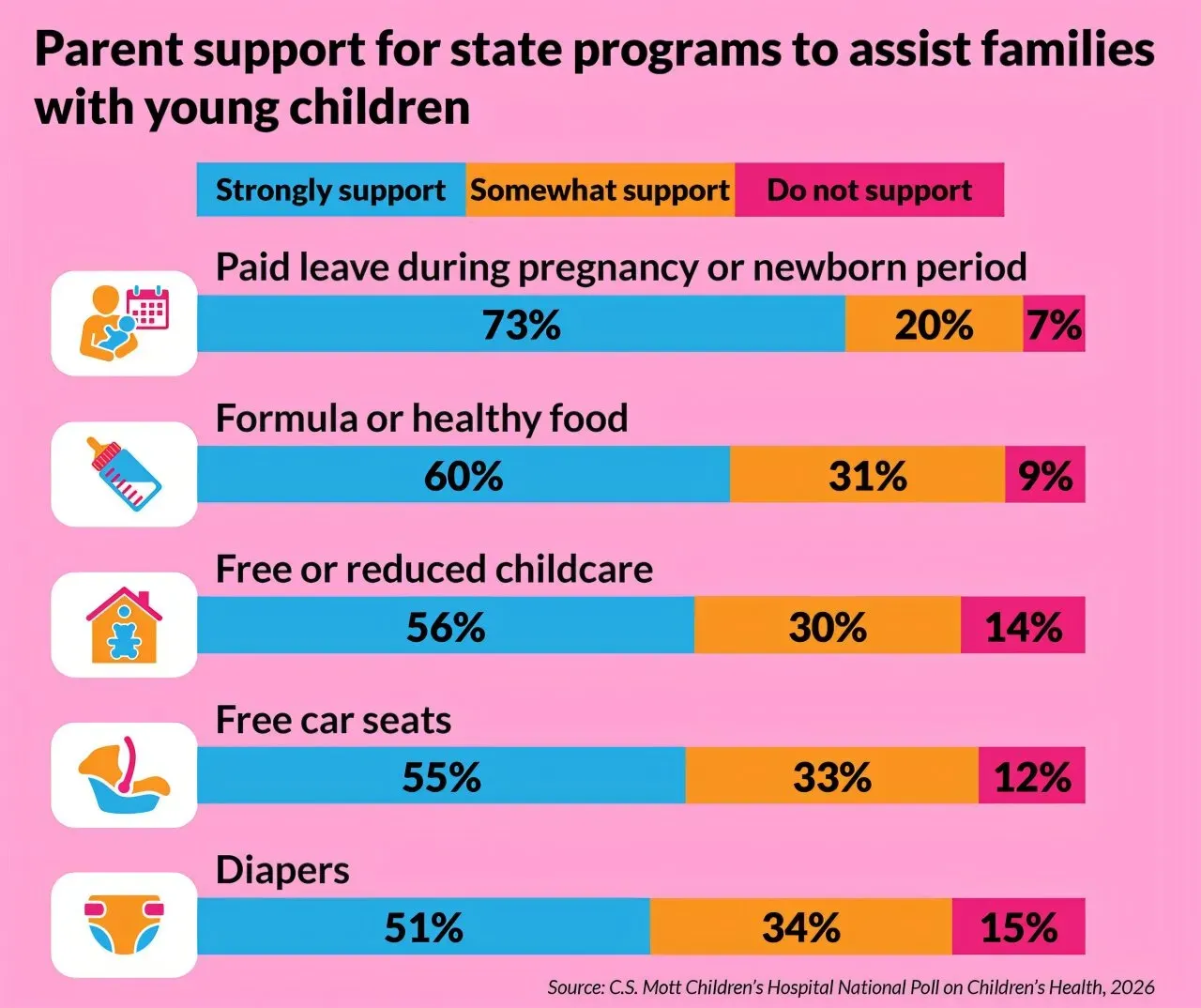
A significant majority of parents expressed strong support for paid leave during pregnancy or the newborn period, recognizing its potential to provide much-needed flexibility and reduce stress.
Programs providing formula or healthy food also garnered substantial backing, with more than half of respondents strongly supporting initiatives that offer free or reduced-cost child care, car seats, and diapers.
Parents with children under the age of three were particularly likely to advocate for such programs and believe they should be available to all families in need.
Many parents are going to great lengths to cover the costs of raising a young child, often at the expense of their own financial comfort. This can involve cutting back on non-essential expenses or working extra hours to make ends meet.
The survey reveals that even financially secure families are not immune to these pressures, with many feeling compelled to reduce their spending in order to provide for their child's needs. Parents across all income brackets report relying on second-hand baby clothes and equipment as a way of coping with the costs.
Diapers, car seats, nutritious food, and quality childcare are just some of the essential items that parents feel are necessary for their child's health, safety, and development. These are not discretionary expenses but rather fundamental requirements for raising a young child.
When it comes to supporting families with young children, many parents of older kids seem uncertain about which programs provide the most valuable assistance. Half of them say they don't know which organizations offer the help that these families need most.
Some parents of older children do try to help out in their communities, with nearly two in five having donated to a local organization or faith-based program that supports young families over the past two years.
Support for public programs to help families with young children is lower among those who have not donated to local organizations or faith-based programs that support young families.
These individuals are more likely to prefer helping families they know personally rather than strangers, suggesting a sense of community involvement is crucial in shaping opinions on public assistance.
According to Clark, the level of support for families also depends on people's understanding of available resources and how they can access them. Many parents may agree that young children need a strong start in life without knowing which programs can make it possible.
By making resources more accessible and giving families flexibility in choosing what works best for them, it is possible to turn this shared goal into meaningful support for children.
Facts based on reporting originally published by Phys.org.
You may republish this story, in full or in part, if you credit News Central Site and link to it (licence CC BY 4.0). Photos are not included.