Germany Shifts Stance on China Amid Trade Disputes
The move is a response to Beijing's unfair trade practices and increasing competition from Chinese companies.
Germany's stance on China is shifting as pressure mounts from import issues, which are now taking precedence over the benefits of exporting to the country.
For years, Berlin had been hesitant to take a harder line against Beijing's unfair trade practices, fearing Chinese retaliation that could harm German exporters.
However, in recent months, this caution has given way to a willingness to escalate tensions with China. Chancellor Friedrich Merz and French President Emmanuel Macron have jointly called for a new tool to cut off trading partners from the EU's single market if they engage in unfair practices.
This move is clearly aimed at Beijing, which has been accused of deliberately undermining fair market conditions through political or economic means.
The letter sent by Merz and Macron to European Commission President Ursula von der Leyen warns that this measure is necessary to protect fair market conditions.
As German industry once profited from China's rapid growth, today it faces increasing competition from Chinese companies in key sectors such as automotive manufacturing and precision engineering.
According to data from Germany Trade & Invest, China has fallen from its position as Germany's second-largest export market to ninth place for the first half of 2026. This decline is attributed to Chinese competitors' ability to close the technology gap with German firms, benefiting from lower costs and state subsidies.
The automotive sector has been particularly hard hit by the shift in market dynamics. Data from Rhodium Group reveals that German car exports to China plummeted by 66% between 2022 and 2025, impacting major brands such as Mercedes-Benz and BMW.
German automakers are now facing stiff competition from a new wave of Chinese electric vehicle manufacturers not only in their domestic market but also in other key markets including Europe. This increased rivalry has led to significant job losses and potential factory closures for German companies.
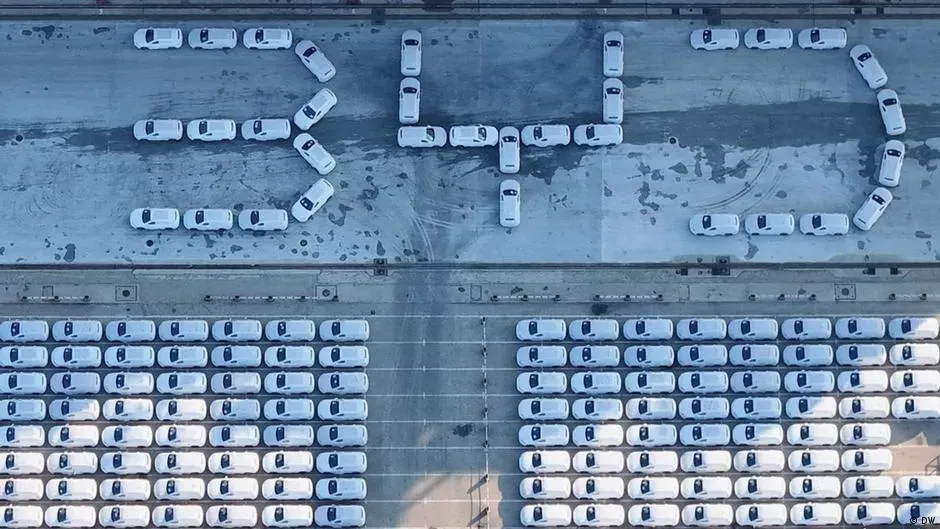
As imports of new Chinese-made cars into Germany surge, with an increase of 121% in the first seven months of this year alone, according to Destatis, the federal statistics agency, German automakers are struggling to maintain their market share.
The German government is facing growing pressure from its powerful automotive lobby to take a harder stance on trade defense instruments.
One of the key players in this push for a more protectionist approach is Oliver Richtberg, head of foreign trade at VDMA, Germany's mechanical engineering association.
Richtberg has been vocal about his concerns, stating that Germany is being "deindustrialized through unfair measures" and that most companies can no longer accept this situation.
The EU's goods deficit with China was a staggering €360 billion last year, equivalent to around €1 billion per day, according to Eurostat figures for the wider European Union.
The EU has been trying to push back against cheap Chinese imports by implementing new trade measures, including an industrial protection law and anti-coercion regulations.
However, these efforts are facing resistance from Beijing, which views them as discriminatory, as well as opposition from within the EU itself.
The EU's efforts to reduce its reliance on Chinese components are facing significant challenges, particularly in the automotive sector. The European Automobile Manufacturers' Association has expressed concerns that the proposed draft act does not provide sufficient incentives for manufacturers to produce locally, citing the need for a substantial incentive package to offset the costs of local production.
One major concern is China's control over rare earth minerals and magnets, which are crucial for German automotive, renewable energy, and defense manufacturing. This leverage gives Beijing significant influence over Germany's industrial base, and officials have warned that new export curbs on these essential materials could be imposed at any time.
In a bid to mitigate this risk, the EU is exploring a range of measures, including a "kill-switch mechanism that would allow Brussels to limit Chinese exports in response to Beijing's actions. Unnamed German officials have described this approach as a second-strike weapon," suggesting that it could be an effective deterrent against future trade restrictions.
In a move that may signal a shift towards a more conciliatory approach, the EU and China reached a tentative agreement at their recent trade talks in Beijing. According to EU Trade Commissioner Maros Sefcovic, this understanding aims to limit Chinese exports of hybrid and plug-in hybrid vehicles to the European Union by more than half.
The proposed cap on such imports would be set at 350,000 vehicles annually, with an annual increase of 6% over four years. This agreement appears to reflect a compromise between Brussels' desire to reduce its reliance on Chinese components and Beijing's concerns about discriminatory trade practices.
Germany's EU partners are now facing increasing import pressures from China, which has become a more critical export market for Beijing than the US.
Data from ACEA shows that new hybrid-electric cars accounted for nearly 37% of all new cars registered in the EU between January and August this year. Meanwhile, MERICS research indicates that Chinese exports to the EU reached $254 billion in the first half of the year, outpacing the $172 billion sent to the US.
This shift in dynamics could give European negotiators more bargaining power as they seek to balance trade protection with avoiding a full-blown trade war with China.
Facts based on reporting originally published by DW English.
You may republish this story, in full or in part, if you credit News Central Site and link to it (licence CC BY 4.0). Photos are not included.