France Protests Turn Violent Amid Debt Crisis Concerns
Protests against high living costs in France turned violent with luxury stores and supermarkets being looted, public buildings vandalized, and some set ablaze.
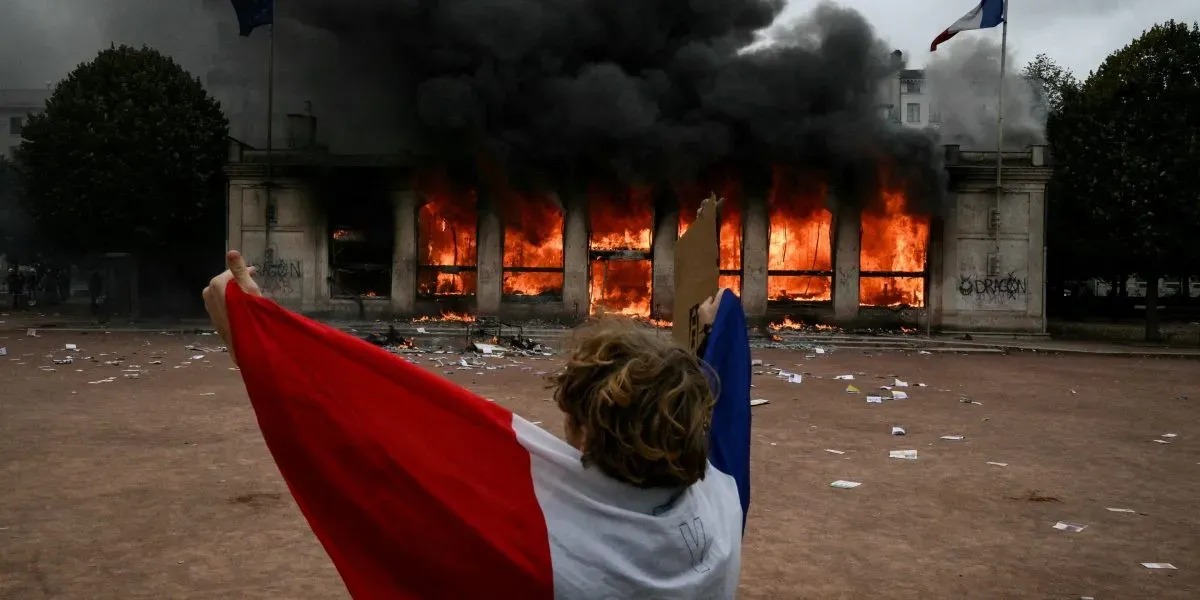
Protests against high living costs have engulfed France, adding to growing concerns over public spending and debt ahead of a crucial vote in the National Assembly.
The demonstrations turned violent in some cities, with luxury stores and supermarkets being looted, while public buildings were vandalized and even set ablaze. The destruction highlights the deep-seated frustration among citizens who feel that their government is failing them.
Students have been at the forefront of protests, decrying substandard classrooms, understaffed schools, and inadequate facilities to cope with rising temperatures. They blame years of underinvestment in public education for the dire situation.
France's debt burden has reached alarming levels, sending bond yields soaring to their highest point in 24 years. This is a worrying sign reminiscent of the eurozone debt crisis that gripped Europe over a decade ago.
The country's presidential election in the spring has only added to market jitters, with both far-right and far-left candidates vying for power. Investors are losing faith that either side will take the tough measures needed to rein in the deficit and stabilize the economy.
The interrelated crises unfolding in France have reached a critical juncture, with one analyst warning that the country is on the cusp of a make-or-break moment in its debt crisis.
A significant contributing factor to this predicament is the generous government pension plan, which Nobel laureate Paul Krugman has linked directly to the student unrest. According to Krugman's analysis, France's extremely favorable pension scheme has led to education spending being compromised, resulting in a situation where older French citizens are effectively subsidized at the expense of others.
France's public debt has skyrocketed to a record $4 trillion, accounting for 119% of GDP, the highest ratio since the immediate aftermath of World War II. While the pandemic and ongoing conflicts with Ukraine and Iran have undoubtedly exacerbated France's fiscal woes, President Emmanuel Macron's reversal on proposed reforms aimed at curbing the debt has also played a significant role.
A revised budget proposal put forth by Prime Minister Sébastien Lecornu seeks to modestly reduce the deficit from 5.4% of GDP to 5%. However, this plan faces its first critical test in the National Assembly on Tuesday and failure to pass it could have severe consequences for France's economic stability.
The potential fallout is dire, with some predicting that a failed budget vote would send the cost of servicing French debt soaring, potentially forcing the country to seek assistance from the International Monetary Fund or the European Central Bank, a humiliating prospect for the world's seventh-largest economy.
The French government's inability to pass a budget has sparked concerns about the country's economic stability.
Market analysts believe that France's problems are more related to its governance than its economy, with investors fearing that the extreme left and right cannot work together effectively to implement necessary reforms.
This sentiment is reflected in the policies of far-right leader Marine Le Pen, who has pledged to lower the official retirement age to 62 and potentially even further. Meanwhile, Jean-Luc Mélenchon's campaign on cancelling French debt by having the central bank simply write it off is also raising eyebrows among investors.
The result is that bond investors are demanding higher interest rates from France, which has pushed borrowing costs to extremely high levels. The country is now at risk of becoming socially volatile and institutionally paralyzed, making it an unattractive destination for investment.
A parliamentary election in June may not provide the clarity needed by financial markets, as it could lead to further political gridlock if no party secures a majority.
The situation in France is becoming increasingly precarious as the country teeters on the edge of a debt crisis. A series of significant events would need to unfold for France to regain the confidence of financial markets and stabilize its economy.
These convulsions could include a no-confidence vote that leaves France without effective governance, a credit downgrade from Moody's, an escalation of street protests turning into violent riots, a sharp increase in bond yields, and the election of Marine Le Pen as president. The European Central Bank may be hesitant to intervene, fearing it would encourage moral hazard.
The absence of swift intervention from the ECB combined with the limitations of existing bailout mechanisms means France is running out of options. Only after enduring significant economic pain over the next few months might France find a way to commit to austerity measures and restore fiscal responsibility.
Facts based on reporting originally published by Fortune.
You may republish this story, in full or in part, if you credit News Central Site and link to it (licence CC BY 4.0). Photos are not included.