Construction Underway for New Sculpture Garden on National Mall
Workers are smoothing freshly poured concrete in West Potomac Park to prepare for two traditional Uzbek open-sided pavilions and life-size statues of notable Americans.
Workers in West Potomac Park just off the National Mall were seen smoothing freshly poured concrete in early September. The area was fenced off, indicating a major construction project underway. It appears to be part of a larger initiative to create a new sculpture garden.
The installation of two traditional Uzbek open-sided pavilions, known as aywans, is taking place at the site. Aywans feature elaborately carved wooden columns and roofs, adding an exotic touch to the area. The structures are being built in preparation for the installation of life-size statues of notable Americans.
The federal call for artists specified that the statues must be realistic and classical, made from traditional materials such as marble, granite, bronze, copper, or brass. This requirement reflects a desire to create a sense of timelessness and permanence. The National Garden of American Heroes is intended to commemorate important figures in American history.
As a city built on symbolism, Washington D.C.'s landscape is ever-changing. The distinction between planned projects and already-completed installations can be blurry at times. The National Mall has long been a site where ideas about America's identity are displayed for all to see.
The Hirshhorn Museum's new sculpture garden is a significant addition to the National Mall, located just over a mile northeast of where the aywans were being installed.
This project marks the culmination of Melissa Chiu's 12-year tenure as director of the Hirshhorn Museum, which ended when she took on the role of director at the Guggenheim in New York in September.
The sculpture garden will feature nearly 60 works of art spanning over a century, including pieces from the museum's founder Joseph H. Hirshhorn's collection and recent acquisitions by diverse artists working today.
The garden is designed to complement the more classical National Gallery of Art, with its unique collection showcasing American identity through the lens of modern and contemporary sculpture.
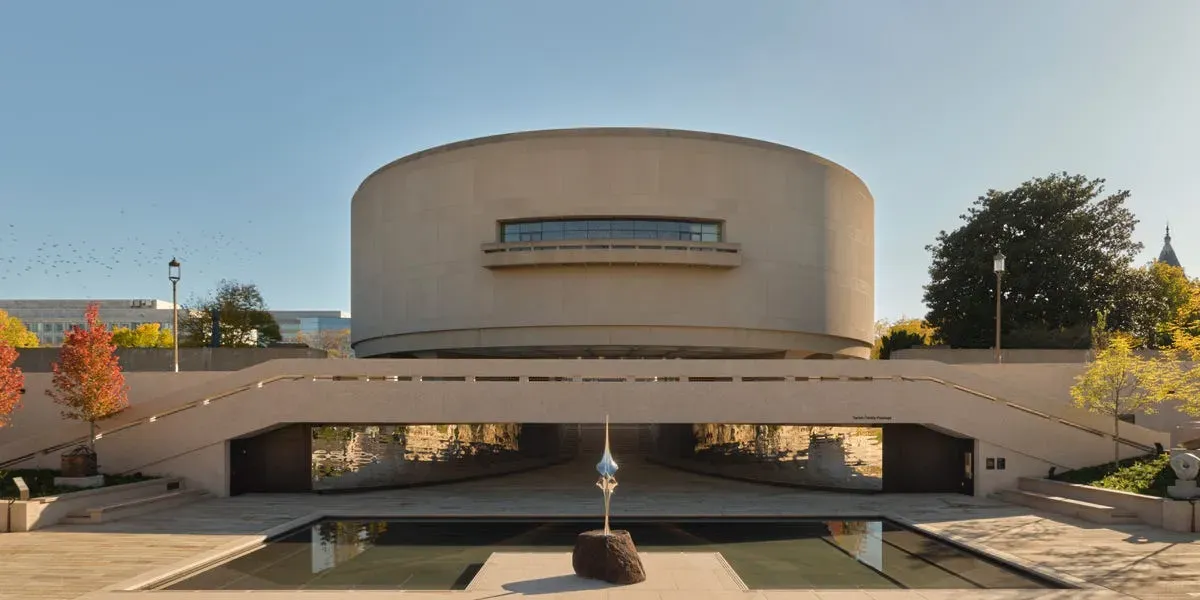
The Hirshhorn Museum's unique architecture was designed by Gordon Bunshaft as a standalone sculpture, a monumental concrete cylinder set apart from the neoclassical buildings surrounding it. This bold design choice aimed to break away from traditional museum aesthetics and create a distinct identity for the institution.
As the new Sculpture Garden takes shape, visitors are being encouraged to engage with contemporary art in innovative ways. The garden's design is meant to complement the National Gallery of Art, showcasing American identity through modern and contemporary sculpture. This approach reflects the Hirshhorn's commitment to pushing boundaries and making art more accessible to a wider audience.
The museum's focus on accessibility has been a key aspect of its programming, with staff working to reduce physical and intellectual barriers that might deter visitors from engaging with challenging works. By rethinking everything from wall texts to educational materials, the Hirshhorn aims to create an inclusive environment where visitors can appreciate art on their own terms.
In line with this approach, the museum has developed a mobile guide called Hirshhorn Eye, which allows visitors to hear artists discuss their work directly. This initiative reflects the institution's commitment to putting the artist at the forefront of the visitor experience and facilitating meaningful connections between viewers and creators.
The museum's emphasis on accessibility has also led it to reevaluate its voice and tone in engaging with visitors. By shifting from a more formal, didactic approach to one that is more conversational and inclusive, the Hirshhorn aims to create a welcoming environment where everyone can feel at ease exploring contemporary art.
The Hirshhorn Museum's efforts to engage a broader audience extend beyond its physical walls through digital initiatives and multimedia projects.
This approach is particularly relevant given the museum's diverse visitor base, which includes individuals who may not typically frequent contemporary art institutions.
Many visitors arrive at the museum with little expectation of encountering world-class modern and contemporary art due to its free admission and prime location on the National Mall.
The Hirshhorn Museum's new Sculpture Garden is undergoing significant changes, with many of its original works being returned to their former glory. Iconic pieces like Rodin's The Burghers of Calais and Monument to Balzac will be reinstalled alongside Matisse's complete series of The Backs I-IV. These additions will be joined by a selection of modern and contemporary art from renowned artists such as Moore, Giacometti, Barbara Hepworth, David Smith, and Lucio Fontana.
The museum has also been acquiring new works that expand its geographical and cultural scope. Recent commissions include pieces by Lauren Halsey, Raven Halfmoon, Mark Grotjahn, Liz Larner, Woody De Othello, Izumi Kato, Pedro Reyes, and Chatchai Puipia. These additions will further enrich the garden's diverse offerings.
Among the new installations is a poignant piece called Wish Tree, created by artist Mungo Thomson. This striking work invites visitors to leave behind handwritten wishes for peace, creating a sense of community and shared longing among those who visit. Another notable addition is Elmgreen Dragset's Eight, an imposing 28-foot-tall vertical swimming pool complete with diving board, ladder, and lights.
The new Sculpture Garden will be a marked departure from its original design by Gordon Bunshaft. The austere setting of the old garden was characterized by a lack of shade or greenery, with visitors entering from the Mall having to descend a flight of stairs to encounter a 10-foot concrete wall. However, subsequent interventions by landscape architect Lester Collins have softened the space, adding canopy trees and more vegetation to create a more welcoming atmosphere.
The Hirshhorn Museum's Sculpture Garden underwent significant changes in recent years, addressing infrastructure issues and revamping its design.
To tackle these challenges, architect Chiu collaborated with artist Hiroshi Sugimoto, who had a prior connection to the museum through a 2006 exhibition of his work.
Sugimoto envisioned the garden as an interactive space where visitors could engage with art, rather than just viewing it from afar.
Facts based on reporting originally published by Harper's Bazaar.
You may republish this story, in full or in part, if you credit News Central Site and link to it (licence CC BY 4.0). Photos are not included.