College Football Playoff Expands from 12-Team Format to 24 Teams Starting Next Year
The College Football Playoff (CFP) is expanding its postseason format from 12 teams to 24 teams, starting next year.
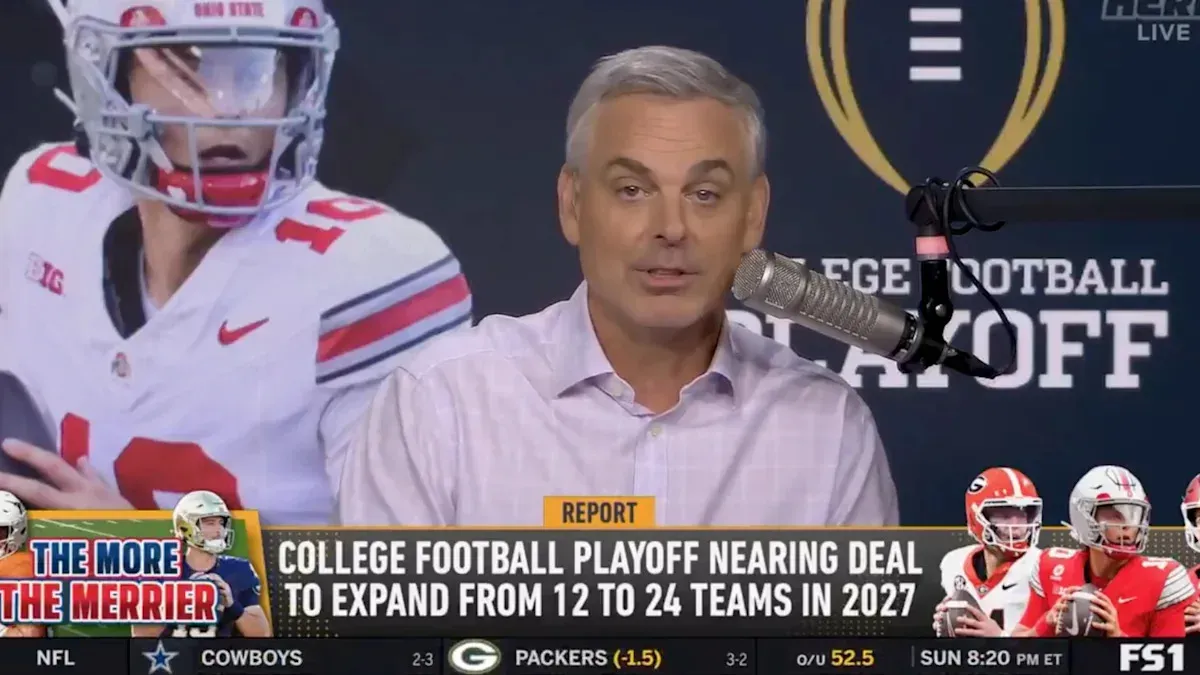
College football fans are bracing themselves for a significant change to the sport's postseason format. The College Football Playoff (CFP) is set to expand from its current 12-team format to include 24 teams starting next year.
The timeline of this expansion has taken some by surprise, but it was widely anticipated as a natural progression following the initial four-team playoff format. Critics argue that increasing the number of teams in the playoff field will diminish the significance of the regular season in college football.
A single loss can still be devastating to a team's chances of making the playoffs, even with the current 12-team format and its seven at-large bids. However, it is likely that a second loss would seal their fate. The expansion to 24 teams raises questions about whether top programs like Alabama or Notre Dame will ever miss the playoffs again.
Colin Cowherd, a prominent sports commentator, recently expressed his skepticism towards the notion that expanding the playoff field will diminish the regular season. He criticized those he called "romancers" for predicting such an outcome, and instead believes that a larger playoff field will only serve to enhance the sport's competitive landscape.
A larger playoff field will allow 17% of college football teams to participate, making the competition more inclusive and creating new opportunities for smaller schools.
This expansion mirrors the NFL's format, where 44% of teams make the playoffs without diminishing interest in the regular season. Similarly, other professional sports like hockey and basketball have high participation rates without compromising their competitive dynamics.
Critics of expanded playoffs often argue that it favors larger programs with more resources, but Cowherd counters that this is not what has happened with Name, Image, and Likeness (NIL) rules. Instead, these regulations have benefited smaller schools like Indiana, which made a deep run in the NCAA tournament last year.
The new playoff format will allow teams to participate even after losing three games, eliminating the need for them to beat powerhouse programs like Ohio State or Oregon. This increased inclusivity is seen as a positive development by Cowherd, who believes it creates more opportunities and does not dilute the sport's competitive landscape.
The introduction of Name, Image and Likeness (NIL) policies has opened up new opportunities for student-athletes to earn compensation for their name, image, and likeness. This development is being seen as a positive step by many in the college football community.
The transfer portal has also become a crucial tool for student-athletes looking to find the right fit at another school. With the ability to transfer more easily, players are no longer stuck in situations that may not be ideal for them. This increased flexibility is benefiting both the players and the teams.
One of the key arguments made by proponents of the expanded College Football Playoff is that it will create more opportunities for teams to participate. The current system allows 24 teams to make the playoffs, which means that nearly a fifth of all college football teams have a chance to compete at this level. This increased participation is seen as a major advantage.
The old bowl game system was criticized by many, including Colin Cowherd, who argued that it was cluttered and unnecessary. The elimination of these games has led to a more streamlined postseason schedule, which many believe will result in a higher quality regular season.
There are 67 top-tier programs in the ACC, SEC, Big Ten, and Big 12 conferences, not to mention Notre Dame's inclusion, bringing the total to 68.
Even if four teams from smaller conferences were to make it into the expanded playoff, which seems unlikely, around 30% of the power programs would still be participating in postseason games. This contradicts concerns that an expanded playoff would lead to a diluted championship format.
The expansion will not bring about the downfall of college football, despite some critics' claims.
Facts based on reporting originally published by Yahoo Sports.
You may republish this story, in full or in part, if you credit News Central Site and link to it (licence CC BY 4.0). Photos are not included.