Caltech Students Revamp Mathathon Event to Embrace AI
Undergraduate students at Caltech reached a compromise with math community critics to revamp the competition's parameters and ensure controlled use of AI technology.
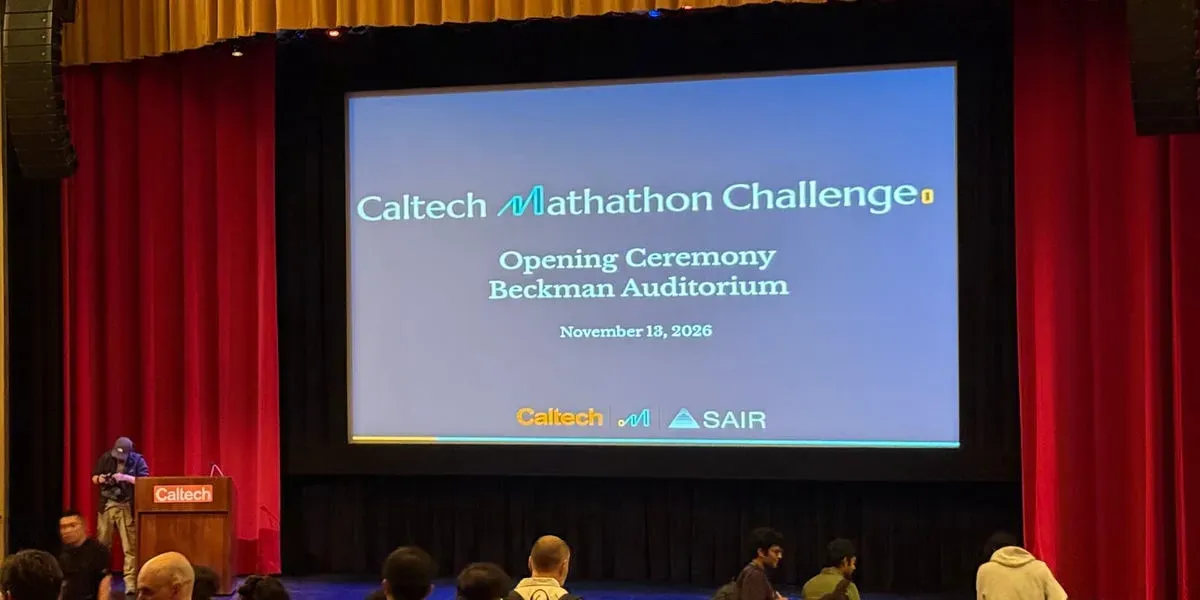
Caltech students were facing a crisis when they met on a Friday in early September via video call. Their "mathathon event, designed to harness chatbots' power to tackle the world's most challenging math problems, was at risk of being canceled due to opposition from some members of the math community.
The meeting brought about an unexpected turn of events as the undergraduate organizers reached a compromise with their critics. They agreed to revamp the competition's parameters in exchange for crucial support from the wider mathematical community. The deal marked a significant shift towards embracing AI while ensuring its use is controlled and measured.
Ward, a Caltech student who was present at the meeting, initially advocated for the event's cancellation but later became involved in its organization. His involvement was instrumental in shaping the revised approach to AI in mathematics, paving the way for a more human-centered and controlled use of technology in the field.
The changes implemented by the organizers reflect a growing recognition that AI can be a valuable tool in mathematics when used judiciously. The revamped mathathon event is now seen as a model for bridging deep-seated divisions within the math community, where some members advocate for a more cautious approach to AI while others see its potential benefits.
The atmosphere was surprisingly convivial as students and faculty from Caltech's mathematics department gathered on campus.
The event was a far cry from the heated debates that had been raging within the math community over the use of artificial intelligence in solving long-standing problems.
Younger students who were enthusiastic about AI mingled with those who held more skeptical views, exchanging ideas in a spirit of mutual respect.
Mathematicians and computer science enthusiasts alike roamed the picturesque campus, some pausing to pick up docile turtles or work on their laptops.
The university's mathematics professor Sergei Gukov expressed his enthusiasm for this new era of collaboration.
This unification is amazingly great, he said, highlighting the potential benefits of AI in mathematics.
Mathematicians at every level had been grappling with the implications of OpenAI's breakthrough solution to the Navier-Stokes Millennium Prize question in September.
The debate centered on whether mathematicians should harness AI and, if so, how they could use it responsibly.
Some critics accused OpenAI of exploiting lists of open problems for self-promotion, disregarding the contributions of human researchers.
The rapid advancement in artificial intelligence (AI) has sparked a heated debate among mathematicians over who should be credited for solving complex problems. The issue at hand is whether AI models or human researchers should take precedence in publishing solutions to renowned open problems.
Leading figures in the math world are scrambling to develop their own AI models, an effort to regain control over AI-generated solutions that have been gaining prominence. However, this endeavor is taking place before these new models are fully developed, leaving many young mathematicians searching for alternative ways to stay relevant in a rapidly evolving field.
In response to the changing landscape, some mathematicians are turning to closed and open-source models as a means of staying competitive. This shift is evident at the Caltech mathathon, where nearly every participant employed a combination of cutting-edge models that ran continuously in the background while they took brief breaks to recharge with energy drinks.
The mathathon itself was initially designed to emulate the approach taken by big AI companies, which focus on tackling high-profile unsolved problems and publishing lengthy proofs, leaving human mathematicians to sift through them for useful information.
The organizers of the mathathon took a crucial decision during a video call, agreeing to set aside open problems" that were initially at the center of controversy. Instead, participants would focus on finding innovative ways to tackle existing mathematical challenges.
To make the event more inclusive and transparent, additional incentives were introduced for teams that could clearly explain their solutions, helping to sift through complex AI-generated data. This move was a response to concerns about the reliance on artificial intelligence in mathematics research.
The organizers' efforts paid off as Anthropic agreed to end its sponsorship of $1 million in tokens, while OpenAI withdrew from the event due to mounting calls for its cancellation. Despite these challenges, the mathathon's creators remain hopeful that it will achieve its aspirations and redefine the role of human mathematicians in AI-driven research.
Facts based on reporting originally published by Business Insider.
You may republish this story, in full or in part, if you credit News Central Site and link to it (licence CC BY 4.0). Photos are not included.