Bering Land Bridge base camp reveals what life was like nearly 14,000 years ago
Excavations at the Shég' Xdaltth'i' site in Alaska have uncovered early archaeological components dating back to 13,800, 13,000, and 12,700 years ago.
A newly discovered archaeological site in Alaska has shed light on what life was like nearly 14,000 years ago. The site is located in a region that was once connected to Asia by land, known as the Bering Land Bridge.
The Bering Land Bridge formed around 35,000 years ago and eventually disappeared under rising sea levels about 12,000 years ago. This exposed land and maritime region allowed humans and animals to migrate between Asia and North America.
Excavations at the site have uncovered three early archaeological components dating back to 13,800, 13,000, and 12,700 years ago. These findings provide valuable insights into how people settled and adapted in this harsh northern environment.
Researchers, including Kelly Graf from the University of Kansas, are studying the site as part of a larger project to understand human migration patterns during the late Pleistocene era. According to Graf, it's fascinating to see how early humans evolved from hunter-gatherers to where we are today.
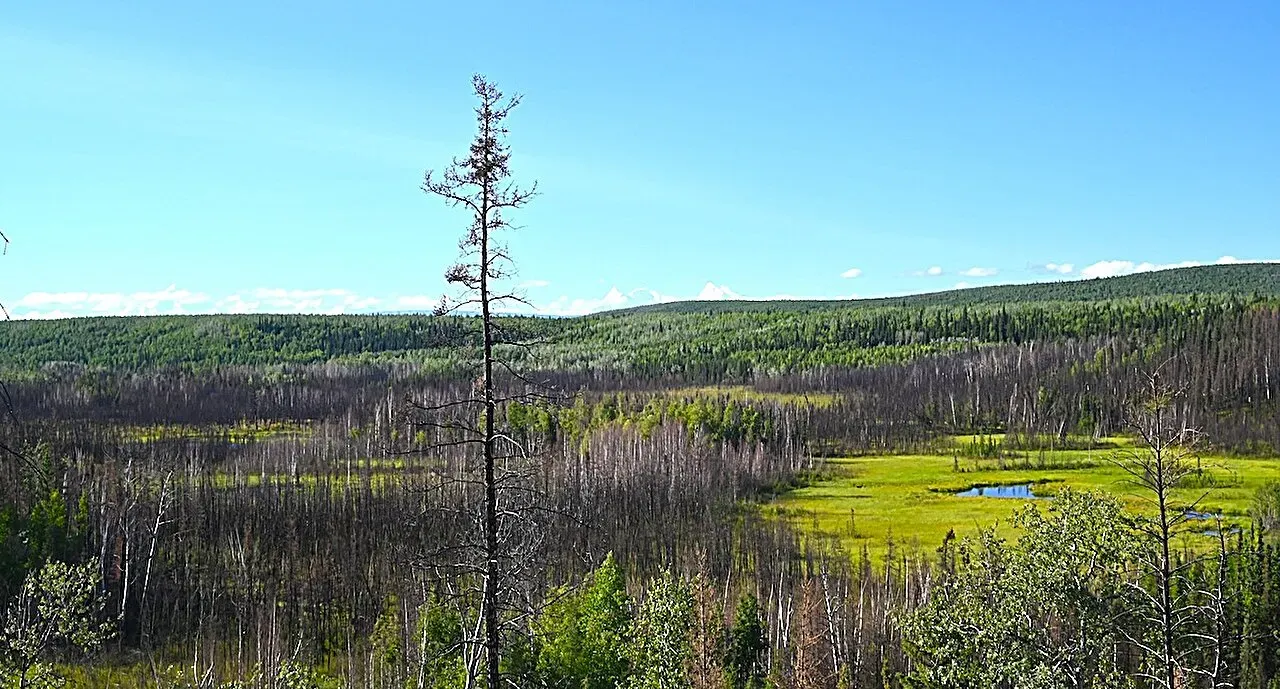
The Shég' Xdaltth'i' site in Alaska is located on a small ridge overlooking the Tanana River, a major river system of the region. The area is now covered in spruce trees, but during the last part of the Pleistocene era, it was dominated by shrub-tundra vegetation.
The Bering Land Bridge base camp has yielded significant evidence of early human hunting practices, with Graf noting that megafauna such as mammoth, bison and horse were hunted. These species are now extinct, but caribou, which is still found in the region today, was also a target for hunters. The hunting of caribou remains an important resource for indigenous communities in Alaska.
The Shég' Xdaltth'i' site is just one of many archaeological occupations found in Beringia, an area roughly equivalent in size to the U.S. state of Maryland. Graf has been leading excavations at the site since 2013, initially visiting every year until the COVID-19 pandemic disrupted her work.
The site has yielded a vast array of cultural remains, with over 80,000 archaeological specimens discovered during Graf's excavations. These finds include unique tools such as hafted-biface forms and osseous tools, as well as diverse fauna and well-preserved activity areas.
Archaeologists have made significant discoveries at a Bering Land Bridge base camp, providing insights into daily life nearly 14,000 years ago.
The site's excavation has yielded a unique collection of artifacts, including tools and hunting equipment. A large stone anvil was found within a dwelling feature surrounded by bashed-up bison bones and quartz hammerstones used for breaking bones to extract marrow and render grease. This suggests that the early inhabitants were skilled at processing animal remains.
Among the key discoveries are bird bones used to fashion needles, likely for sewing or other purposes. The site also features numerous diamond-shaped bifacial points, which may have been sharpened tips of weapons. These findings are significant because they are similar to those found on the Russian side of the land bridge, suggesting that people traveled across the Bering Land Bridge.
The presence of these distinctive tools and hunting equipment at the base camp provides a glimpse into the lives of early inhabitants. It appears that they were skilled hunters who relied on large game such as bison for their survival. The fact that they had access to quartz hammerstones and other tools suggests a high level of technological sophistication.
The discoveries made at the Bering Land Bridge base camp are shedding new light on the peopling of the Americas. They provide valuable insights into the lives of early inhabitants, including their hunting practices and technological capabilities.
The discovery of a base camp on the Bering Land Bridge has provided valuable insights into the lives of early inhabitants nearly 14,000 years ago. The site's significance extends beyond its historical importance, as it offers a window into the evolution of humans and their environment.
Studying the past is crucial for understanding human adaptability and resilience in the face of environmental challenges. By examining the habits and technologies of early Homo sapiens populations, researchers can gain a deeper appreciation for how humans have navigated life's difficulties throughout history.
The discovery on the Bering Land Bridge serves as a testament to the ingenuity and resourcefulness of our ancient ancestors, whose lives were marked by significant hardship and adaptation.
Facts based on reporting originally published by Phys.org.
You may republish this story, in full or in part, if you credit News Central Site and link to it (licence CC BY 4.0). Photos are not included.