Waffle House Index Tracks Hurricane Severity Across Southeastern United States
A peculiar yet effective indicator of a hurricane's severity has emerged in the Southeastern United States: the Waffle House Index, which gauges damage based on whether Waffle House locations remain open or shut down.
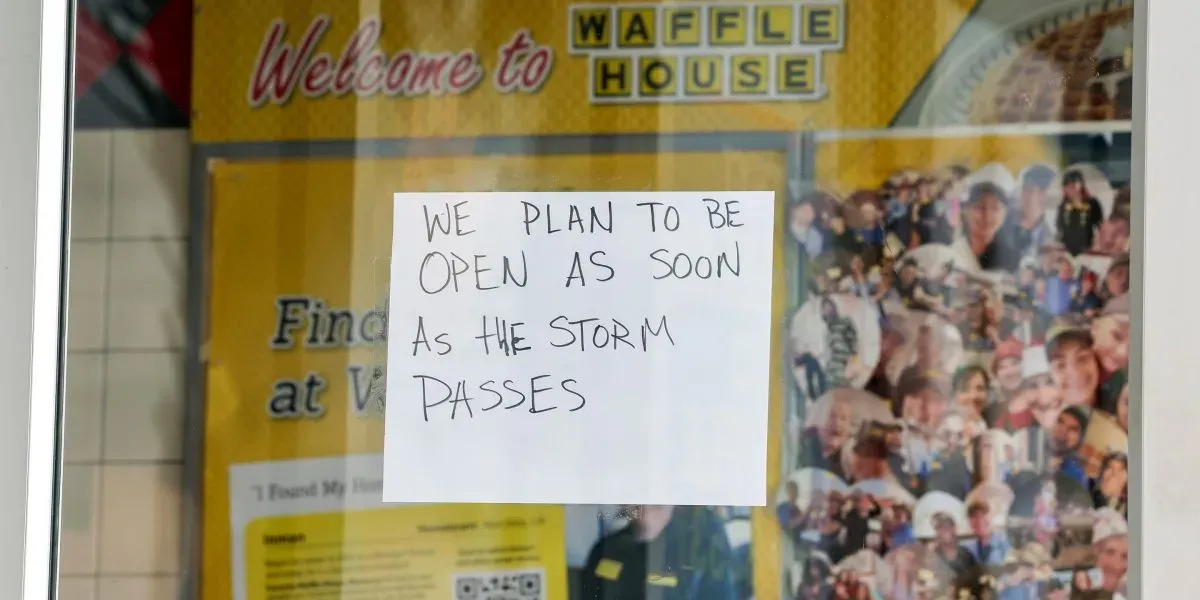
A peculiar yet effective indicator of a hurricane's severity has emerged in the Southeastern United States: the Waffle House Index. When hurricanes sweep through towns, the presence or absence of this beloved diner chain becomes a gauge for locals and federal officials alike to assess the extent of damage.
The index relies on a simple premise: if a Waffle House remains open, even partially, it's likely that the storm's impact was minimal. Conversely, when these dependable diners shut down, it signals impending disaster or significant devastation in the affected area. This metric has gained widespread acceptance among residents and authorities in the region.
The reasoning behind this unorthodox index may seem illogical at first glance, but its effectiveness is undeniable. By tracking Waffle House locations, particularly the 1,900+ across the Southeast and mid-Atlantic regions, individuals can anticipate potential disruptions to their daily lives due to power outages, severe flooding, or other extreme conditions.
Waffle House has a reputation for being prepared for disasters, with a 24/7 operation that continues even in the face of severe weather. Decades of experience have shown that when storms hit, Waffle House locations often remain open longer than any other business. This reliability has earned them a unique status as a barometer for storm resilience.
For residents living in areas prone to hurricanes and other extreme weather events, the Waffle House Index serves as an essential tool for making informed decisions about evacuation or sheltering in place. Federal officials also utilize this metric to identify communities most in need of aid and resources.
While its origins may be anecdotal, the Waffle House Index has evolved into a trusted indicator of storm severity, reflecting the chain's reputation for resilience and preparedness. As hurricane season approaches, this peculiar measure will undoubtedly continue to play a crucial role in disaster response efforts across the Southeast.
The Federal Emergency Management Agency (FEMA) has turned to an unlikely ally in tracking disaster recovery efforts: the Waffle House restaurant chain. The agency's administrators have developed a color-coded system to gauge the severity of storm damage based on the status of local Waffle Houses.
Green indicates that a Waffle House is serving its full menu, suggesting minimal damage and functioning infrastructure in the surrounding area. This means customers can expect hot meals and fully stocked supplies, as well as access to electricity and running water.
Yellow signifies that a Waffle House is operating with a limited menu, often relying on generators for power. This may be due to disruptions in food supply chains or local infrastructure damage, but the restaurant remains open for business.
Waffle House's own storm center provides detailed information about its locations, including color-coded maps of regions affected by storms. This data helps FEMA and other disaster response teams assess the extent of damage and allocate resources accordingly.
The agency also offers live tracking of Waffle House locations through social media, allowing users to monitor recovery efforts in real-time.
The Waffle House Index gained traction as Fugate's team observed multiple locations staying open amidst severe storm damage. This phenomenon was particularly evident in communities where power and running water were scarce. The open restaurants became a notable feature on the color-coded map used to assess damage severity.
Fugate carried this approach with him when he joined FEMA under President Barack Obama, utilizing it to guide response efforts during disasters. One such instance was the devastating tornado that struck Joplin, Missouri in 2011, where both Waffle House locations remained operational despite extensive damage.
The resilience of Waffle House restaurants stems from a deliberate business strategy adopted by the company following Hurricane Katrina in 2005. During this disaster, seven locations were severely damaged or destroyed, while over 100 more had to shut down temporarily. However, the chain's executives recognized an opportunity and shifted their focus towards maintaining operations during and after disasters.
This new approach has yielded significant results for Waffle House, with the company investing in portable generators and a mobile command center. Additionally, employees have been trained on how to prepare limited menus when power is lost, ensuring that customers continue to receive essential services even in the most challenging conditions.
Facts based on reporting originally published by Fortune.
You may republish this story, in full or in part, if you credit News Central Site and link to it (licence CC BY 4.0). Photos are not included.