Polymetallic Nodules Harbor Unique Community of Tiny Organisms
A recent study has revealed that polymetallic nodules in the Pacific Ocean serve as specialized habitats for tiny organisms and harbor a unique community of life.
Deep-sea mining threatens unique habitats hidden inside metal-rich nodules in the Pacific Ocean. A recent study has revealed that polymetallic nodules serve as specialized habitats for tiny organisms. These formations are not just valuable sources of raw materials but also home to a distinct community of life.
An international research team, led by Dr. Tanja Stratmann from MARUM, Center for Marine Environmental Sciences at the University of Bremen, has demonstrated that polymetallic nodules harbor a unique community of tiny organisms. The researchers found these organisms living in the crevices and pores within the nodules, which differ significantly from those found on the surrounding seafloor.
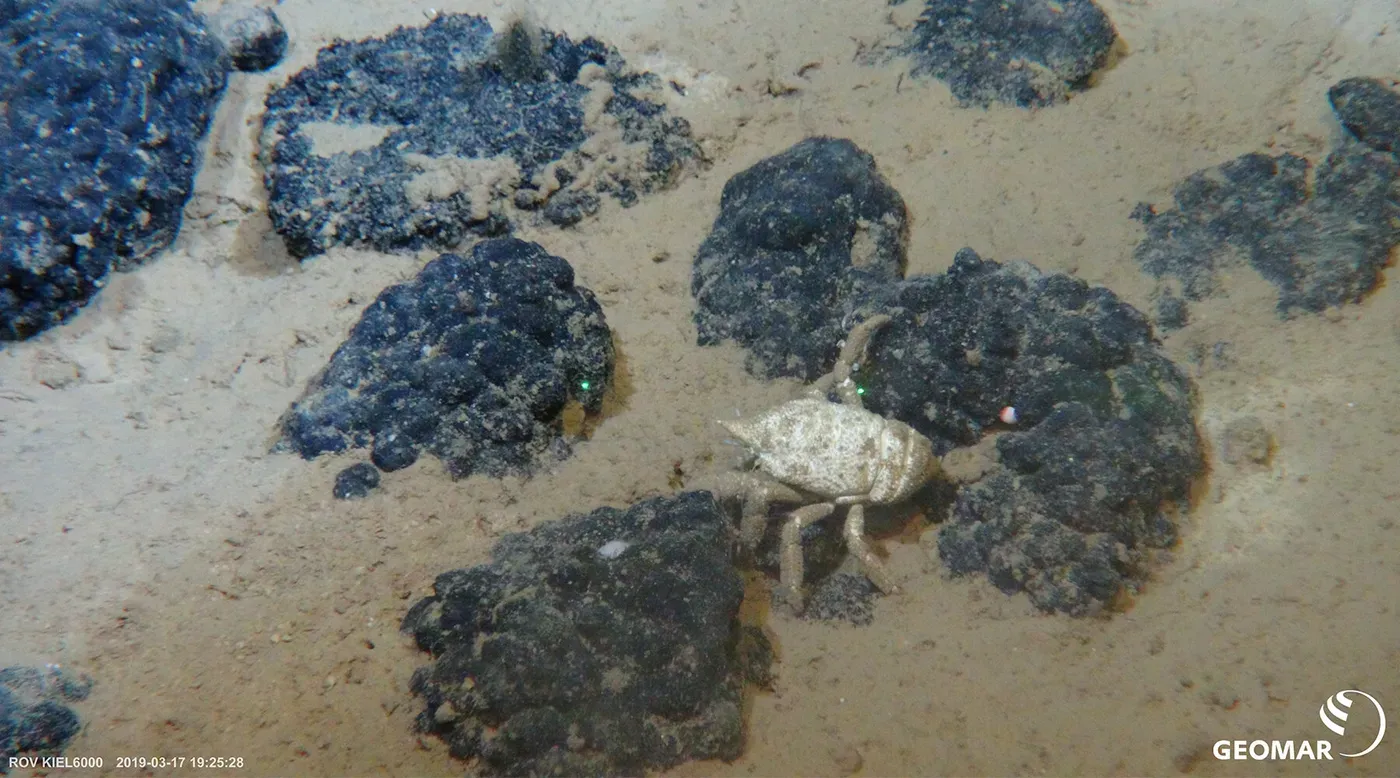
Polymetallic nodules take millions of years to form, growing extremely slowly, often just a few millimeters per million years. These dark lumps of iron and manganese oxides are fist-sized and can be found at depths of 4,000 to 6,000 meters (13,100 to 19,700 feet), where they provide rare hard surfaces on the otherwise soft, muddy seafloor.
The researchers investigated who lives in the tiny cracks and cavities of these nodules. Their findings highlight the importance of preserving these unique habitats from commercial mining activities that could permanently destroy them.
Since polymetallic nodules form over such a long period, any damage caused by deep-sea mining would be irreversible. This makes it crucial for planners to consider protecting areas in the deep sea where these nodules are found.
The deep-sea environment is home to a vast array of unique and intricate ecosystems that are still being discovered by scientists. One such ecosystem has been found within metal-rich nodules on the seafloor in the central Pacific.
Researchers have used specialized equipment like box corers and diving robots to collect samples from these areas, with careful dissection of the nodules in laboratories revealing a surprising diversity of life inside them.
In fact, analysis of 244 nodules has revealed that each one provides a home for an average of 17 individual animals. In some cases, however, this number can be as high as 245, indicating that these nodules are not just isolated pockets of life but complex habitats in their own right.
The internal structure of the nodules is what makes them so remarkable, providing a three-dimensional environment for small creatures to thrive. This is particularly significant when considering the sheer scale of the seafloor and the potential impact of deep-sea mining on these ecosystems.
Despite being relatively low in numbers compared to the surrounding sediment, the species found within the nodules are crucial to the overall ecosystem. Moreover, genetic analyses have shown that communities within the nodules are remarkably consistent across vast distances but differ significantly from those found in the sediment.
The implications of this research are far-reaching and highlight the importance of preserving these unique habitats. The study's findings underscore the need for careful consideration when it comes to deep-sea mining and the potential impact on these delicate ecosystems.
The unique habitats within metal-rich nodules pose a significant threat to biodiversity if extracted through industrial deep-sea mining.
These ecosystems take millions of years to form and are home to specialized species that have adapted to their sheltered environments.
One such example is the single-celled Thurammina sp. 1, which is commonly found in these nodules and appears perfectly suited to its habitat within them.
If the nodules were extracted, it's unlikely that these specialized inhabitants would be able to survive elsewhere, given their unique adaptations to their environment.
The loss of these local communities could have far-reaching consequences for global biodiversity, with potential extinctions on a geological time scale.
Further research is needed to determine whether the animals living within the nodules can survive in other areas if their habitats are destroyed.
An international research expedition is currently underway to study the polymetallic nodule ecosystem in the Clarion-Clipperton Zone. This zone is home to unique habitats that support a diverse range of marine life.
Further exploration of these ecosystems is crucial for understanding their importance and potential impact on future mining activities.
Facts based on reporting originally published by Phys.org.
You may republish this story, in full or in part, if you credit News Central Site and link to it (licence CC BY 4.0). Photos are not included.