Gravity May Be Capable of Reconnection
A new study has discovered that gravity may be capable of reconnecting in a manner similar to the sun's magnetic field, a phenomenon known as magnetic reconnection.
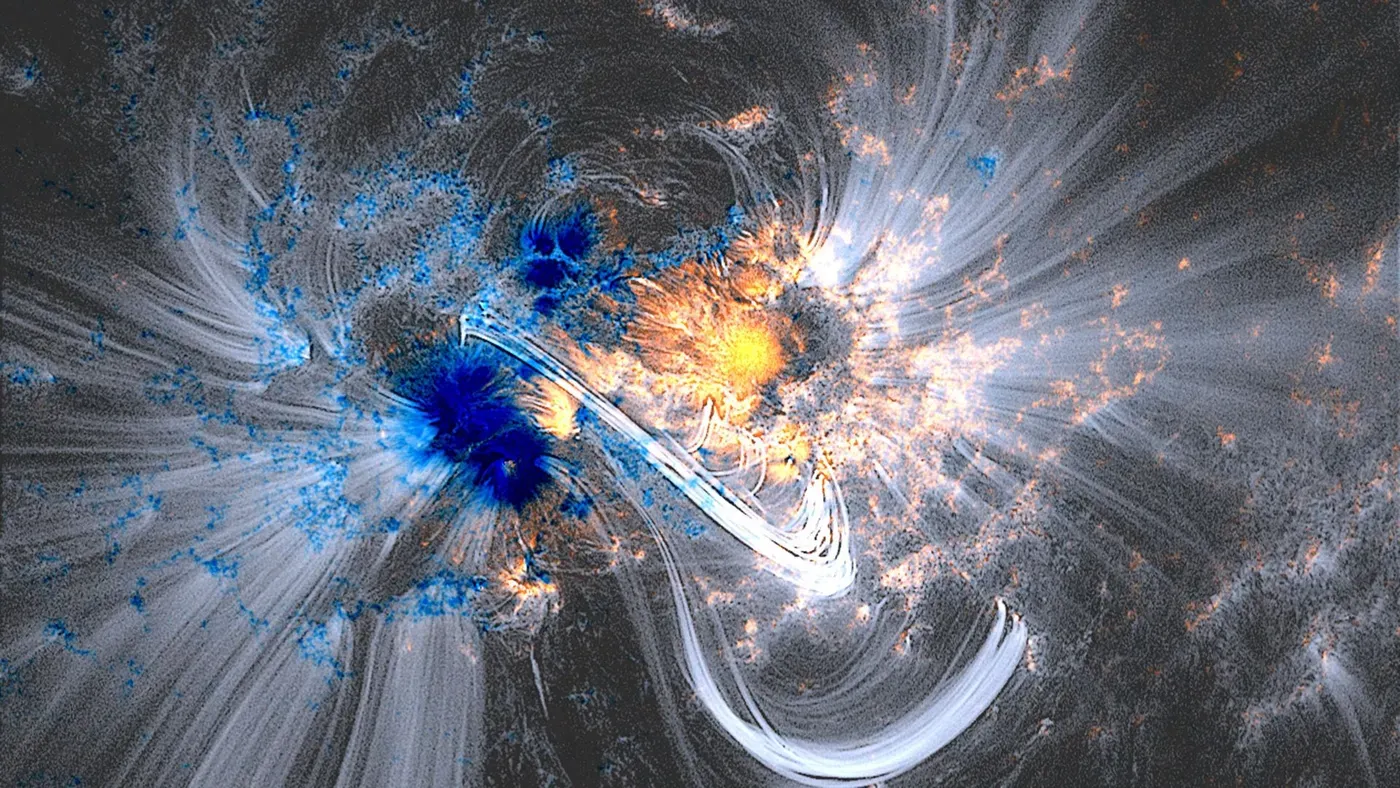
A groundbreaking new study has shed light on the mysterious forces that shape our universe. Researchers have discovered that gravity may be capable of reconnecting in a manner similar to the sun's magnetic field, a phenomenon known as magnetic reconnection.
This process involves sheet-like structures within the gravitational field breaking apart and reforming into new arrangements. According to Einstein's theory of general relativity, such events can occur when specific conditions are met.
The study offers a framework for understanding when and how this "gravitational reconnection" takes place. It also provides a method for measuring the speed at which it occurs, as well as a revised understanding of the relationship between gravity and matter.
The study's authors have found that Einstein's equations can be expressed in a way that reveals similarities between gravity and magnetism. This connection allows for a new understanding of how gravitational fields behave and interact with matter. In particular, it suggests that the process of reconnection, which is well-known in plasma physics, may also play a role in gravity. Reconnection occurs when magnetic field lines break and reconnect elsewhere.
The researchers used a mathematical framework called the tetrad formulation to analyze Einstein's equations. This approach has been applied previously to study the behavior of gravitational fields. The team found that, when expressed in this form, the principles governing magnetism also emerge in the context of gravity. This unexpected connection may help scientists better understand the fundamental forces at play in the universe.
The tetrad formulation allowed the researchers to describe the geometry of space-time and how it relates to gravitational fields. In particular, they found that gravitational fields can form two-dimensional structures called field sheets. These sheets have one dimension that stretches through space and another that extends through time. Each sheet effectively represents a trail left behind by an object as it moves through space.
The study's findings build on previous research published earlier this year in the journal Physical Review Letters. That work also used the tetrad formulation to analyze gravitational fields and suggested that they can form field sheets with the same properties as those found in the current study.
The researchers have found that gravitational field sheets can break and reconnect in a manner similar to magnetic field lines in plasmas. This process is not always accompanied by the reconnection of these sheets, as previously thought. The study suggests that breaking the frozen-in rule does not guarantee reconnection.
When the sheets are stretched to their limits, they may snap and reconnect, but sometimes they merely slip relative to the flow carrying them. In such cases, the sheets remain intact because they become frozen into a different flow. This alternative flow prevents genuine reconnection from occurring.
The researchers have observed that the breaking of gravitational field sheets can result in a change in their arrangement, much like magnetic field lines do when they snap and reconnect. However, this is not always the case, as the sheets may simply slip relative to the flow without undergoing significant changes.
Genuine reconnection occurs only when no alternative flow exists for the sheets to become frozen into. This finding has implications for our understanding of Einstein's equations and how gravity behaves under different conditions.
The researchers have derived equations that describe how quickly this reconnection can occur and its impact on energy transfer between gravity and matter.
In general relativity, it's understood that gravity and matter can exchange energy and momentum in a way that conserves their combined total.
However, the study suggests that reconnection changes the local rate of this energy exchange, indicating that gravitational helicity is also affected by this process.
Gravitational helicity measures how twisted and interconnected gravitational field lines are, much like its magnetic counterpart.
The team of researchers has proposed several candidates that could be responsible for reconnecting gravity, including singularities at the centers of black holes and the collective effect of small gravitational ripples that are difficult to track individually.
Another possibility is the role of quantum effects linked to Hawking radiation, a faint glow predicted to emanate from black holes. This phenomenon could contribute to the process of gravitational reconnection.
The researchers believe that understanding whether gravitational reconnection plays a part in transferring energy during extreme events such as binary black hole mergers or neutron star collisions is crucial, and could potentially leave a signature in gravitational waves detectable by observatories like LIGO.
Facts based on reporting originally published by Live Science.
You may republish this story, in full or in part, if you credit News Central Site and link to it (licence CC BY 4.0). Photos are not included.