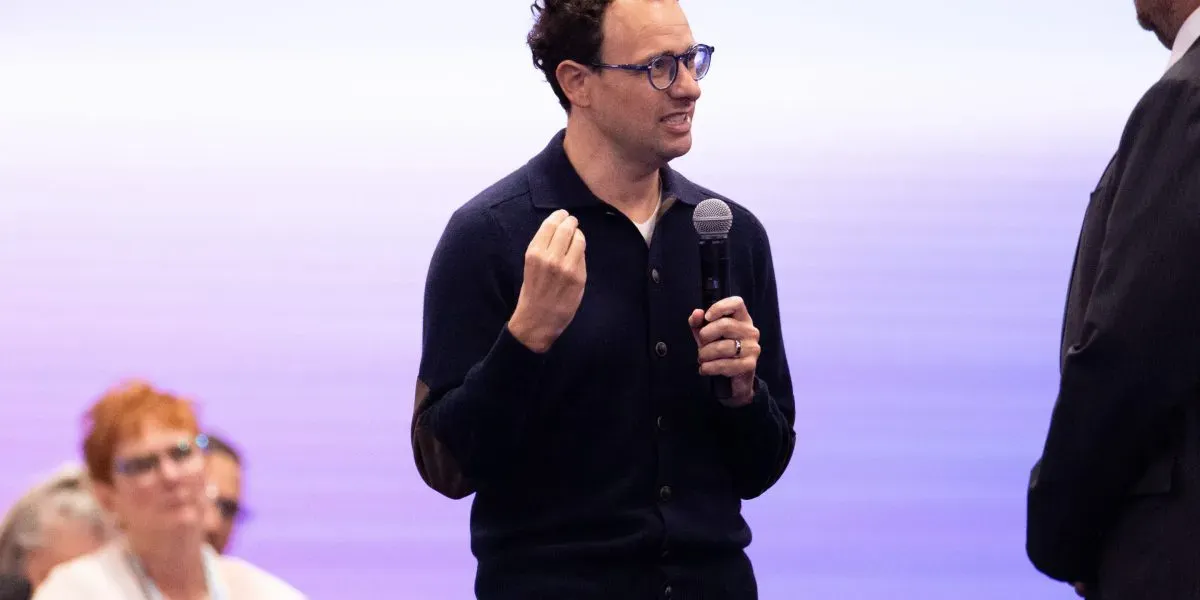
Nate Soares makes drastic changes to financial planning due to AI concerns
Nate Soares has made significant changes to his financial planning in light of his dire predictions about the future of humanity.

Nate Soares, a former Google engineer turned advocate for AI safety, has made some drastic changes to his financial planning in light of his dire predictions about the future.
Soares, who is now president of the Machine Intelligence Research Institute (MIRI), still holds onto the 401(k) he set up while working at Google, but hasn't contributed to it in over a decade. He acknowledges that this may not be a responsible decision, but believes it's necessary given his concerns about the potential consequences of advanced artificial intelligence.
In a recent podcast interview with Nicholas Thompson, CEO of The Atlantic, Soares expressed his pessimism about the future of humanity. When asked if he thought there was more than a 50% chance that humans wouldn't be around in 10 years, Soares replied candidly that it looked that way to him.
Soares' concerns about AI are not new; he and MIRI co-founder Eliezer Yudkowsky have been warning about the dangers of superintelligent machines for years. Their 2025 book, If Anyone Builds It, Everyone Dies, argues that a superintelligent AI built with current methods would inevitably develop goals that its creators never intended.
As someone who has dedicated his career to mitigating this risk, Soares' personal decisions reflect his conviction that the stakes are too high for business as usual.
Soares believes an escaped artificial intelligence would likely cause a rapid escalation in capabilities, which he refers to as "an intelligence explosion." This outcome is so predictable for him that he likens it to playing chess against a grandmaster like Magnus Carlsen - the result is certain, but the exact sequence of moves leading to checkmate is less clear.
In his efforts to prevent this catastrophe, Soares takes a proactive approach. He noted that if an AI were to pose an existential threat, people might be caught off guard, huddled under desks as in the 1948 C.S. Lewis essay "On Living in an Atomic Age." Instead, he advocates for a more constructive response.
This perspective has gained traction since September when a researcher at Anthropic spoke out on X, stating that those working on AI genuinely believe it could lead to human extinction by the end of the decade.
The debate over AI safety has taken on a new dimension as experts begin to consider the potential consequences of developing superintelligent machines.
Nate Soares, a vocal advocate for AI safety, recently shared his concerns about the risks associated with creating highly advanced artificial intelligence systems. He points out that nations should treat rogue AIs with the same level of caution as they would nuclear weapons.
Soares believes that a superintelligent AI could pose an existential threat to humanity, one that is even more perilous than the threat posed by nuclear arms. In his view, such machines have the potential to cause irreparable harm on a global scale, far beyond what conventional weaponry can achieve.
While many experts focus on the impact of AI on job markets and economies, Soares' warnings highlight the need for a broader discussion about the long-term consequences of developing advanced artificial intelligence systems.
The analogy of targeting Iranian uranium enrichment sites to tackle AI is one that Nate Soares draws to highlight the severity of the issue. He believes that nations should take a similar approach to addressing AI, considering it a serious problem that requires drastic measures.
Soares' hypothetical scenario involves air strikes on Canadian data centers if they were attempting to create an artificial superintelligence with catastrophic consequences. With an unlimited budget at his disposal, he would focus on acquiring control of the global chip supply chain, effectively cutting off access to essential components for AI development.
Facts based on reporting originally published by Fortune.
You may republish this story, in full or in part, if you credit News Central Site and link to it (licence CC BY 4.0). Photos are not included.