Massive Asteroid Strike Caused Decades-Long Global Chaos
The analysis of sediments preserved on the New Jersey coast has revealed the full extent of the damage caused by the Chicxulub asteroid strike.
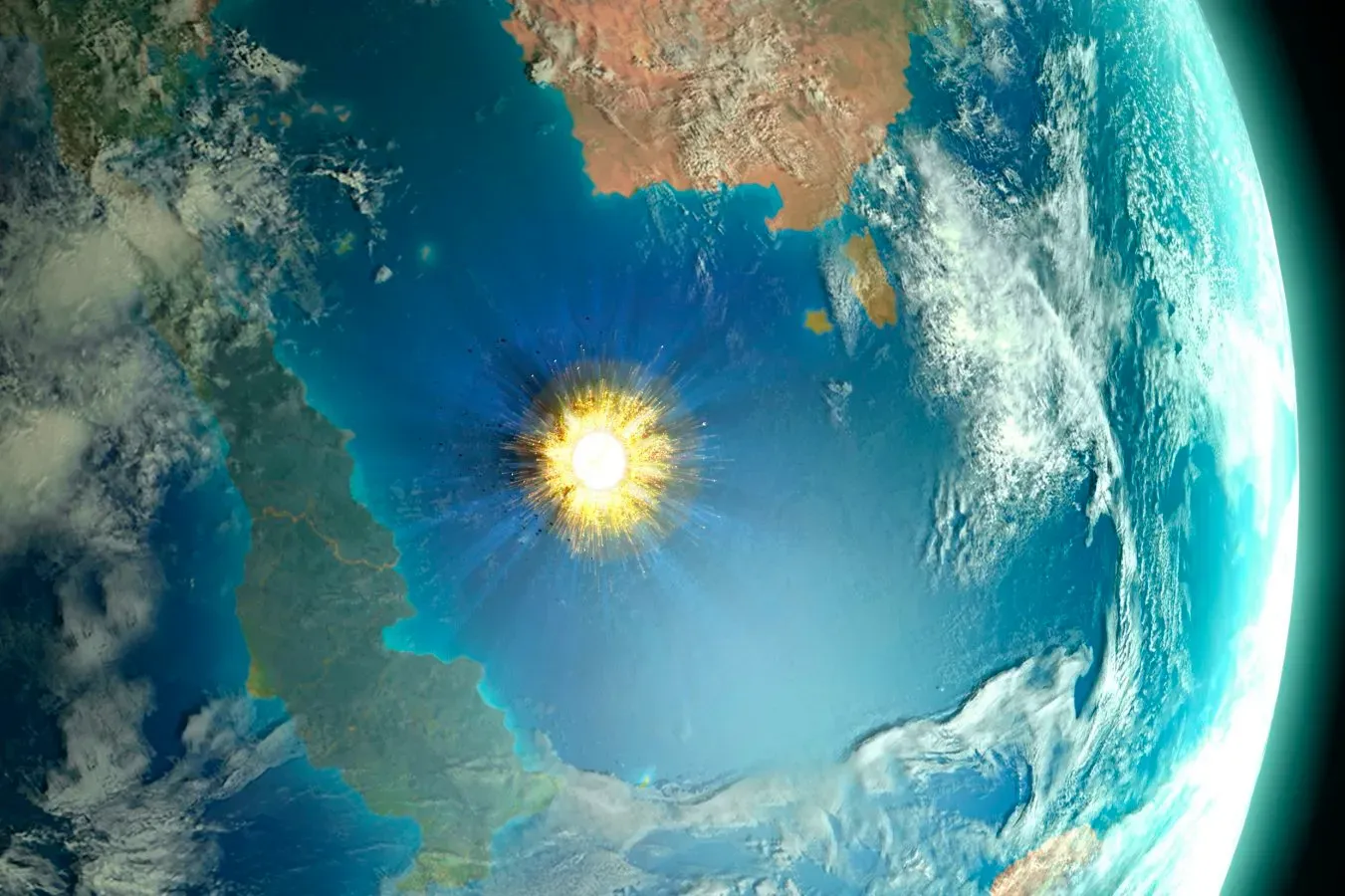
A massive asteroid strike 66 million years ago marked the beginning of a prolonged period of global chaos and destruction that lasted for decades. The devastating effects of the Chicxulub asteroid impact, which formed the vast crater in what is now the Gulf of Mexico, were not limited to a single catastrophic event.
Analysis of sediments preserved on the New Jersey coast has provided valuable insights into the long-term consequences of the asteroid strike. Located thousands of kilometres away from the impact site, these sediments offer a unique window into the geological history of the region and reveal the full extent of the damage caused by the Chicxulub asteroid.
The asteroid itself is estimated to have been up to 15 kilometres in diameter, with its massive size contributing to the severity of the impact. As it struck the Earth's surface, it deformed the crust to a depth of 35 kilometres, leaving the impact site hot for millions of years.
The massive asteroid strike that wiped out the dinosaurs triggered powerful earthquakes and tsunamis that were felt thousands of kilometres away from the impact site.
Researchers studying rock cores from New Jersey found evidence of extensive environmental degradation in the years following the disaster, with sediment layers being mixed and remobilised multiple times due to large-scale earthquakes and tsunamis.
The cores also suggest that more than a dozen aftershocks, possibly as strong as magnitude 7 or 8, shook the New Jersey coast, causing ongoing disruption to the environment. This prolonged period of seismic activity is thought to have lasted for decades after the initial impact.
These findings paint a picture of a planet in turmoil, with the Chicxulub asteroid strike being followed by a series of devastating earthquakes and tsunamis that had far-reaching consequences for life on Earth.
The discovery of large quantities of kaolinite in New Jersey cores has provided further insight into the devastating impact of the Chicxulub asteroid strike on Earth's environment. Normally formed over centuries through weathering in tropical regions, this mineral was found to have been produced in just a few years at the study sites.
This rapid formation may be attributed to the presence of vast amounts of fungi, which can accelerate the process of kaolinite creation. Miller suggests that these microorganisms could have played a significant role in shaping the post-impact environment.
The team's findings also support the theory that much of the planet's vegetation died during the nuclear winter-like conditions following the asteroid strike. This would have created an ideal breeding ground for fungi, allowing them to thrive and contribute to the rapid formation of kaolinite.
A new timeline has been developed by the researchers, detailing the first 20 years after the asteroid impact. The sequence begins with the immediate aftermath of the disaster, followed by dust settling back to Earth from the atmosphere, leading to prolonged periods of near-complete darkness and nuclear winter-like conditions.
The team's findings have shed light on the prolonged effects of the asteroid strike that wiped out the dinosaurs. According to Craig O'Neill at Queensland University of Technology, Australia, this new data allows for a detailed examination of what occurred in the immediate aftermath of the disaster.
The sequence begins with dust settling back to Earth from the atmosphere, leading to prolonged periods of near-complete darkness and nuclear winter-like conditions. Chris Kirkland at Curtin University, Australia, notes that these records show processes that operated over years to decades after the impact, not just its immediate consequences.
Annemarie Pickersgill at the University of Glasgow, UK, highlights the significance of seismicity recorded in New Jersey sites, which provide further evidence for long-term disturbances. The detailed record preserved in these sites offers new insights into the effects of a massive impact event on geological and environmental conditions over several decades.
Facts based on reporting originally published by New Scientist.
You may republish this story, in full or in part, if you credit News Central Site and link to it (licence CC BY 4.0). Photos are not included.